

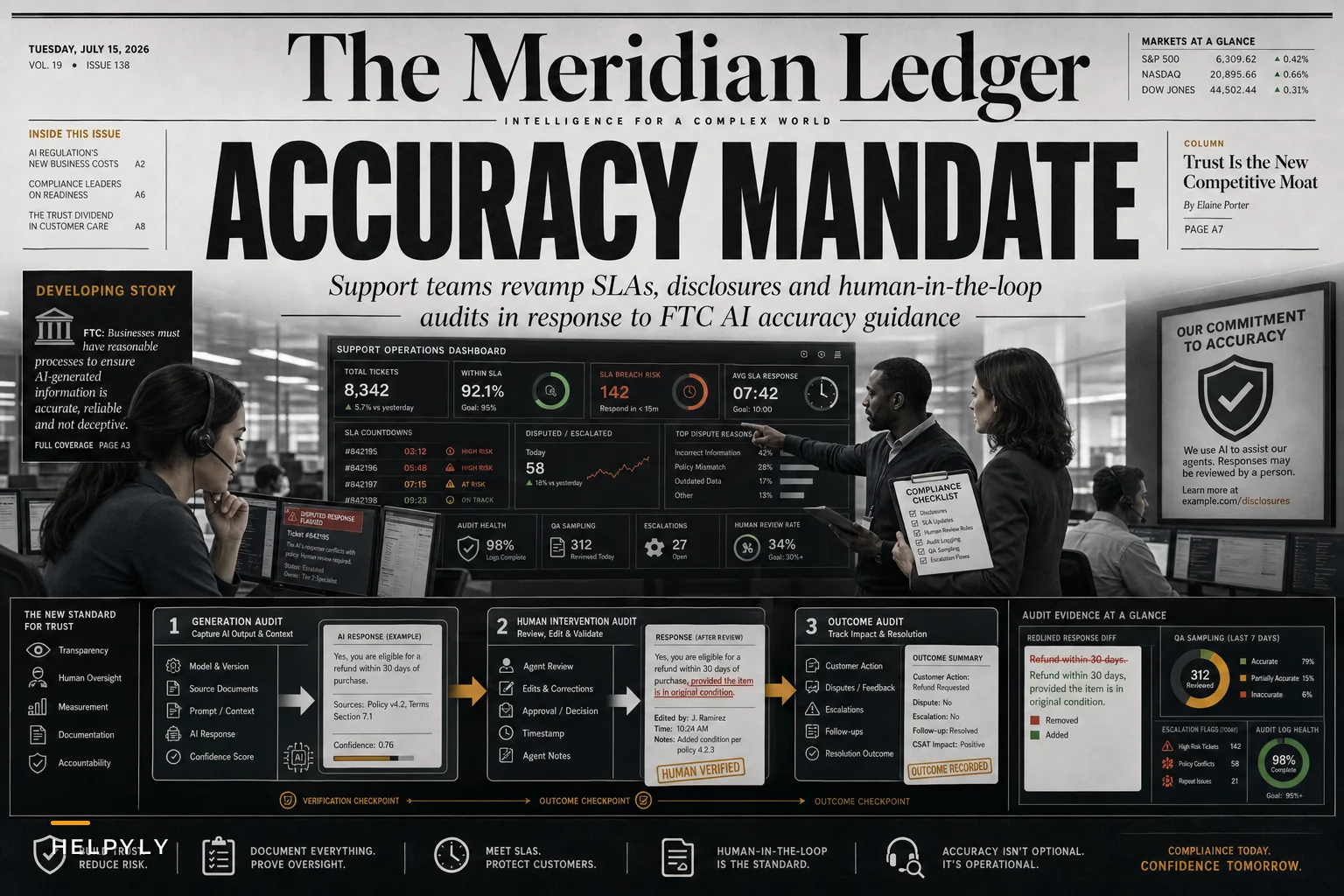

The FTC just dropped a policy statement that's going to create real headaches for every support team using AI in customer interactions. Published in the Federal Register on July 7th, the proposed guidance says that if your AI gives customers wrong information or buries important details, you could be on the hook for consumer protection violations. The comment period closes July 31st.
Most support operations use AI somewhere in their stack - drafting responses, summarizing tickets, routing conversations, pulling knowledge base articles. The problem isn't the AI itself. It's that almost nobody built the operational infrastructure to track when it gets things wrong. And the FTC is now saying that's not optional.
The accuracy problem nobody talks about in support operations
Here's what typically plays out in support teams running AI. A customer asks about a refund policy. The AI pulls from three different knowledge base articles, blends them into something that sounds coherent, and serves it up as a suggested response. The agent, juggling seventeen other tickets, glances at it, figures it looks fine, and hits send.
Two weeks later, that same customer complains they were told something completely different from what's in the actual terms of service. The support manager digs through tickets and realizes the AI has been confidently merging outdated policy info with current guidelines for a month. Nobody caught it because nobody was checking.
This isn't rare. It happens because the operational systems weren't built for AI oversight. Support platforms track response times, resolution rates, CSAT. They don't track accuracy drift, confidence thresholds, or hallucination patterns. The FTC's guidance essentially says this kind of operational blindness could constitute deceptive practice. If you're using AI in customer interactions, you need to demonstrate reasonable steps to ensure accuracy - and that's a meaningful shift in how support operations have to function.
Why traditional SLAs break when AI enters the picture
Support SLAs were designed for human agents. First response in 2 hours. Resolution in 24. Escalation after 48. These metrics assume a human is reading, understanding, and responding appropriately.
Never let a customer request slip through the cracks.
Helpyly helps you track, resolve, and optimize every support interaction effortlessly.
- Centralized ticket management
- Automated customer notifications
- Performance analytics dashboard
No credit card required
AI blows this model up. An AI can respond in 2 seconds, but if that response contains wrong pricing information, you've created a worse problem than a slow reply ever would have. Traditional SLAs reward speed. With AI in the mix, you need SLAs that balance speed with accuracy verification.
A subscription box company learned this the hard way. They implemented AI-suggested responses to hit aggressive response time targets. Within three months, they'd handed out roughly $47,000 in make-good credits because the AI kept misreading their tiered pricing structure - telling premium plan customers about basic plan limitations, confidently and consistently.
The fix wasn't complicated. They rethought their SLA structure and added accuracy gates. Any AI response mentioning pricing, policies, or account changes required human verification within 30 minutes. Response times crept up slightly, but error-related escalations dropped around 70%.
Building the three-layer audit system you actually need
Most support teams think audit trails mean logging what happened. That's only the first layer, and it's not sufficient for FTC compliance. You need three distinct audit layers, each serving a different purpose.
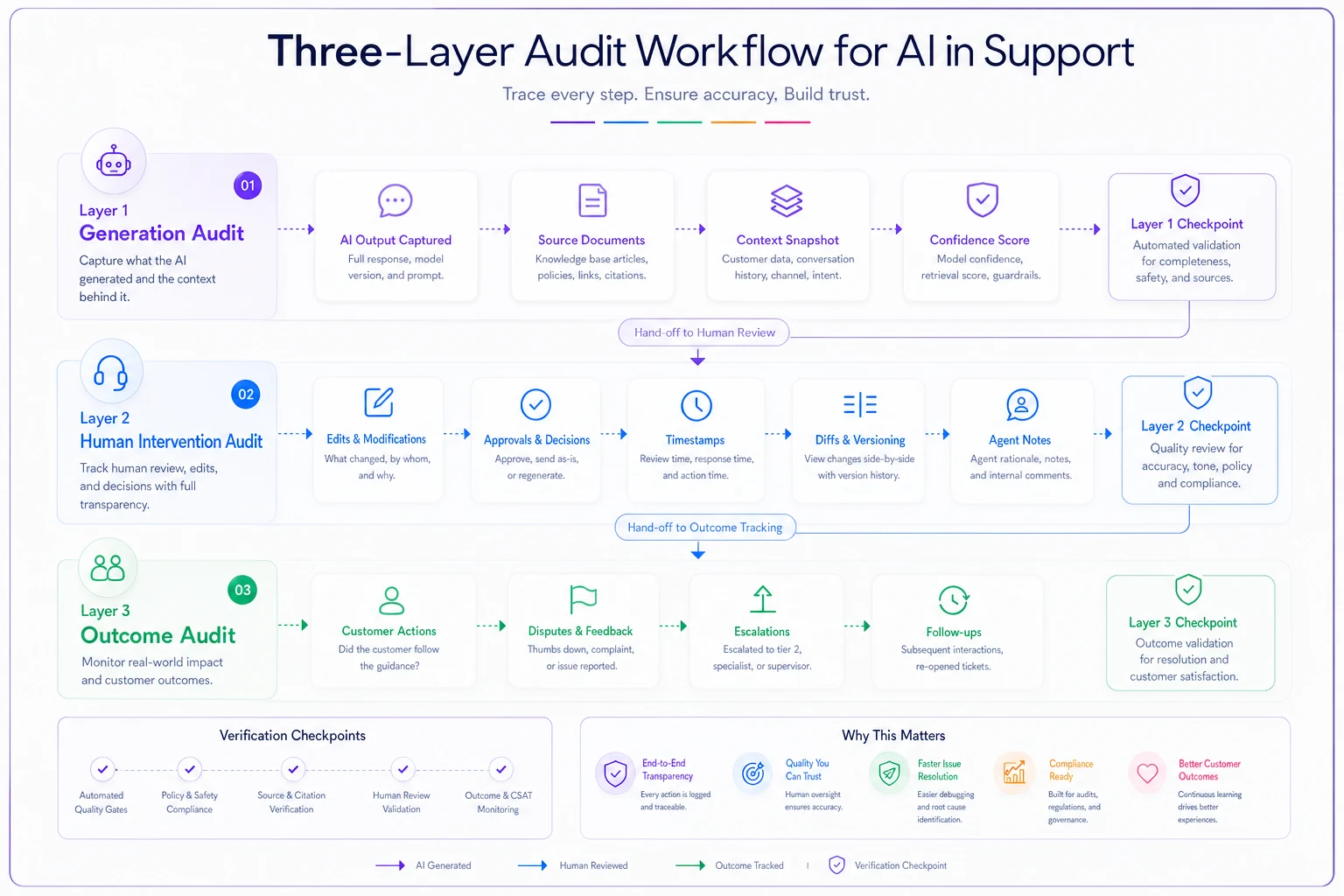
Visualize the layers as checkpoints in a single flow so you can see where accuracy failures are introduced and caught.
Layer 1: Generation audit Track what the AI produced and why - not just the output, but the source documents it referenced, the context it used, the confidence score. When a customer claims they got wrong information, you need to show exactly what your AI generated and what it was based on.
Layer 2: Human intervention audit Track what the agent actually did with the AI output. Did they modify it? Approve it as-is? Rewrite it completely? You need timestamps, diff tracking, agent notes on why changes were made. This is what proves you have human oversight rather than AI operating unchecked.
Layer 3: Outcome audit Track what happened after the interaction. Did the customer follow the AI's guidance? Did they escalate or dispute later? This is where accuracy problems that slip through the first two layers actually get caught.
A mid-sized electronics retailer implemented this three-layer system after their AI started confusing warranty terms across product categories. They found their AI was accurate around 89% of the time on first pass - but human agents only caught about half the errors because the wrong responses looked plausible. The outcome audit revealed the pattern: customers who received certain AI-generated warranty information were three times more likely to file disputes later. That's the kind of insight you can only get if you're tracking outcomes, not just outputs.
The disclosure templates that actually work
The FTC guidance emphasizes transparency about AI use. But slapping "This response was generated by AI" on everything isn't particularly helpful and might erode trust unnecessarily. You need disclosures that inform without alarming.
For fully automated responses: "This automated response is based on our current policies and procedures. For complex situations, you may request review by a support specialist."
For AI-assisted but human-reviewed responses: "Our team uses AI tools to help provide faster, more accurate responses. This message has been reviewed by a support representative."
For AI-generated summaries or suggestions: "This summary was prepared using AI assistance to help resolve your issue more quickly. Please let us know if any details seem incorrect."
Match disclosure depth to risk level. A bot answering store hours doesn't need the same language as AI explaining refund eligibility. Build a matrix - low-risk topics get minimal disclosure, high-risk topics get explicit mention of AI involvement and clear escalation options. The goal is transparency that's proportionate, not boilerplate that customers tune out.
Setting accuracy thresholds that prevent disasters
Every AI system has a confidence score, but most support teams never look at it. They use default settings and assume the AI knows when it doesn't know something. This is exactly how you end up with AI confidently giving customers fabricated policy information.
| Response Type | Minimum Confidence | Human Review Required | Fallback Action |
|---|---|---|---|
| Factual (hours, locations) | 95% | No | Provide general info with disclaimer |
| Policy (refunds, warranties) | 90% | If under 95% | Escalate to specialist |
| Account-specific | 85% | Always for changes | Provide generic guidance only |
| Troubleshooting | 80% | If involves safety/damage | Offer multiple solutions |
| Complaints/Legal | N/A | Always | Direct to human immediately |
Start with stricter thresholds for policy- and account-related responses and loosen them only after you've validated accuracy through outcome audits.
A home services platform ran into this after their AI started hallucinating service coverage areas - confidently telling customers they served areas they'd never operated in. Confidence scores for geographic responses were averaging around 72%, but nobody had set a threshold. They implemented 85% minimum for coverage confirmations, and error rates dropped from roughly 12% to under 2%.
Thresholds aren't a set-it-and-forget-it thing. They need review as your AI updates, your knowledge base changes, and new response categories get added. Build a quarterly review into your operations calendar.
Response time vs accuracy: the new SLA math
The old SLA math was simple. Faster response equals happier customer equals better metrics. AI complicates this. A wrong answer in 2 seconds creates more downstream work than a right answer in 2 hours.
-
AI draft generated within 30 seconds
-
Human review for high-risk topics within 10 minutes
-
Accuracy verification completed within 30 minutes
-
Total response time under 45 minutes with 95% accuracy target
This looks slower on paper. It's actually faster when you factor out the follow-up tickets, escalations, and corrections. One B2B software company found that adding 15-minute accuracy reviews reduced total ticket handling time by about 23% because they stopped generating cascading problems downstream.
The key is building automatic accuracy checks into the workflow itself. If the AI mentions a price, auto-flag for review. If it references a policy document, verify that document is current. If it makes a promise about timing or availability, confirm against actual systems before sending. These triggers don't require a new platform - most support tools can handle conditional routing with the right configuration.
When to completely bypass AI (and how to decide)
Some situations shouldn't touch AI at all, even with human review. The FTC guidance makes this fairly clear - using AI inappropriately isn't just risky, it's potentially deceptive.
Hard stops for AI involvement:
-
Legal threats or disputes
-
Health and safety issues
-
Discrimination complaints
-
Financial disputes over $500
-
Anything involving minors
-
Data breach notifications
-
Contract negotiations
Beyond the hard stops, you also need soft bypasses based on patterns. If your AI consistently gets confused about certain product categories, route those directly to specialists. If specific customer segments generate more errors, default to human handling.
A fitness equipment company found their AI couldn't reliably handle customers who bought through third-party retailers versus direct. The warranty and authentication rules were different enough that wrong information came out roughly 30% of the time. Rather than trying to train around the edge cases, they built detection rules. Any ticket mentioning Amazon, Walmart, or similar retailers bypassed AI entirely. Simple fix, big impact.
The metrics that prove compliance (and the ones that don't)
Your current metrics probably don't prove FTC compliance. Customer satisfaction scores don't demonstrate accuracy. Resolution rates don't show AI oversight. You need metrics specifically built for AI accuracy validation.
Metrics that matter for compliance:
-
AI accuracy rate (verified through outcome audit)
-
Human override frequency and reasons
-
Time from AI generation to human review
-
Percentage of AI responses with disclosure
-
Error detection lag (how long before mistakes get caught)
-
Customer disputes citing incorrect information
Metrics that seem important but aren't:
-
AI usage percentage (more AI doesn't mean better accuracy)
-
Response time improvement (speed without accuracy is liability)
-
Cost per ticket reduction (cutting costs through errors isn't compliant)
-
AI confidence scores alone (without outcome validation)
Also worth tracking: the delta between what AI suggests and what agents actually send. If agents are constantly rewriting AI responses, either the AI needs adjustment or agents need clearer guidelines. A healthy system shows agents accepting somewhere between 70-80% of suggestions with minor edits. Below 50% means the AI isn't helping. Above 90% might mean agents aren't actually reviewing. That middle range is where you want to be, and it's a useful early warning signal when things start drifting.
Building your 30-day compliance sprint
The comment period closes July 31st, but the FTC's enforcement posture is already shifting. Here's a practical 30-day plan to get support operations ready:
Week 1: Audit current state
-
Document every AI touchpoint in support workflows
-
Pull accuracy data if it exists
-
Identify high-risk response categories
-
Review recent complaints for AI-related issues
Week 2: Implement quick fixes
-
Add disclosure templates to AI responses
-
Set confidence thresholds by response type
-
Create bypass rules for high-risk situations
-
Start logging AI generations separately from sent responses
Week 3: Build measurement systems
-
Implement three-layer audit tracking
-
Create accuracy verification workflows
-
Set up outcome tracking for AI-assisted tickets
-
Build dashboards for new compliance metrics
Week 4: Train and adjust
-
Train agents on new review requirements
-
Adjust SLAs to include accuracy gates
-
Test emergency bypass procedures
-
Document everything for compliance records
This isn't about pulling AI out of your support operations. It's about building the operational layer that makes AI use defensible.
The real operational shift nobody's discussing
The FTC guidance isn't really about AI accuracy in isolation. It's about operational responsibility.
For years, support teams could attribute bad information to human error. An agent misread a policy, misunderstood a question, made a one-off mistake. That was a training problem, not a systemic one.
AI changes this. When your AI gives wrong information to hundreds of customers simultaneously, that's not human error. That's operational failure. And the FTC is saying you own it.
This means support operations need to start thinking more like engineering teams. Version control for knowledge bases. Rollback procedures for AI updates. Testing before deploying new models. Monitoring for drift. It's a bigger cultural shift than most support managers expect.
A regional insurance provider learned this after a knowledge base update caused their AI to start mixing up coverage types - telling customers their home insurance covered things it absolutely didn't. Took three days to notice, two weeks to fully resolve. Under the FTC's framework, that's potentially three days of deceptive customer interactions.
The fix was operational, not technical. They implemented staged rollouts, testing AI updates against historical tickets before going live. They added canary deployments where updated AI only handled about 5% of tickets initially, with heavy monitoring. Automatic rollback triggers kicked in if accuracy dropped below thresholds.
This connects directly to the governance and fallback systems we've covered before - you need AI that knows when it doesn't know something. Compliance adds another layer though: proving that uncertainty detection actually works in practice, not just in theory.
What happens when you don't update fast enough
The companies that ignore this guidance won't just face fines. They'll face operational problems that compound quickly.
Customer trust degrades fast when people discover they've been getting AI-generated misinformation. One bad viral post about your "lying chatbot" can unwind years of reputation building. The make-goods and credits you'll need to issue will dwarf whatever efficiency savings the AI generated.
Agents lose confidence in AI assistance and either ignore it or waste time double-checking everything. The efficiency gains disappear, but you're still paying for the platform. Legal starts vetoing AI initiatives, which kills innovation in your support operations. Competitors who handled compliance properly pull ahead while you're stuck in review cycles.
The biggest risk is operational blindness - not knowing what your AI is actually telling customers until something goes badly wrong. It's manageable for a while, until it isn't.
The competitive advantage hidden in compliance requirements
Most support managers miss this part: the operational discipline required for FTC compliance makes your support operations genuinely better, not just safer.
A travel booking platform discovered through accuracy audits that their AI was consistently confusing refund policies for flights versus hotels. They'd never caught it because customers usually figured things out eventually - but it was adding an average of 1.7 extra interactions per booking issue. Fixing that one accuracy problem cut ticket volume around 8%.
The disclosure requirements that feel like friction actually build trust when done right. Customers appreciate knowing when AI is involved, especially when escalation to a human is easy. The review requirements that slow initial response times tend to speed up actual resolution - agents focused on accuracy send better first responses that solve problems rather than creating new ones.
The FTC press release frames this around consumer protection, and Reuters covered the broader implications for how AI bias safeguards intersect with consumer law. The companies paying attention now will be better positioned than those treating this as a future problem.
Start with the basics: know what your AI is saying, verify it's accurate, and make sure customers know when AI is involved. Build from there. The companies that get this right won't just navigate the FTC's enforcement landscape - they'll end up with support operations that are more efficient and more accurate at the same time, which is the point of using AI in the first place.
Ready to elevate your customer support?
Join 2,000+ support teams using Helpyly to reduce response times, automate workflows, and deliver outstanding customer experiences.