



Most support orgs don't get designed. They accrete. You hire your first three agents, then someone becomes a "senior" agent because they've been there longest, then you promote them to lead because they're good at the job and you needed someone to answer the questions the others couldn't. By the time you're at 25 people, you've got a shape nobody chose on purpose, and every new hire makes the coordination cost a little worse.
The frustrating part is that support org design isn't actually mysterious. There are known inflection points where the same structure that worked yesterday starts leaking. Managers tend to treat each reorg as a one-off crisis instead of a predictable event tied to headcount. If you know the numbers where things break, you can write the rules ahead of time and pull them off the shelf when you hit them.
This is that set of rules. Not a philosophy, not a maturity ladder — concrete thresholds and the specific structural changes each one demands.
The three things that actually break as you grow
Before the numbers, it helps to name what's actually failing, because it's rarely "we need more people." It's almost always one of three things.
Span of control. How many people report to one manager. Everyone knows about this one and still gets it wrong. A lead handling five agents and a lead handling twelve are doing completely different jobs, even if the title is identical.
Handoff density. Every time a ticket changes hands — agent to specialist, tier 1 to tier 2, support to engineering — you introduce a coordination tax. At small scale nobody notices because the person you're handing to is sitting next to you. At scale, handoffs become the single largest source of resolution delay, and nobody's tracking them.
Decision latency. Who's allowed to decide what. In a five-person team everyone can ask the founder. At forty people, if agents still need a manager to approve a $50 refund, you've built a structure where managers do nothing but approve refunds and agents learn to stop thinking.
Almost every "we need to reorganize" conversation is really one of these three quietly hitting a wall. The trick is knowing which wall you're about to hit and at what headcount.
The headcount inflection points
The same rough thresholds keep showing up across a wide range of support teams. They're not laws of physics, but they're consistent enough that you can plan around them.
Never let a customer request slip through the cracks.
Helpyly helps you track, resolve, and optimize every support interaction effortlessly.
- Centralized ticket management
- Automated customer notifications
- Performance analytics dashboard
No credit card required
| Team size | What breaks first | Structural change needed |
|---|---|---|
| 1–6 | Nothing yet — everyone does everything | Keep it flat. Resist titles. |
| 7–12 | The founder/lead becomes the bottleneck for hard tickets | Introduce a real tier-2 role and a first line lead |
| 13–20 | One manager can't coach and cover queues | Split into two pods with dedicated leads |
| 21–35 | Handoffs multiply, decisions stall | Formal decision matrix + specialist tracks |
| 36–60 | Pods drift apart, quality diverges | Add a QA/enablement layer separate from line management |
| 60+ | No single person sees the whole operation | Regional or functional divisions, ops role owns the system |
The most common mistake is lagging these changes by six months. A team hits 15 people, everyone feels the strain, and management responds by hiring two more agents — which makes the span problem worse, not better, because now the one overloaded lead has 17 reports instead of 15. You don't fix a structure problem with headcount. You fix it with structure, and headcount is just the trigger.
Getting spans right (and why "7" is a lie)
There's a rule of thumb floating around that a manager should have around seven direct reports. Fine as a starting point, wrong as a rule, because span of control depends entirely on what the manager is actually doing.
A lead whose job is pure queue coverage and quick escalations can handle 10–12 agents without much trouble. A lead who's expected to run weekly 1:1s, do coaching, calibrate quality, and handle career development caps out around 5–6 before something gets dropped — and what gets dropped is always coaching, because queues scream and career development doesn't.
The pattern worth internalizing: the more coaching-heavy the role, the tighter the span. The real decision isn't "how many reports" — it's "what do I want this lead to actually own?" If you want leads who develop people, build for a span of five and accept you'll need more of them. If you want leads who just keep the machine running, you can stretch wider, but you're going to grow QA problems you'll pay for later.
One example that stuck with me: a mid-sized SaaS support team had one manager over 14 agents. QA scores were sliding and nobody could figure out why. The manager wasn't bad — he was structurally incapable of giving 14 people meaningful feedback while also covering the queue. Splitting into two pods of seven, each with a coaching lead, moved their average QA score up noticeably within about two quarters. Nothing changed about the people. The span changed.
Role tiers: what each layer is actually for
Tiers get muddy fast because titles inflate faster than responsibilities. Someone becomes "Tier 2" and it means nothing except they answer harder tickets sometimes. To make tiers do real work, each one needs a clear reason to exist.
-
Tier 1 — resolution volume. Owns the bulk of tickets, works from known playbooks, escalates anything outside the playbook. Their job is throughput and consistency, not creativity.
-
Tier 2 — judgment and edge cases. Handles the stuff that doesn't fit a script. They own the tickets tier 1 can't, and just as importantly, they feed patterns back so tier 1's playbooks improve.
-
Specialists (billing, technical, trust/safety) — depth in one domain. These aren't a "higher" tier, they're a sideways one. Confusing depth with seniority is a classic mistake that makes your best technical person feel like they got passed over.
-
Leads — people and queue ownership, not the hardest tickets. The day your lead is your best tier-2 agent and running the team, you've built a role that guarantees one of those two jobs gets neglected.
The failure mode here is treating tiers as a promotion ladder rather than a division of labor. When tier 2 is just "the reward for being good at tier 1," you drain your best resolvers out of the queue where they were most valuable and stick them on lower volume. Sometimes that's right. Often it's just title creep.
Handoff protocols: where scale actually goes to die
This is the part almost nobody designs on purpose, and it's the part that quietly eats your resolution time as you grow.
At small scale, a handoff is a tap on the shoulder. At 30 people across shifts and channels, a handoff is a ticket sitting in a queue with half the context missing while the customer waits. The coordination tax is invisible in the aggregate metrics until you specifically measure it.
-
What triggers a handoff? Define it by condition, not by vibe. "Escalate anything involving a chargeback over $200" beats "escalate hard billing stuff." Vague triggers mean either over-escalation (tier 2 drowns) or under-escalation (customers wait for a tier-1 agent to flail).
-
What travels with the ticket? A minimum context packet — what's been tried, what the customer wants, what's blocking resolution. When this is missing, the receiving person restarts the investigation from zero and the handoff cost doubles.
-
Who owns it after the handoff? The single most expensive ambiguity in support. If ownership is fuzzy, tickets bounce. The rule that works: whoever received the handoff owns resolution until they explicitly hand it back or forward. No implicit ownership. Ever.
Watch for this as teams grow: the number of handoffs per resolved ticket creeps upward, and almost nobody's dashboard shows it. You'll see resolution time climbing and blame the agents, when the real culprit is that a ticket now touches four hands instead of one. Track handoffs-per-ticket as its own metric and you'll spot structural rot months before it shows up in CSAT.
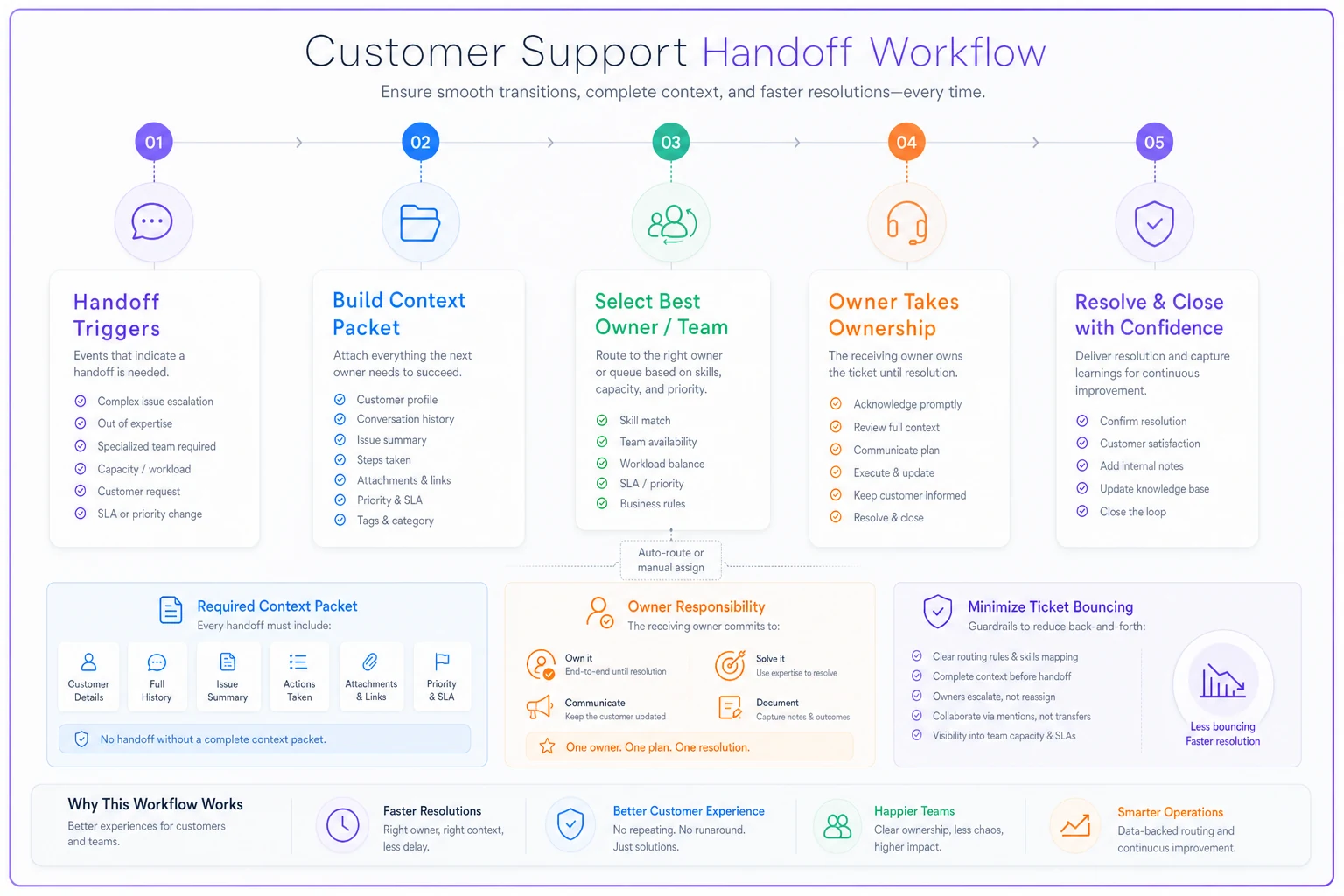
This diagram highlights the trigger, the context packet, and the single-owner rule so teams can visualize where handoffs create delay.
Decision matrices: killing the approval bottleneck
The single fastest way to make a growing support team feel slow is to route every non-trivial decision up a level. Refund over some amount? Ask a manager. Waive a fee? Ask a manager. The manager becomes a decision vending machine and agents stop developing judgment because they never have to use it.
A decision matrix fixes this by writing down, in advance, who can decide what — usually keyed to dollar amounts, risk level, or customer tier.
-
Tier 1 agents
refunds up to $50, standard goodwill credits, policy-covered replacements — no approval needed.
-
Tier 2 / specialists
refunds up to $250, one-time exceptions to policy, expedited handling.
-
Leads
anything above that, contractual disputes, anything touching legal.
The number itself matters less than the fact that it's written and pushed down. When you give tier-1 agents a real decision budget, two things happen: resolution speeds up, and the decisions don't get worse. Agents given clear authority and clear limits tend to stay comfortably inside them. The fear that they'll go rogue rarely materializes — what actually happens without a matrix is that they escalate everything, and the org confuses that helplessness for caution.
A real scenario
A B2B software company's support team grew from about 8 to 22 people over a year and a half. Same structure the whole way: one support manager, everyone reporting to him, no formal tiers, escalations by Slack message.
By the end, median first response was fine, but full resolution had stretched past two days on anything non-trivial. The manager was working past 7pm most nights approving refunds and untangling escalations. Two of their strongest agents quit within a month of each other — exit interviews both mentioned "no path forward" and "everything goes through one person."
-
Split into two pods of roughly 9, each with a coaching lead (span dropped from 22-to-1 down to about 9-to-1 per lead).
-
Named a real tier-2 track — three specialists pulled out of the general queue with defined escalation triggers.
-
Wrote a one-page decision matrix so agents could handle refunds and standard exceptions without pinging anyone.
Over the next quarter or so, resolution time on complex tickets came down by roughly a third, and the manager stopped being the bottleneck for daily decisions. Nothing about the team's talent changed. They just stopped running a 22-person team on a structure built for eight.
When a rules-based approach is the wrong move
This whole playbook assumes you want repeatability, and there are cases where you shouldn't force it.
If you're under six people, don't do any of this. Formalizing tiers and decision matrices on a five-person team creates bureaucracy for problems you don't have yet. Stay flat, stay flexible, let people do everything.
If your ticket types are wildly heterogeneous — say, a support team that also does deep custom implementation work — rigid tiers can misfire, because the "tier 2 vs tier 1" split assumes a somewhat stackable difficulty curve that doesn't exist in your work. You may need capability-based routing instead of tier-based.
And if you're in the middle of a genuine crisis — an outage, a surge — this is not the week to reorg. Stabilize first, restructure when things are calm.
Where systems and tooling actually fit
None of the above requires software. You can run tiers, spans, handoff protocols, and a decision matrix on a whiteboard and a shared doc, and plenty of teams do at first.
Configure your ticketing system to enforce the required context packet at handoff so the next resolver always gets structured info.
Where tooling earns its place is in enforcement and visibility — the two things that quietly decay when everything lives in people's heads. A handoff protocol only works if the required context actually travels with the ticket; that's much easier when your workflow platform enforces the context packet at handoff instead of trusting everyone to remember. A decision matrix only works if the limits are visible at the moment of decision, not buried in an onboarding doc. And you can't manage span or handoff density if you can't see them, which means the metrics have to surface automatically rather than being assembled by hand once a quarter.
The point isn't the tool. It's that as a team scales past 30 or 40 people, the informal version of these rules stops holding, and something has to carry the structure that used to live in one overworked manager's memory. Whether that's a support platform, a well-configured ticketing system, or lightweight automation around routing and approvals — the job is the same: keep the rules consistent even when people rotate through shifts and roles.
The takeaway that actually helps
Support reorgs feel chaotic because people treat them as judgment calls made under pressure. They don't have to be. Span limits, tier definitions, handoff triggers, and decision authority all map cleanly onto headcount ranges you can see coming from a mile away.
Write the rules for the next inflection point before you get there. Decide now that when you cross twelve, you split into pods. That when you cross twenty, you publish the decision matrix. That when you cross forty, QA comes out from under line management. When the number arrives, you're not scrambling — you're executing something you already thought through when you weren't stressed.
That's the whole game. Not a smarter org chart. A set of triggers and the discipline to pull them on schedule.
That's the whole game. Not a smarter org chart. A set of triggers and the discipline to pull them on schedule.
Ready to elevate your customer support?
Join 2,000+ support teams using Helpyly to reduce response times, automate workflows, and deliver outstanding customer experiences.