

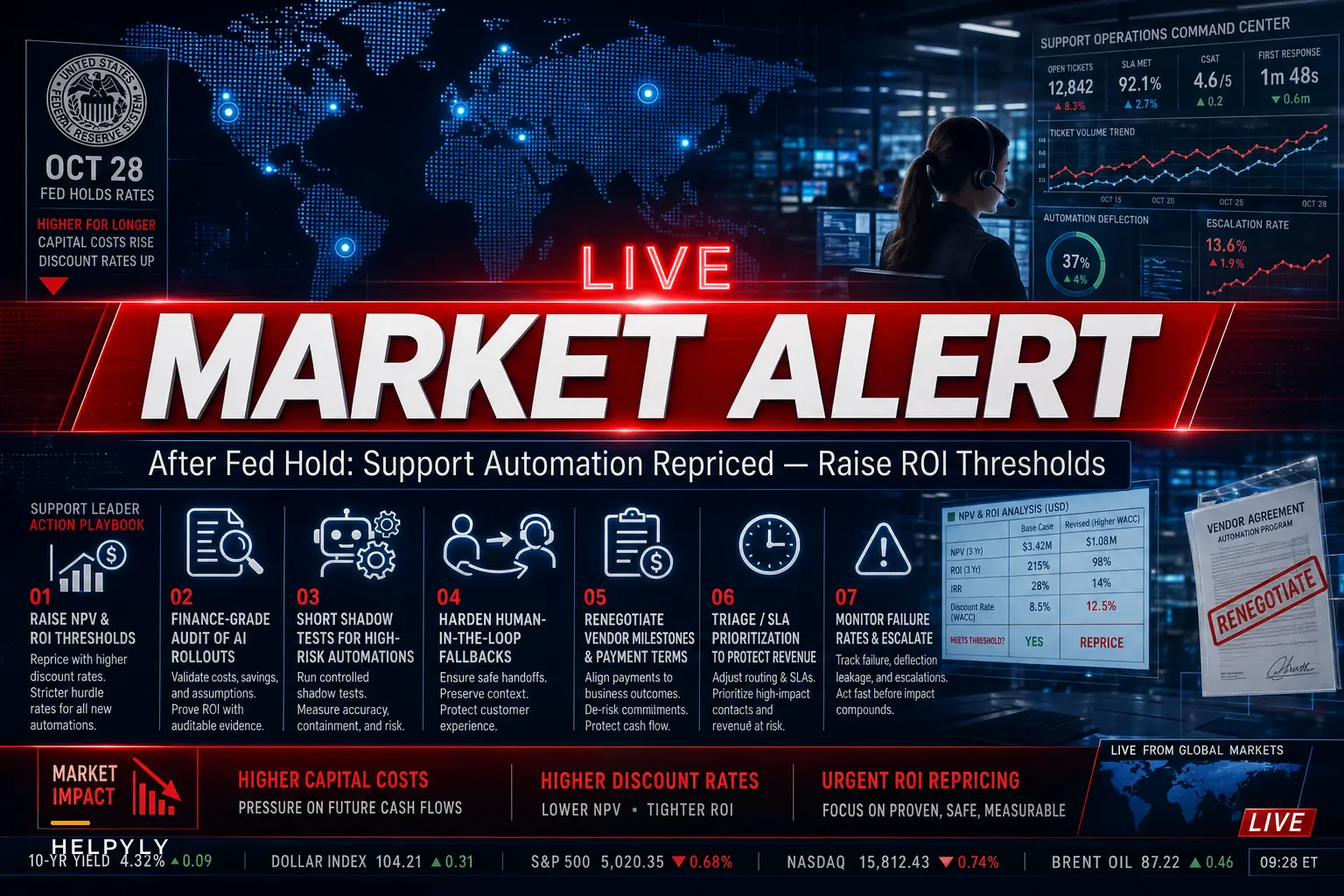

The Fed held the federal funds rate steady at a 3.75%–4.00% target range on October 28, and buried in the commentary was something support leaders should pay attention to: elevated interest rates are now explicitly shaping how companies decide to invest in AI infrastructure. You can read the FOMC statement directly, and CNBC's live coverage of the decision spent a good chunk of time on exactly that thread—capital isn't getting cheaper, and that changes the math on big tech bets.
For most support orgs, this doesn't show up as some dramatic announcement. It shows up as finance quietly asking harder questions. The automation pilot you planned to greenlight in Q1? Now someone wants a payback period. The vendor renewal you assumed would sail through? Suddenly there's a line-by-line review. This isn't a crisis—but it is a shift in posture, and the teams that read it early tend to come out ahead.
The real change isn't the rate—it's who gets to approve spend now
The rate hold itself barely touches your day-to-day. What changes is the internal gravity around approvals.
When money is cheap, finance tolerates fuzzy ROI. "It'll improve CSAT" or "agents will save time" is enough to get a tool funded. When capital costs more, that same sentence gets a polite "show me." The bar moves from plausible benefit to provable return. Support is especially exposed here because so much of our value has historically been explained in soft terms—satisfaction scores, sentiment, "experience."
The automation projects that die in budget reviews are rarely the bad ones. They're the ones with no clean dollar figure attached. A chatbot deflecting 18% of tier-1 tickets might be genuinely valuable, but if nobody has translated that deflection into a fully-loaded cost number, it loses to a project that has done that translation—even if the second project is objectively weaker.
So the first move isn't to cut. It's to make your strongest work legible to the people holding the purse.
Sort your automation work by funding survivability
Not every automation initiative deserves the same defense. Before you touch a single roadmap item, it helps to categorize what you've got running—or planned—by how well it actually survives scrutiny.
Never let a customer request slip through the cracks.
Helpyly helps you track, resolve, and optimize every support interaction effortlessly.
- Centralized ticket management
- Automated customer notifications
- Performance analytics dashboard
No credit card required
| Project type | Typical ROI clarity | Survives a tight budget review? | What to do now |
|---|---|---|---|
| Ticket deflection (KB, self-serve) | High—measurable deflection | Usually yes | Quantify fully-loaded cost per deflected ticket |
| Routing / triage automation | Medium—indirect savings | Depends on evidence | Attach misroute reduction to handle-time dollars |
| Response drafting / assist tools | Medium—time savings, hard to isolate | Shaky without data | Run a controlled before/after on AHT |
| Sentiment / analytics dashboards | Low—informational, not transactional | Often cut first | Tie to a decision it actually changed |
| "Innovation" pilots with no owner | Very low | Almost never | Pause or fold into a funded project |
That last row is uncomfortable but honest. Experimental pilots without a clear owner and a clear number are the easiest thing for finance to kill—and honestly, they often should be. Protecting your runway means being willing to let those go yourself before someone else does it louder.
A worked example: making deflection legible
"We deflected a bunch of tickets" is not a budget argument. Here's the kind of calculation that actually moves the conversation.
Say a mid-sized SaaS support team handles around 14,000 tickets a month. Their self-service and automated deflection layer handles roughly 11–13% of what would otherwise become tickets—call it about 1,600 contacts a month that never reach an agent.
Now the part most teams skip: fully-loaded cost. Not just agent wages. Loaded cost per handled ticket—wages, benefits, tooling seats, QA overhead, management time—lands somewhere around $5.50–$7.00 for this team. Take the midpoint, roughly $6.25.
1,600 deflected contacts × $6.25 ≈ $10,000 a month, or somewhere near $115k–$125k annually.
Against an automation tooling cost of, say, $2,800/month, that clears its own cost several times over. That's a defensible line item. Finance doesn't argue with a 3–4x return built from their own cost assumptions.
Notice what made it work: the number came from loaded cost, not headline wages, and deflection was measured against a realistic baseline instead of a vanity "tickets avoided" figure. A lot of support automation looks weak on paper purely because nobody did this translation. If building these cases from scratch feels unfamiliar, the walkthrough on how to create a finance-grade automation portfolio for support teams covers the structure in more depth—NPV framing, run-rate models, the stuff that makes finance stop squinting at your proposals.
The second-order problem: customers are getting more price-sensitive too
While your budget tightens, something parallel happens on the customer side. Higher borrowing costs ripple into household and business finances, and one of the most reliable early signals support teams see is a shift in ticket mix.
Billing disputes go up. "Why was I charged this" contacts climb. Cancellation and downgrade requests become more frequent—and more emotionally loaded, because the customer is already stressed about money. This is the quiet part of the macro environment that lands directly in your queue.
-
Flag billing and cancellation intents earlier in triage so they reach your most capable agents, not the general queue
-
Pre-build calm, clear response templates for price-dispute conversations—these are not the place for defensive or scripted-sounding language
-
Tighten SLA targets specifically on retention-sensitive ticket types, even if you relax them slightly elsewhere
-
Give agents a small amount of real resolution authority on disputes so cases don't bounce through three escalations before anyone can actually fix anything
That last point matters more than it looks. A dispute that takes four touches to resolve costs you four times the handling and raises the odds the customer leaves anyway.
Harden your fallbacks before you expand automation
A mistake that gets more expensive in exactly this environment: leaning harder on automation to save money without shoring up what happens when it fails.
When budgets are tight, the temptation is to push more volume through automated paths to keep headcount flat. Reasonable instinct. But automated paths fail silently—a bot that confidently gives a wrong billing answer to an already-anxious customer doesn't just fail to deflect; it manufactures a worse, angrier ticket and sometimes a churned account.
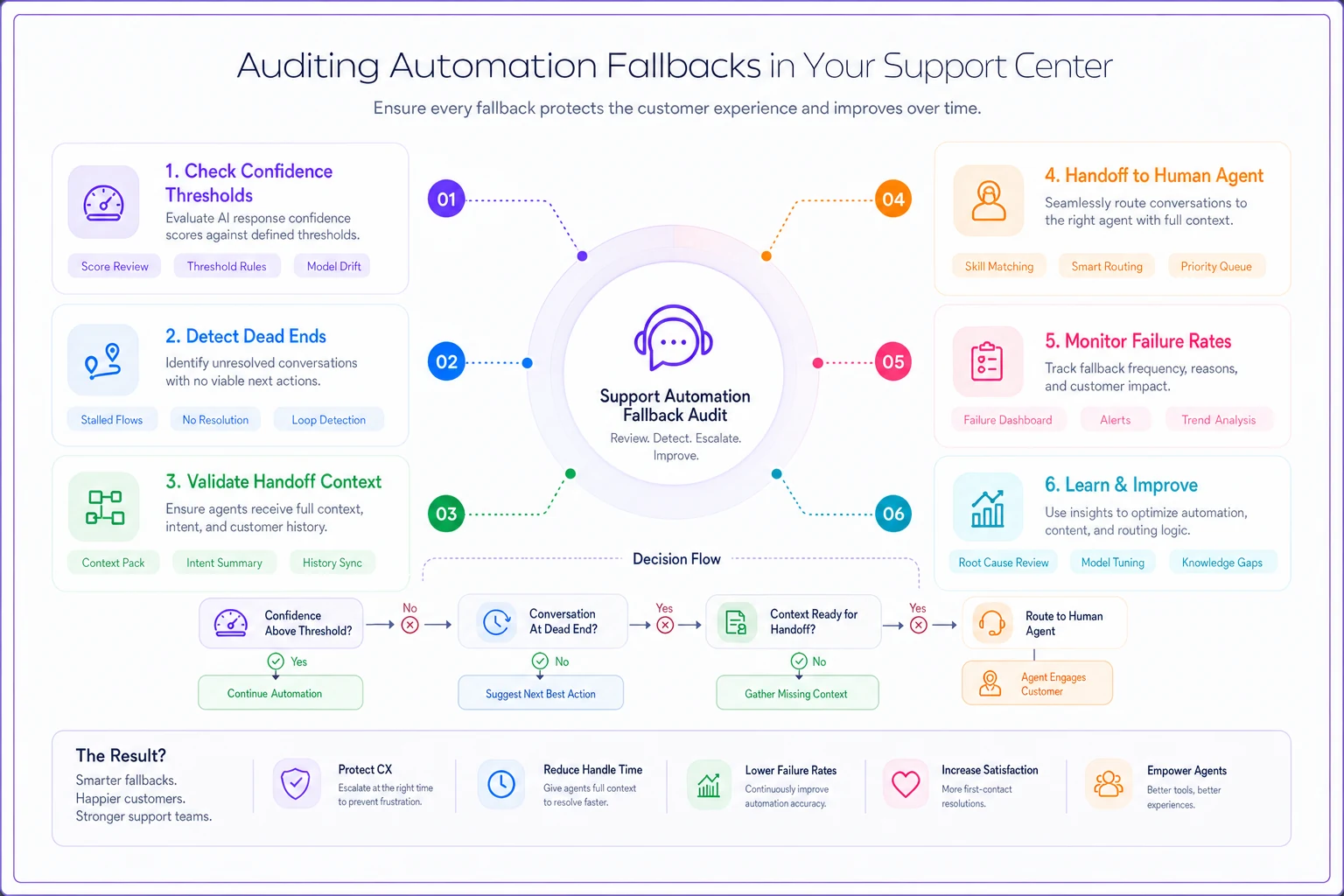
Fallback design is what separates automation that saves money from automation that quietly costs it. A few things worth auditing right now:
-
Confidence thresholds. Does your automation hand off to a human when it's unsure, or does it guess? Guessing is where hidden costs live.
-
Dead-end detection. Can you tell when a customer is stuck in a loop? If you can't see it, you're paying for it in abandons and re-contacts.
-
Human handoff context. When a case escalates out of automation, does the agent get the full conversation, or does the customer have to repeat everything? Repetition on a billing dispute is how you turn a frustrated customer into a former one.
-
Monitored failure rates by intent. Billing and cancellation intents should have tighter automation guardrails than, say, "how do I reset my password."
Here's a quick workflow to audit fallbacks:
When pushing more into automation makes sense
If your automation handles well-understood, low-emotion, high-volume intents—password resets, order status, basic how-tos—and your deflection accuracy is genuinely high, leaning in during a budget crunch is smart. These are the ticket types where automation is strictly better and cheaper.
When it's a bad idea
If you're tempted to automate emotionally charged or financially sensitive conversations purely to cut cost, don't. In a climate where customers are already on edge about money, a bad automated billing interaction is one of the fastest ways to convert a cost-saving project into a retention problem. The savings evaporate the moment a frustrated customer cancels and tells three colleagues why.
A short, honest real scenario
A subscription analytics company—roughly 20 support agents, handling billing-heavy B2B accounts—went into their budget review assuming two automation projects would get funded: a response-drafting assistant and a routing overhaul.
The drafting tool had no isolated data. They'd rolled it out broadly, so they couldn't separate its impact from everything else changing at the same time. The routing project had a clean before/after: misroutes dropped from around 14% to under 6% over two months, mapped to roughly $4,000–$5,000 a month in recovered handle time.
Finance funded the routing work without much debate and shelved the drafting tool pending real evidence. The lesson the team took away wasn't "drafting tools are bad." It was that they had never set the drafting tool up to prove itself. Six weeks later they re-ran it as a controlled rollout on half the team, finally got a defensible AHT delta, and got it funded in the next cycle.
Same tool. Different outcome. The only variable was whether the number existed.
What to actually do in the next 30 days
You don't need to overhaul everything. A tight, focused response beats a dramatic one.
-
Re-score your automation portfolio by ROI clarity, not by how exciting the project is. Be ruthless about the low-clarity rows.
-
Rebuild your top 2–3 cases on loaded cost, not headline wages. This single change usually makes strong projects look as strong as they actually are.
-
Watch your ticket mix, not just volume. Rising billing and cancellation share is your early warning that the macro environment has reached your queue.
-
Audit your automation fallbacks, especially on money-related intents. Silent failures get costlier when customers are already anxious.
-
Review vendor contracts for auto-renewals and seat commitments you're not fully using. Tight budgets are a good excuse to clean these up.
-
Pick one unfunded pilot and either give it a number or sunset it yourself. Doing this before finance does it buys you credibility.
Pick one unfunded pilot and either give it a number or sunset it yourself. Doing this before finance does it buys you credibility.
The underlying shift worth internalizing
The rate hold isn't really the story. The story is that support has entered a period where provable value gets funded and plausible value gets questioned. That's actually an opportunity for teams that have done the operational homework—because the work of translating support outcomes into finance language is exactly the work that's been undervalued for years.
Orgs that treat this moment as "cut automation to save money" will weaken themselves. The ones that treat it as "make our best automation undeniable, harden the rest, and watch for the customer-side ripple" will come out of it with a leaner, more defensible, more trusted operation. Higher capital costs don't punish good support operations. They punish unmeasured ones.
Orgs that treat this moment as "cut automation to save money" will weaken themselves. The ones that treat it as "make our best automation undeniable, harden the rest, and watch for the customer-side ripple" will come out of it with a leaner, more defensible, more trusted operation. Higher capital costs don't punish good support operations. They punish unmeasured ones.
Ready to elevate your customer support?
Join 2,000+ support teams using Helpyly to reduce response times, automate workflows, and deliver outstanding customer experiences.