



Most support teams treat QA scores and training as two separate universes. QA happens on Thursdays when a lead pulls ten tickets and marks them up. Training happens quarterly, in a two-hour session where someone shares slides about "empathy" while half the room answers tickets on their second monitor. The gap between the two is where skill problems live forever.
The fix isn't more training hours. It's shrinking the distance between a QA miss and the correction. When an agent botches a refund policy explanation on Monday and doesn't hear about it until next month's calibration, the lesson is dead on arrival. They've written forty more tickets with the same mistake baked in.
This is what agent microlearning is actually for — not a library of courses people never open, but tightly scoped modules that fire automatically when a scorecard reveals a specific gap. Done right, the correction lands within a day or two of the miss, in the channel the agent already lives in, and takes under five minutes. That's the whole game.
The core mechanic: QA scorecard as a trigger, not a report card
A QA scorecard usually ends its life as a number. Agent got 82%. It goes in a spreadsheet, maybe a dashboard, and nothing structural happens. The manager might say "watch your tone next time" in a 1:1 three weeks later.
The shift that matters is treating each dimension of the scorecard as an event source. You're no longer scoring an agent — you're detecting a skill gap and routing a fix. When the "policy accuracy" dimension drops below threshold on two tickets in a rolling window, that pattern fires a specific module. Not a generic "compliance refresher." The exact 3-minute module on the refund edge case they got wrong.
The difference in practice looks like this:
| Old model | Microlearning trigger model |
|---|---|
| Score recorded, filed | Score maps to a specific gap category |
| Feedback delivered in next 1:1 | Correction delivered within 24–48h |
| Generic training scheduled quarterly | Targeted 3–5 min module fired per miss |
| One-size lesson for whole team | Module matched to the exact failure |
| No completion tracking tied to score | Re-QA in a defined window verifies the fix |
The reason this works has less to do with the content and more to do with timing and specificity. A short lesson delivered right after a real mistake, tied to a real ticket the agent remembers, sticks harder than an hour of abstract instruction.
Why the gap exists in the first place
In real operations, the disconnect usually comes down to three things.
Never let a customer request slip through the cracks.
Helpyly helps you track, resolve, and optimize every support interaction effortlessly.
- Centralized ticket management
- Automated customer notifications
- Performance analytics dashboard
No credit card required
First, QA and L&D are owned by different people who don't share tooling. QA lives in the support platform. Training lives in some LMS nobody logs into voluntarily. Nothing connects a failed ticket to a lesson.
Second, modules don't exist at the right granularity. Teams have a "product training" deck and a "soft skills" workshop, but nothing at the level of "how to handle a chargeback dispute when the customer already filed with their bank." So even when a manager wants to correct a specific miss, there's no unit of content that matches. They fall back to a verbal note that evaporates.
Third, there's no measurement window. Someone gets coached, and then nobody checks whether it worked until the next random QA pull — which might not even touch that skill again for weeks. The loop never closes.
If you've already built out your review process — and if you haven't, the mechanics in scaling QA without chaos with asynchronous reviews and calibration scripts are the foundation this whole approach sits on top of — the missing piece is usually this last mile: turning scores into targeted, timed corrections.
Module recipes: what a good microlearning unit actually contains
A microlearning module is not a mini-course. If it takes more than five minutes, it's not micro, and it won't survive contact with a real queue. The teams that get this right build modules to a strict recipe.
A good module has:
-
One skill, one scenario. Not "handling difficult customers" — "de-escalating a customer who's been transferred twice." Narrow enough that the title tells you exactly what you'll fix.
-
A real (redacted) example of the failure. Show the actual botched interaction, or a close reconstruction. Agents recognize themselves in it.
-
The corrected version side by side. What good looks like, in the exact same scenario.
-
One thing to do differently. A single behavioral change, not a list of seven tips.
-
A 2-question check. Not a quiz for grading — a lightweight "did this land" signal.
Keep modules under five minutes — anything longer won't survive contact with a real queue.
Here's a rough map of module categories against the scorecard dimensions that usually trigger them:
| Scorecard dimension | Common failure pattern | Module recipe |
|---|---|---|
| Policy accuracy | Quotes wrong refund/return window | Edge-case walkthrough + decision tree |
| Tone / empathy | Correct answer, cold delivery | Side-by-side rewrite of the same reply |
| Resolution completeness | Answers the question, misses the underlying issue | "Read the whole ticket" scenario drill |
| Process adherence | Skips verification step | 90-second flow reminder + why it matters |
| Escalation judgment | Held a ticket that should've moved up | Threshold examples, 3 real cases |
The mistake most teams make here is over-producing. They think a module needs slides, a voiceover, production polish. It doesn't. A well-written page with a real example and a corrected version outperforms a glossy video most of the time, because agents can skim it between tickets. Build for the reality of a busy queue, not for a training portal.
Delivery channels: meet agents where they already are
Where you deliver the module matters as much as what's in it. The instinct is to email a link or assign it in the LMS. Both fail for the same reason — they require the agent to leave their workflow, and they won't.
In-app / in-context. The module surfaces inside the support tool, ideally attached to the ticket that triggered it. The agent sees "here's the ticket that missed, here's the 3-minute fix" without switching tabs. Highest completion rate by a fair margin, because there's zero friction and the context is right there.
Slack (or Teams). A direct message with the module, delivered as a threaded card the agent can open, read, and mark done without leaving chat. Works because it lands somewhere they check constantly, and it feels like a nudge from a colleague rather than an assignment from HR.
A quick comparison of how these play out:
| Channel | Best for | Watch out for |
|---|---|---|
| In-app, ticket-attached | Corrections tied to a specific miss | Needs tooling that supports it |
| Slack DM | Fast nudges, pattern-level gaps | Easy to ignore if overused |
| Almost nothing | Goes unread, feels formal | |
| LMS assignment | Formal certification only | Requires context-switch, low completion |
The thing that quietly kills these programs is volume. If an agent gets six module pings a day, they stop reading all of them. Delivery discipline is part of the design — which is what trigger rules are for.
Trigger rules: firing modules without drowning people
This is where most implementations go wrong. Teams get excited, wire up a trigger for every scorecard dimension, and within a week agents are buried in micro-modules and start ignoring the whole system.
Good trigger rules are conservative. A few principles that hold up:
-
Require a pattern, not a single miss. One low score can be a bad day or a weird ticket. Fire the module when the same dimension misses twice in a rolling window (say, 10 QA'd tickets), or when a single miss is severe enough to matter on its own — a compliance or policy error, for example.
-
Cap module volume per agent. No more than one or two fired modules per week. If more gaps exist, that's a coaching conversation, not a flood of pings.
-
Suppress duplicates. If an agent already got the refund module this week, don't fire it again on the next refund miss — flag it for a human instead.
-
Route severity up. A pattern of the same failure across three cycles isn't a training gap anymore. It escalates to a 1:1, not another module.
Here's the numbered flow a clean trigger pipeline follows:
-
QA review completes, scorecard dimensions recorded.
-
Each dimension checked against its threshold and the agent's recent history.
-
If a trigger condition is met, the matching module is selected.
-
Volume and duplicate caps are checked — does firing this exceed the agent's weekly limit?
-
If clear, the module is delivered in the agent's primary channel.
-
A re-QA flag is set for the same skill within the measurement window.
The last step is the one people forget, and it's the one that makes the whole thing a loop instead of just a nudge.
Visual of the trigger pipeline:
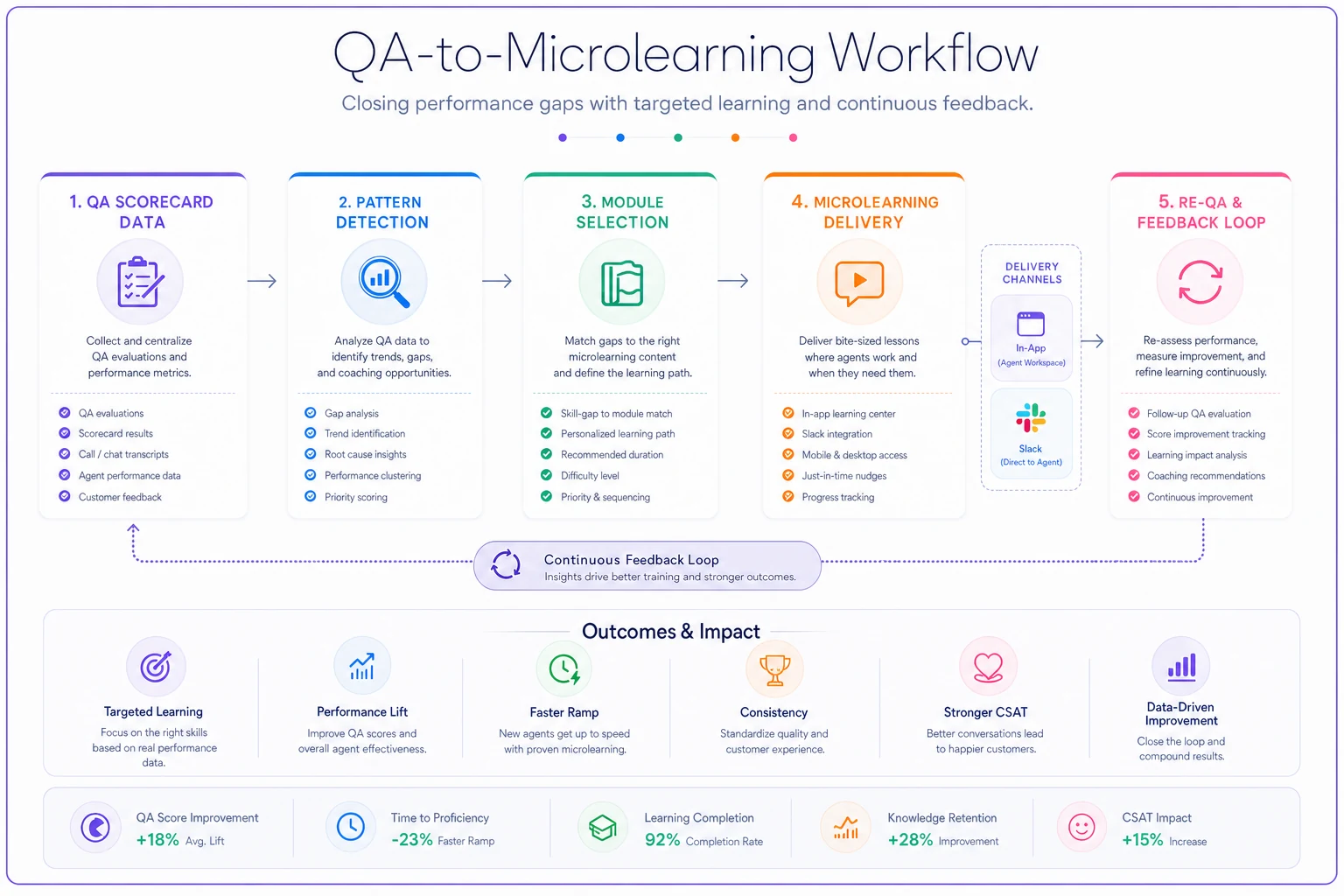
That last step is the one people forget, and it's the one that makes the whole thing a loop instead of just a nudge.
Measurement windows: proving the module actually worked
A module you don't measure is just a suggestion. The measurement window is the defined period after delivery in which you re-check the same skill and see if the score moved.
A workable setup: when a module fires for "policy accuracy," you tag that agent for a targeted re-QA on policy-heavy tickets within the next 7–14 days. You're not waiting for random sampling to eventually touch the skill again — you're deliberately pulling tickets that test it.
-
Fixed. Score on that dimension recovers and holds. Module worked, close the loop.
-
Partial. Some improvement, still shaky. One more targeted module or a quick coaching touch.
-
No change. Score flat or worse. The module isn't the fix — this needs a conversation, or the gap is deeper than content can solve.
The pattern worth watching across a team is time-to-recovery: how many days between a triggered miss and a verified fix. When that number shrinks, the microlearning loop is working. When it stays flat, you've built a content library, not a correction system.
A realistic example of the loop running
A mid-sized SaaS support team — around 14 agents handling billing, technical, and account questions — had a persistent problem with refund policy accuracy. QA scores on that dimension sat in the low 80s, and the same errors kept resurfacing every calibration.
They built four narrow modules for the refund scenarios that kept failing: prorated cancellations, chargebacks already filed with the bank, annual-plan mid-term refunds, and the "we don't refund but here's what we can do" script. Each was under four minutes, delivered as a Slack card attached to the failed ticket, triggered when an agent missed refund accuracy twice in a 10-ticket window.
Over roughly six weeks, the refund accuracy dimension climbed from the low 80s to the low-to-mid 90s. The more telling metric was recurrence — the same refund error dropping off almost entirely after an agent completed the matching module. Time-to-recovery went from "sometime next month, maybe" to around 8–10 days. No new headcount, no quarterly training day.
The part that surprised the team lead wasn't the score jump. It was that agents stopped resenting QA. When feedback arrives as a specific, useful 3-minute fix instead of a number and a lecture, it stops feeling like surveillance and starts feeling like help.
When this makes sense — and when it doesn't
This approach earns its keep when you have consistent QA volume and recurring, categorizable failures. If the same handful of skill gaps keep showing up across your team, microlearning triggers will move them fast.
When it's a bad idea: if your QA program isn't stable yet. You can't trigger reliably off inconsistent scoring. If two reviewers grade the same ticket differently, your triggers fire on noise, and agents lose trust in the system fast. Get calibration solid first.
Who should not do this: very small teams — under four or five agents — where a manager already sees every miss and can coach in real time. The overhead of building modules and trigger rules isn't worth it when a two-minute conversation covers the same ground. Teams whose failures are all one-off and situationally unique won't benefit much either; microlearning works on patterns, not novelty.
The honest limitation
Microlearning fixes skill gaps that are teachable in a few minutes. It won't fix an agent who's disengaged, a policy that's genuinely confusing, or a product that's broken in ways support keeps absorbing. When you see the same dimension failing across many agents at once, that's not a training problem — that's a process or product problem wearing a training costume, and no module will touch it.
The value of a tight trigger-to-module-to-remeasure loop is that it surfaces exactly that distinction. When most triggered modules resolve their gap and a few don't, the ones that don't are telling you something. Those are the real problems worth a manager's full attention. Everything else, the system quietly handles while people keep working the queue.
That's the point of building this well — not to automate coaching away, but to clear the fixable stuff fast so the hard conversations are the only ones left.
Ready to elevate your customer support?
Join 2,000+ support teams using Helpyly to reduce response times, automate workflows, and deliver outstanding customer experiences.