

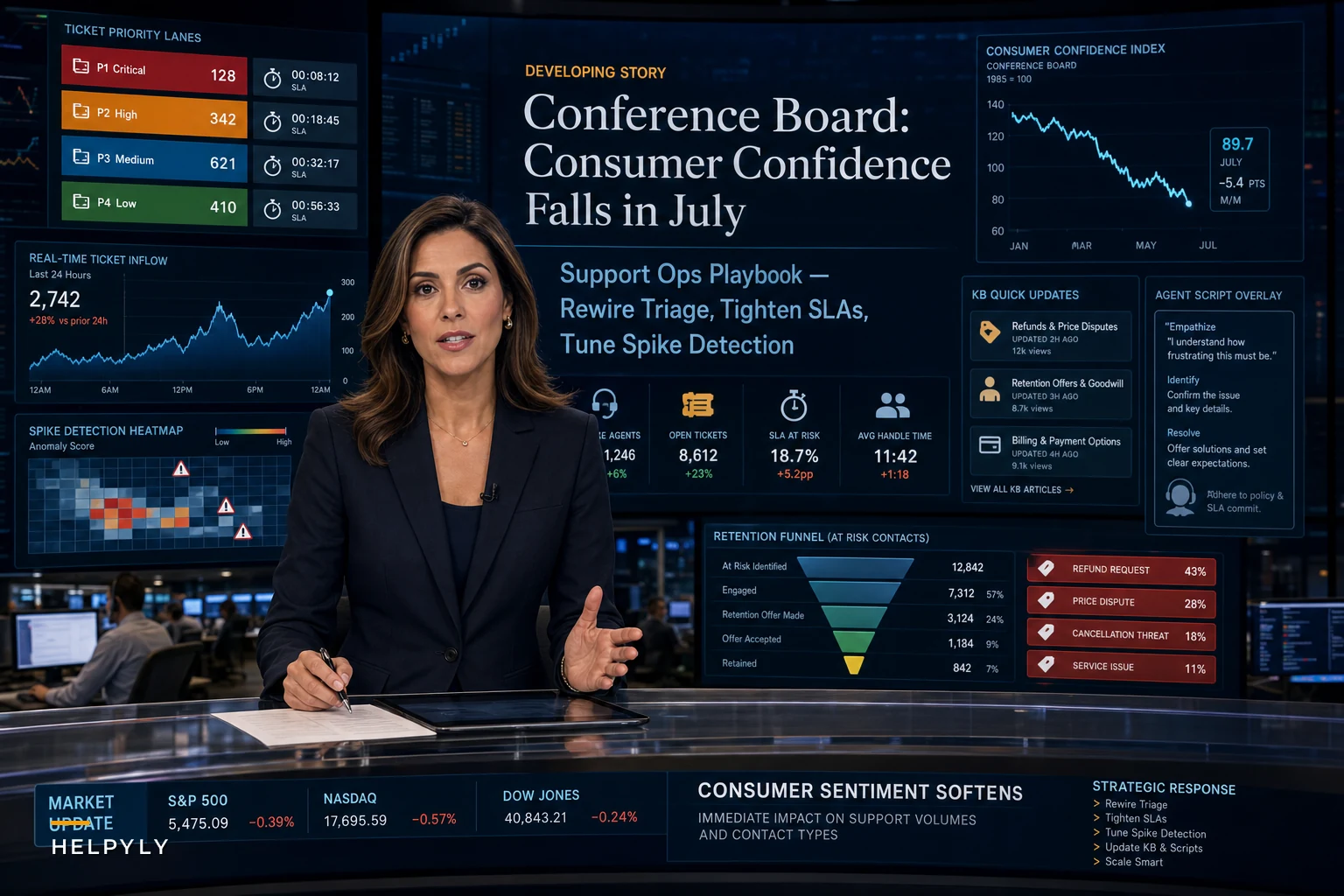

The Conference Board just reported that consumer confidence edged down in July with their index hitting 90.8 — and if you're running support operations, you're about to feel this in ways your standard playbooks won't catch. Not through some dramatic surge in volume (though that might happen too), but through a thousand small shifts in customer tolerance that compound into operational chaos.
Last week alone, three different support managers reached out about the same pattern: customers who normally accept 24-hour response times suddenly escalating after 6 hours. Return requests jumping around 40% without any product changes. Billing inquiries that used to resolve with a single template now requiring multiple touchpoints and manager approvals.
This isn't just customers being difficult. When consumer confidence drops, the entire emotional framework around support interactions shifts. That $12 shipping charge they ignored last month? Now it's worth a 20-minute phone call. The product defect they would've lived with? Now it needs immediate resolution or they're canceling.
The Hidden Multiplier Effect
Most support teams prepare for economic shifts by adjusting headcount or tweaking SLAs. But consumer confidence changes don't really work like that. They create what I'd call "tolerance decay" — where every friction point in your support operation suddenly becomes two or three times more painful for customers.
Think about your current routing rules. You probably have something like:
-
Billing issues → Finance team (24-48 hour SLA)
-
Product questions → General support (12-24 hour SLA)
-
Technical problems → Specialized team (6-12 hour SLA)
During normal times, customers accept these timelines. But when confidence drops, that billing question isn't just about understanding a charge — it's about whether they can afford to keep your service. That product question isn't curiosity — it's them evaluating whether to cancel.
The routing rules that worked last month now create dangerous delays exactly where customers are most sensitive.
Your Detection Systems Are Looking for Yesterday's Problems
What typically happens: support managers watch their dashboards, see volume creeping up 15-20%, and think they're handling it. Meanwhile, the real damage happens in pockets they're not monitoring. One B2B software company lost around 8% of their customer base in six weeks because their anomaly detection was watching overall ticket volume while missing that password reset requests had tripled — a pretty clear signal that customers were trying to log in to cancel. Their system flagged nothing because total volume was only up marginally.
Never let a customer request slip through the cracks.
Helpyly helps you track, resolve, and optimize every support interaction effortlessly.
- Centralized ticket management
- Automated customer notifications
- Performance analytics dashboard
No credit card required
Standard detection looks for spikes like:
-
Total ticket volume above 120% of baseline
-
Response times exceeding SLA by 50%
-
Specific queues backing up beyond capacity
But consumer confidence shifts create different patterns:
-
Sentiment degradation within normal volume
-
Topic clustering around financial concerns
-
Multi-touch resolution rates climbing
-
First-contact abandonment increasing
Your existing spike detection systems need recalibration for these subtler but more dangerous signals.
The Operational Rewiring Checklist
Immediate Routing Adjustments (Week 1)
Refund/Cancellation Fast Track Create a priority lane for any ticket containing financial concern keywords. Don't wait for them to explicitly threaten cancellation. Words like "afford," "budget," "times are tough," or "reconsidering" should trigger immediate routing to retention-trained agents. Set up auto-escalation if these tickets sit for more than 2 hours. Catching at-risk accounts before frustration peaks can save a meaningful chunk of them — somewhere around 30% in cases I've seen.
Billing Inquiry Elevation Move billing questions from your back-office finance queue to frontline support. Train your tier-1 agents to handle basic billing adjustments up to $50 without approval. The goal isn't to give away money — it's to resolve financial anxiety before it becomes cancellation intent.
Proactive Value Reinforcement For any customer who contacts support more than once in 14 days, automatically flag for a "value check" interaction. Not a sales call — just a quick review of features they're paying for but not using, delivered through your regular support channel.
Allow tier-1 agents pre-approved small billing adjustments to resolve financial anxiety quickly.
SLA Restructuring (Week 2)
Traditional SLAs assume all customers have equal patience. During confidence drops, that assumption actively hurts retention. Here's the adjustment framework:
| Customer Segment | Previous SLA | Adjusted SLA | Trigger |
|---|---|---|---|
| New customers (<90 days) | 24 hours | 6 hours | Any contact |
| At-risk (billing inquiry) | 24 hours | 2 hours | Payment keywords |
| High-value (top 20% spend) | 12 hours | 4 hours | Any contact |
| Dormant (low usage) | 24 hours | 8 hours | Reactivation attempt |
| Standard | 24 hours | 24 hours | Maintained |
Notice we're not reducing all SLAs — that's unsustainable. The point is dynamic prioritization based on retention risk.
Staffing Flexibility Rules (Weeks 2-3)
Morning Surge Coverage During confidence drops, anxious customers check email first thing. Move about 20% of afternoon coverage to 6-9 AM. You'll catch the overnight worry tickets before they escalate into something worse.
Lunch Hour Specialists Put senior agents on 11 AM - 2 PM coverage specifically. That's when working customers squeeze in personal admin tasks, and those tickets tend to be make-or-break for retention.
Weekend Triage Team Even if you don't offer full weekend support, have someone doing triage and initial responses. A simple "We've received your message and Sarah from our billing team will call you first thing Monday" can prevent weekend anxiety from turning into Monday cancellations.
Detection Rule Recalibration (Week 3-4)
Stop watching for 50% volume spikes. During confidence shifts, the dangerous signals are much quieter.
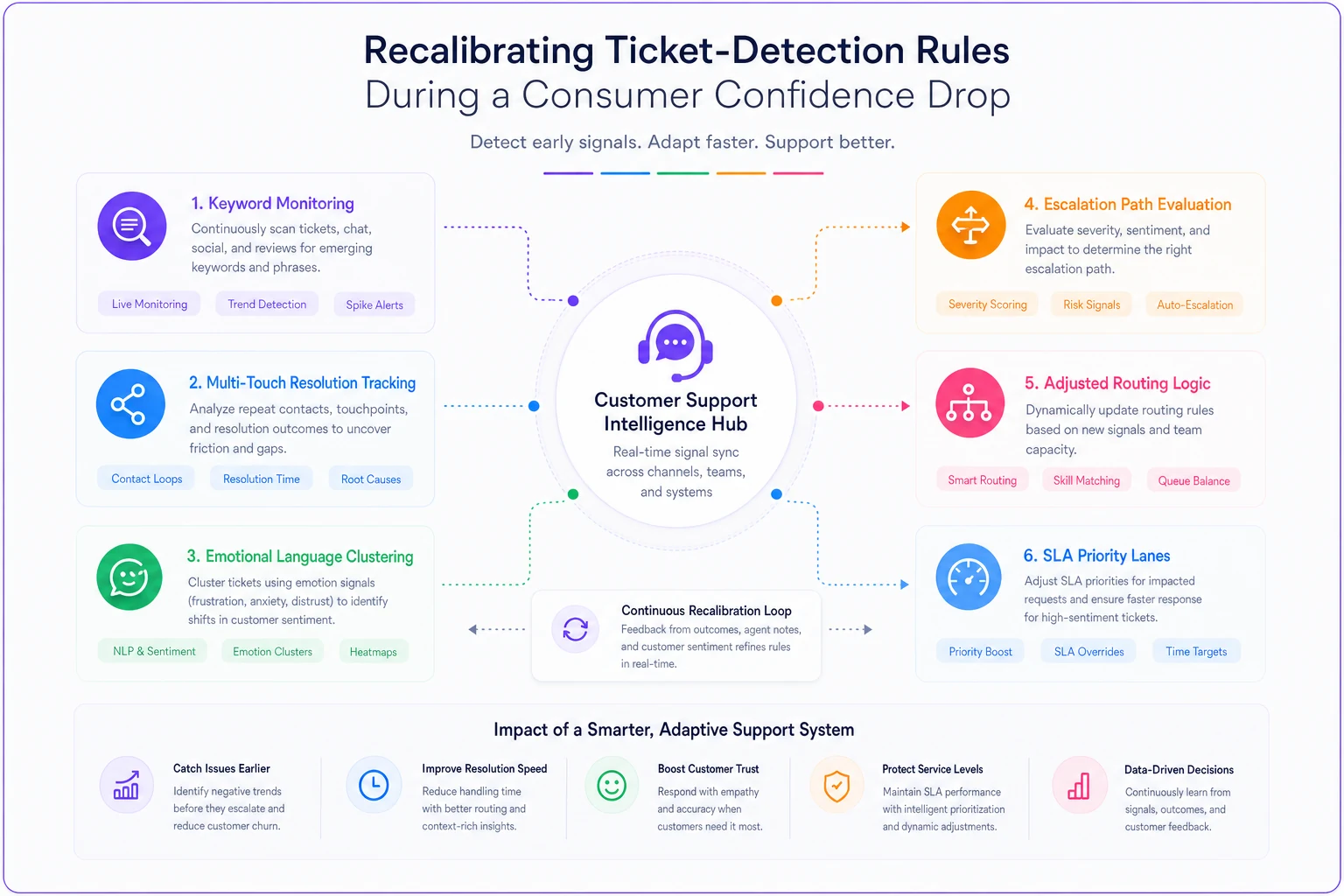
The Comparison Signal Track tickets mentioning competitors by name. When confidence drops, customers actively shop alternatives. Even a 10% increase in competitor mentions tends to predict noticeable churn in the following month.
Resolution Decay Tracking Monitor tickets requiring multiple interactions to resolve. If your average climbs from 1.3 to 1.8 touches, that's tolerance decay showing up in your data. Customers who previously accepted partial solutions now want complete resolution.
Emotional Language Clustering Set up keyword monitoring for exhaustion language: "tired of," "done with," "can't deal with," "frustrated." These phrases tend to spike two to three weeks before actual cancellations start showing up.
The diagram below shows how detection signals should flow into routing and escalation.
Stop watching for 50% volume spikes. During confidence shifts, the dangerous signals are much quieter.
Real Numbers from the Field
A SaaS company I worked with implemented these adjustments during the 2023 mini-banking crisis. Their standard playbook would've had them hiring three additional agents and extending hours. Instead, they restructured routing to fast-track about 22% of tickets, adjusted SLAs for roughly 35% of their customer base, shifted four agents to modified schedules, and deployed new detection rules.
Results over eight weeks:
-
Prevented roughly 340 cancellations (around $47K MRR)
-
Reduced escalation rate from 12% to 7%
-
Maintained team size while improving CSAT by 11 points
-
Spent approximately $3,000 on overtime vs. $24,000 on new hires
The interesting part? Their overall ticket volume only increased 18%. Traditional monitoring would've suggested a minor adjustment was all they needed. The routing and detection changes caught the real risk hiding inside that manageable-looking number.
Stop Preparing for Volume, Start Preparing for Volatility
The mistake most support teams make: assuming consumer confidence changes mean more tickets. Sometimes they do. But more often they mean different tickets — arriving at different times, from customers with different emotional states, requiring different resolution paths.
A subscription box company learned this the hard way. They staffed up when they saw economic indicators weakening, adding six agents to handle expected volume. Volume never materialized — it actually dropped 5%. But their cancellation rate doubled because the tickets they did receive were from customers already halfway out the door. Their prepared responses and standard workflows pushed anxious customers over the edge rather than pulling them back.
The Volatility Preparation Framework
-
Build Switch-Based Systems, Not Static Ones Instead of permanent changes, create operational "modes" you can activate: - Standard mode: Normal routing and SLAs - Caution mode: Enhanced detection, modified routing - Crisis mode: Full retention focus, all-hands protocols Each mode should have clear trigger criteria and be activatable within a couple hours.
-
Create Emotional Templates, Not Just Factual Ones Your current templates probably explain policies clearly. During confidence drops, customers need empathy first, information second. Build templates that acknowledge financial stress without being condescending: "I understand reviewing expenses is important right now. Let me break down exactly what you're paying for and see if we can adjust anything to better fit your current needs..." Not: "Per our terms of service, billing adjustments require..."
-
Design Flexible Workflows Stop building linear workflows that assume every billing inquiry follows the same path. Create branch points based on emotional indicators: - Customer mentions financial stress → Route to retention specialist - Customer asks about specific charges → Standard billing support - Customer compares to competitor pricing → Immediate manager review
Each mode should have clear trigger criteria and be activatable within a couple hours.
The AI Automation Opportunity Most Teams Are Missing
Everyone's focused on AI chatbots handling tier-1 tickets. Fine. But during consumer confidence shifts, the more valuable use of AI automation is pattern detection and routing optimization — not replacing agents, but giving them a better shot at catching problems before they compound.
Modern operational platforms can monitor tickets in real-time for confidence-related signals. Instead of waiting for a weekly report showing climbing cancellation rates, you get alerts when emotional language patterns shift. Routing rules adjust automatically based on detected customer state, not just ticket category.
The key is building these systems before you need them. Once consumer confidence starts dropping, you're already playing catch-up. The teams that weather these shifts have detection and routing flexibility baked into their operations from the start.
An online education platform that took this approach monitors sentiment trajectory across customer history, financial stress indicators in ticket language, engagement patterns suggesting customers are evaluating alternatives, and time-of-day patterns that often indicate anxiety-driven contacts. When the system detects risk patterns, it automatically adjusts routing priority, surfaces appropriate response templates, and alerts managers to emerging trends before they become visible in churn data.
During the recent confidence dip reported by CNBC, they held retention rates while competitors saw 15-20% increases in churn. Their operations adapted in hours rather than weeks.
When This Makes Sense (And When It Doesn't)
These adjustments work when:
-
Your customer base includes value-conscious consumers
-
You have subscription or recurring revenue models
-
Your support team can execute nuanced routing rules
-
You have basic detection systems to build on
Skip this approach if:
-
Your product is mission-critical and customers genuinely can't leave
-
You're already understaffed to a dangerous degree
-
Your customers are enterprise buyers locked into multi-year contracts
-
You have no historical data to baseline against
Skip this approach if:
The Three-Week Implementation Sprint
Week 1: Detection and Monitoring
-
Implement keyword tracking for financial stress
-
Set up competitor mention alerts
-
Create retention risk scoring
-
Establish baseline metrics
Week 2: Routing and Prioritization
-
Build fast-track lanes for at-risk customers
-
Adjust SLA tiers based on risk segments
-
Train agents on confidence-specific responses
-
Deploy emotional response templates
Week 3: Testing and Optimization
-
Run parallel routing tests
-
Monitor false positive rates
-
Adjust detection thresholds
-
Gather agent feedback on new workflows
Don't try to implement everything simultaneously. Start with detection — you need to see the problems before you can route around them.
The Uncomfortable Truth About Economic Cycles
Consumer confidence will keep fluctuating. The question isn't whether your support operations will face these challenges — it's whether you'll have systems in place to catch and respond to them before the damage shows up in your churn report.
The best support teams don't just survive confidence drops. They use them to find operational weaknesses, build more resilient systems, and widen the gap between themselves and competitors who are still reacting to last month's data. While others scramble to hire temporary agents or slash costs, you can hold service quality through smarter routing and earlier detection. Your operational software should be capturing these patterns now. Every ticket contains signals about customer confidence — you just need systems sophisticated enough to read them in time to act.
The teams still running support like it's 2019 are about to get an expensive reminder of why that matters.
The teams still running support like it's 2019 are about to get an expensive reminder of why that matters.
Ready to elevate your customer support?
Join 2,000+ support teams using Helpyly to reduce response times, automate workflows, and deliver outstanding customer experiences.