

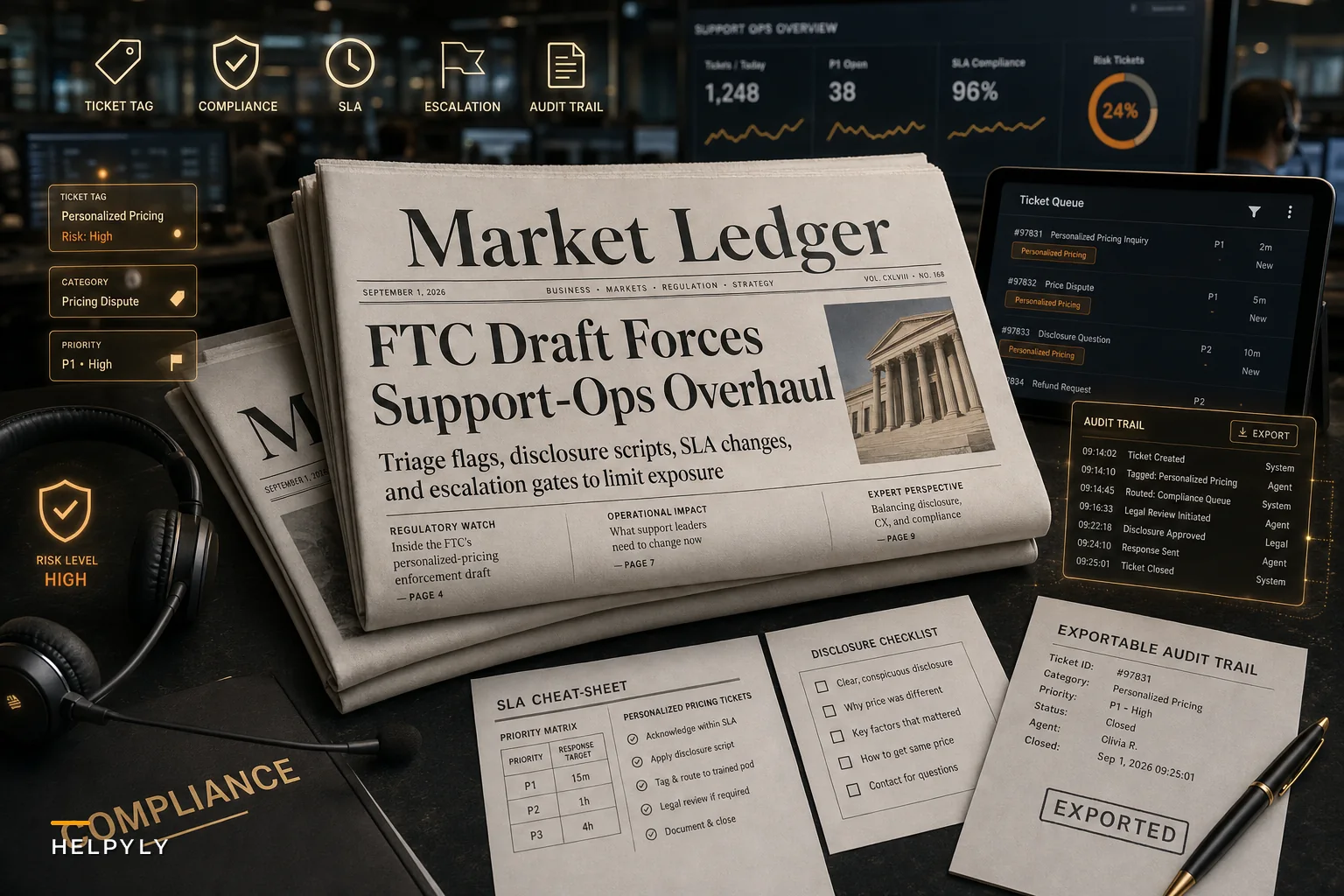

The FTC's draft enforcement policy statement on personalized pricing landed on August 19, 2026, aimed squarely at businesses using consumer data to set prices or offers. The agency is now seeking public comment on whether companies should be required to disclose when personal data feeds into pricing decisions. Reuters put it plainly in its coverage of the proposal: this is the early signal of regulatory scrutiny around what people are calling "surveillance pricing."
For pricing teams and legal, this is a policy question. For support, it's an operational one — and it's arriving faster than the rule itself. The moment this hits the news cycle, customers start comparing prices with friends, noticing that the cart total looks different on their phone versus their laptop, and opening tickets that say things like "why am I being charged more than my coworker?" You don't get to wait for the final rule. The inquiries come now.
This piece isn't about the legal merits. It's about what your queue looks like over the next 90 days and how to keep it from turning into a compliance liability.
Why pricing disputes are a different animal than normal complaints
Most support complaints are about something that broke. A pricing-difference inquiry is about something that might be working exactly as designed — which is what makes it dangerous.
When an agent handles a shipping delay, there's no legal exposure in saying "I'm sorry, it's running late." When an agent handles a personalized-pricing question, every sentence they type can become evidence. A well-meaning rep who says "yeah, our system charges returning customers a bit more" has just handed a regulator a quote. A rep who says "no, pricing is the same for everyone" when it isn't has created a false statement in your own records.
That's the core problem. Personalized-pricing tickets sit at the intersection of customer emotion and legal risk, and your average agent is trained to resolve the emotion as fast as possible. Speed is exactly the wrong instinct here.
What tends to happen across support operations is that the first 72 hours after a pricing story breaks are chaotic — not because volume spikes dramatically, but because nobody has told agents what they're allowed to say. They improvise. And improvisation on a compliance-sensitive topic is how you end up with fifteen different explanations of your pricing model living in your ticket history.
The three failure modes you're actually defending against
Before touching SLAs or macros, it helps to be precise about what can go wrong. There are really only three.
Never let a customer request slip through the cracks.
Helpyly helps you track, resolve, and optimize every support interaction effortlessly.
- Centralized ticket management
- Automated customer notifications
- Performance analytics dashboard
No credit card required
Inconsistent explanations. Ten agents give ten different answers about how pricing works. Individually harmless. Collectively, it looks like either confusion or concealment, and both read badly in an audit.
Admissions that aren't true. An agent guesses at how the pricing engine works and describes something the company doesn't actually do. Now you have a written claim that contradicts your real system.
Untracked disputes. A cluster of customers complains about the same price gap, the tickets get closed one by one as "resolved," and nobody ever sees the pattern. This is the quiet one — and often the most expensive — because the first time leadership hears about a systemic issue is when it arrives through a regulator instead of your own dashboard.
Almost everything in the playbook below exists to neutralize one of these three.
Build the triage flag before you build anything else
The single highest-leverage move is a dedicated ticket flag for personalized-pricing disputes. Not a generic "billing" tag — a specific one, because you need to be able to pull every one of these tickets in a single query later.
Here's what the flag needs to capture at minimum:
-
Whether the customer explicitly referenced personalization, data usage, or "different prices for different people"
-
Whether a price comparison was made (their price vs. someone else's, or across devices/sessions)
-
Which product or SKU the dispute involved
-
Whether the agent made any statement describing how pricing is determined
-
Whether the ticket was escalated, and to whom
The reason to over-capture early is straightforward: you don't yet know what the final rule will require you to prove. Retaining structured detail now is cheap. Reconstructing it from freeform notes six months from now is nearly impossible.
One pattern worth avoiding — teams that create the flag but leave the criteria vague. If agents aren't sure what counts, they'll under-tag, and your audit trail quietly develops holes. Write a two-line definition and put it directly in the flagging interface.
Write a two-line definition and put it directly in the flagging interface.
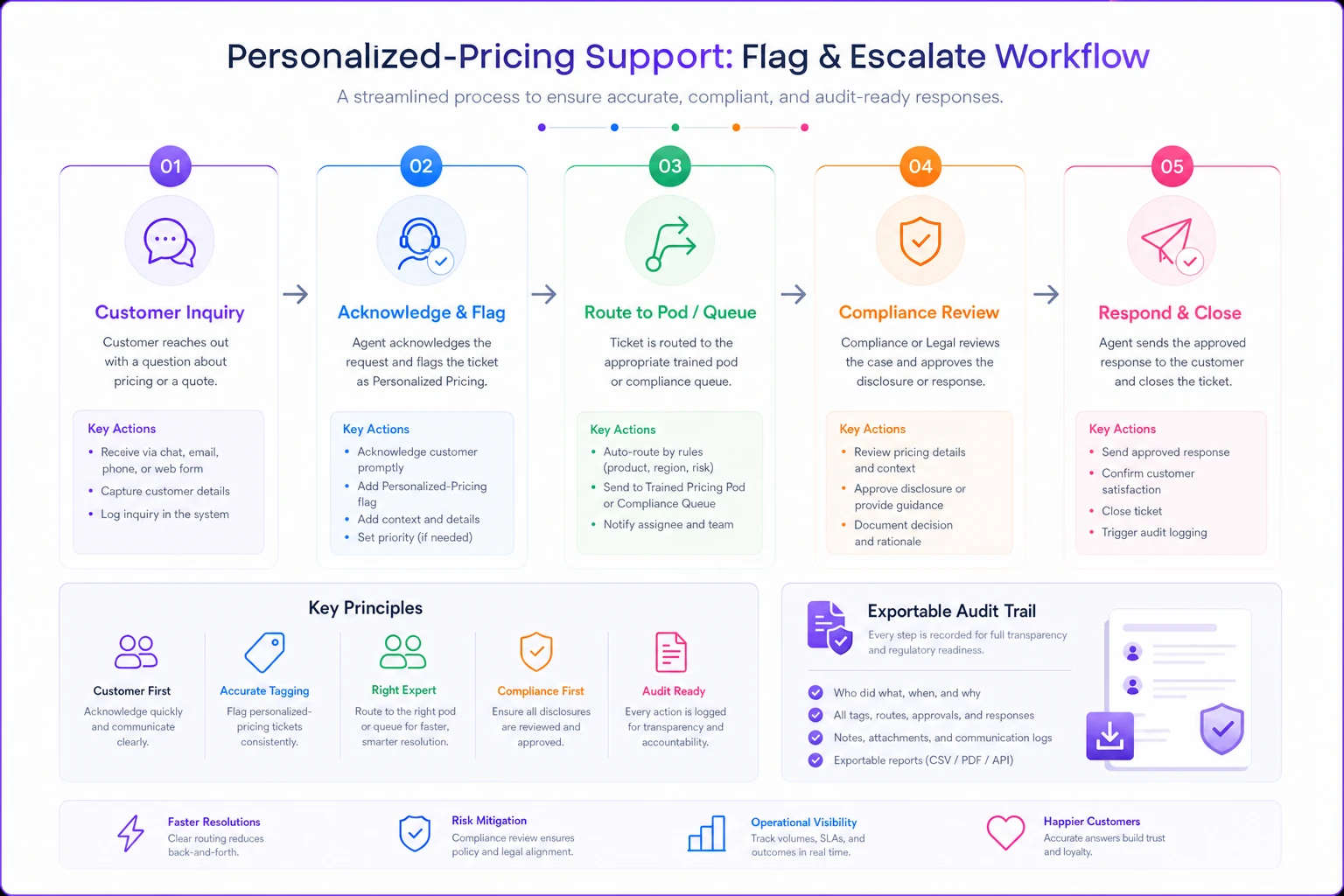
This sketch shows a simple flag-to-escalation workflow.
What agents can say, and what they must route
The cleanest way to protect both the customer relationship and the record is a tight boundary between acknowledgment and explanation.
Agents can acknowledge, empathize, and confirm the price the customer actually paid. Agents should not explain the mechanics of how a price was set, confirm or deny whether personal data influenced it, or speculate about why two customers saw different numbers.
That second bucket routes to a reviewed response — either a pre-approved disclosure statement or a compliance handoff.
| Situation | Agent handles directly | Route to compliance/legal |
|---|---|---|
| "My price seems high" (no comparison) | ✅ Acknowledge, confirm charge, offer standard resolution | — |
| "My friend paid less than me" | Acknowledge only | ✅ Reviewed response required |
| "Are you charging me more because of my data?" | Acknowledge only | ✅ Reviewed response required |
| "Different price on phone vs laptop" | Acknowledge only | ✅ Reviewed response required |
| Customer references FTC / regulation / legal action | Do not respond substantively | ✅ Immediate escalation |
| Media or journalist inquiry disguised as customer | Do not respond | ✅ Immediate escalation to comms |
The last row matters more than people expect. When a pricing story is circulating in the news, some inbound "customers" are reporters testing your frontline responses. One off-script agent quote becomes a headline. A single line in your macro library — "if the sender references publication, reporting, or a story, route to communications" — prevents that.
The disclosure language problem
You'll be tempted to write a clever, reassuring canned response. Don't. This is one of the few areas where the response copy should be drafted or reviewed by legal before it enters the macro library, not tone-tested afterward.
A disclosure statement is a factual claim about your business. It has to be accurate about what you actually do, and it has to stay accurate as the pricing engine changes. A macro that says "we never use your personal information to set prices" is fine — until pricing ships a personalization test six months later and nobody updates the macro. Now your support team is systematically making a false statement, at scale, in writing.
Two guardrails keep this from happening:
-
Every pricing-disclosure macro gets an owner and a review date. If pricing logic changes, the macro is re-verified before it keeps going out.
-
The macro links to a canonical source — a single KB article that legal maintains — rather than restating the policy in the macro body. Update one article, not forty macros.
This is exactly the kind of workflow where you want legal review embedded directly into the support process with compliance flags and automated handoff gates, rather than a Slack message to counsel every time a sensitive ticket appears. The handoff has to be a system, not a favor.
SLA and routing changes that actually make sense
Your instinct will be to make pricing disputes faster to resolve. Fight it.
For a normal ticket, a fast first response is a win. For a compliance-sensitive pricing ticket, a fast substantive response is a risk — it means an agent answered before review. The right target is a fast acknowledgment SLA and a separate, slower, reviewed resolution SLA.
A structure that works:
-
First acknowledgment aggressive — under an hour if you can. This is a templated "we've received this and we're looking into it," nothing substantive.
-
Reviewed resolution deliberately gated. The clock only closes once a compliance-approved response goes out. If that takes a day, it takes a day.
-
Split those two into different metrics. If you fold them together, agents feel pressure to close fast, and closing fast on these tickets is the whole problem.
Routing-wise, flagged pricing disputes should skip the general queue and land in a small, trained pod. Concentrating these tickets with a handful of experienced people consistently beats broadcasting a policy memo to the whole floor. Five people who deeply understand the boundary make fewer mistakes than eighty people who skimmed a document once.
A short real scenario
A mid-sized online retailer — home-goods store doing roughly 40,000 orders a month — ran device-based and loyalty-based pricing adjustments. When a pricing-difference story circulated, they went from a handful of price complaints a week to around 200 in the first five days.
In the first 48 hours, before any process was in place, agents answered freehand. A later review found at least a dozen tickets where reps described the pricing logic inaccurately, and a few where they flatly denied personalization that the company did in fact use. None of it was malicious — just untrained people trying to be helpful under queue pressure.
They then stood up a flag, a two-tier SLA, a five-person pod, and three legal-reviewed macros. Within about a week, substantive off-script responses on flagged tickets dropped to near zero. And the part leadership actually cared about: they could produce a single clean export of every pricing dispute, what was said, and how it was resolved. The volume didn't really change. The exposure did.
Your 90-day checklist
If you do nothing else, do these, roughly in order:
-
[ ] Create a dedicated personalized-pricing dispute flag with a written, two-line definition
-
[ ] Draw the hard line between what agents can acknowledge and what routes to review
-
[ ] Get 2–4 disclosure macros drafted or reviewed by legal, each with an owner and review date
-
[ ] Point every pricing macro at one canonical KB article instead of restating policy
-
[ ] Split acknowledgment SLA from reviewed-resolution SLA into separate metrics
-
[ ] Route flagged disputes to a small trained pod, not the general queue
-
[ ] Add a "references media/regulation" rule that forces escalation
-
[ ] Instrument an audit export so you can pull every flagged ticket in one query
-
[ ] Schedule a weekly review of flagged tickets to catch systemic patterns early
-
[ ] Set a recurring re-verification of macros whenever pricing logic changes
If you do nothing else, do these, roughly in order:
When to move now versus wait
Move now if you run any dynamic, personalized, loyalty-based, or device-influenced pricing. The disclosure debate is already public, and customer awareness is the trigger — not the final rule. Your inquiries are already changing shape.
You can move more slowly if your pricing is genuinely flat — same price for everyone, no personalization, no session-based adjustment. In that case, your main job is a clean, accurate macro that says exactly that, plus the ability to prove it. Don't over-build a compliance apparatus for a risk you don't actually carry.
Don't do this halfway. The worst position is a flag with no definition, a macro with no owner, and an SLA that still rewards speed. That combination creates the appearance of a process while producing the same inconsistent, unaudited record you had before — except now it looks like you knew and didn't act.
The regulation may take a while to finalize, and the final version may look different from the draft. That uncertainty is exactly why the operational work is worth doing early: none of the steps above depend on how the rule lands. Consistent answers, accurate disclosures, and a queryable record are good practice regardless. You're not betting on a specific outcome — you're making sure that whatever your pricing team does, your support queue never becomes the weakest link in the story.
Ready to elevate your customer support?
Join 2,000+ support teams using Helpyly to reduce response times, automate workflows, and deliver outstanding customer experiences.