

Most support teams don't fail at legal escalation because agents are careless. They fail because there's no clean line between "customer is frustrated" and "customer just said something that creates legal exposure." An agent reads a ticket, feels the tension, and either over-escalates everything — which trains legal to ignore support — or under-escalates the one message that actually mattered.
The result is predictable. A GDPR deletion demand sits in the general queue for six days. A chargeback threat gets a canned apology instead of a documented response. A customer writes "my lawyer will be in touch" and the agent replies with a discount code, which later reads terribly in discovery.
This post is about one narrow thing: building a legal escalation support path that catches the right tickets, forces the right evidence, and hands off cleanly — without turning your queue into a compliance bottleneck.
Where legal escalations actually go wrong
The failure usually isn't the escalation itself. It's the shape of what gets handed over.
When support flags something to legal, legal almost always bounces it back with the same three questions: What exactly did the customer say? When? What did we already tell them? If support can't answer those in one pass, the ticket ping-pongs for days while the clock on a regulatory deadline keeps running.
A typical example looks like this. A SaaS company gets a message: "I've emailed three times asking you to delete my account and data, and you're ignoring me. I'm reporting this to the ICO." The agent sees an angry deletion request and routes it to the "account issues" queue. Nobody realizes that a data subject request under GDPR has a statutory clock, and that "I emailed three times" means the clock probably started weeks ago. By the time legal sees it, half the response window is gone.
The pattern is consistent across support orgs: tickets that create the most legal risk look almost identical to normal tickets until you know what to look for. A billing dispute and a "I'm going to sue" message land in the same queue with the same subject line. The fix has to happen at the detection layer, not by hoping agents notice.
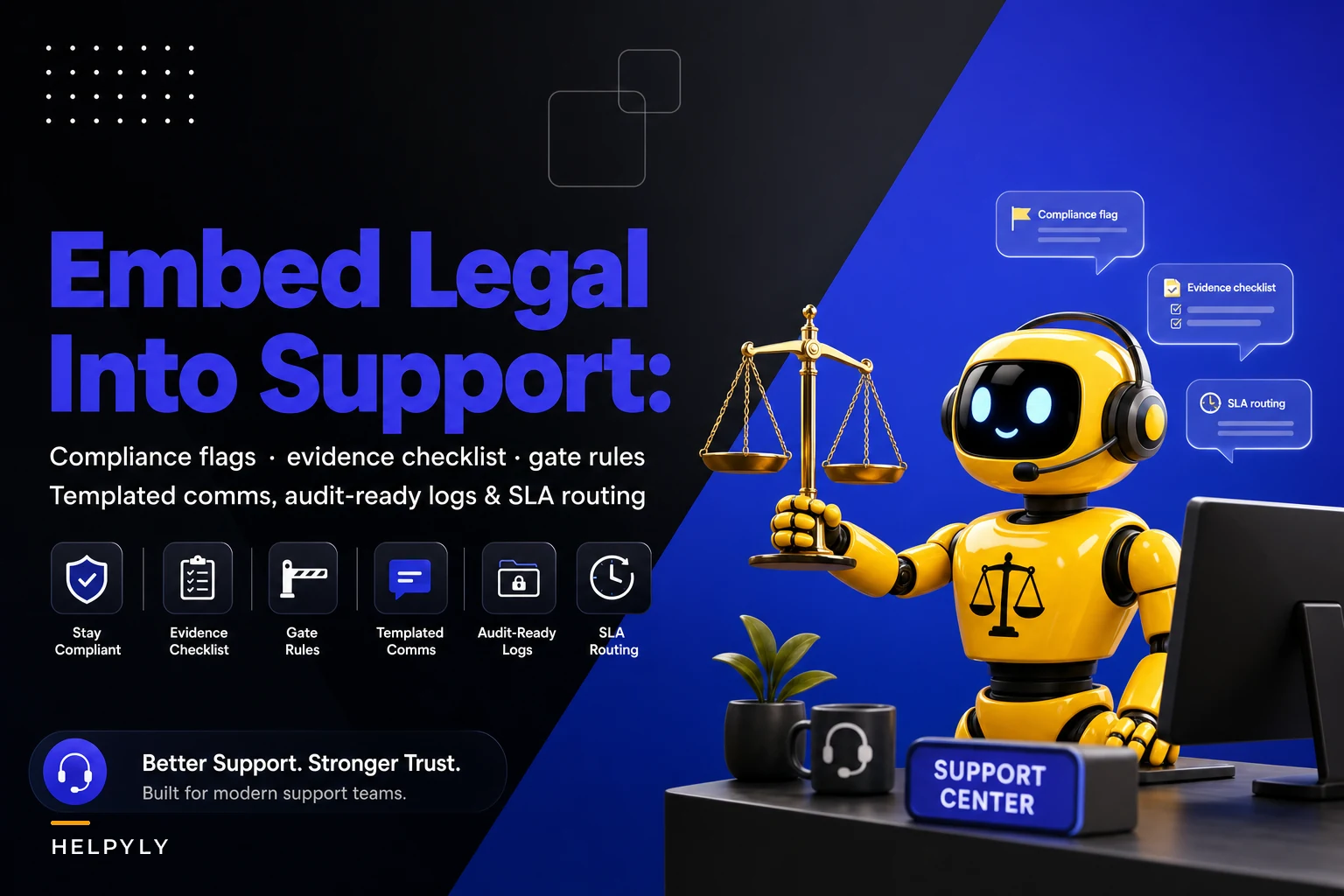
A minimal compliance flag schema
You don't need forty flag categories. Teams that build elaborate taxonomies end up with agents who can't remember which flag applies, so they default to the generic one. What works is a small set of flags tied to a required action, not just a label.
Never let a customer request slip through the cracks.
Helpyly helps you track, resolve, and optimize every support interaction effortlessly.
- Centralized ticket management
- Automated customer notifications
- Performance analytics dashboard
No credit card required
| Flag | Trigger signal | Clock? | Who owns it |
|---|---|---|---|
data-request | Deletion, access, or portability demand; mentions GDPR/CCPA/ICO | Yes — statutory | Privacy/DPO |
legal-threat | "My lawyer," "sue," "legal action," "demand letter" | No, but urgent | Legal |
regulatory | Mentions a regulator, complaint filed, subpoena | Sometimes | Legal + Compliance |
safety-harm | Physical harm, threats, self-harm, safety recall | Yes — immediate | Trust & Safety |
contract-dispute | Disputes terms, refund under contract, breach claim | Depends | Legal (async) |
press-risk | Threatens to go public, journalist involved | No | Legal + Comms |
The important design choice: each flag maps to exactly one owner and a clear urgency tier. When an agent applies data-request, they shouldn't have to also decide who gets it or how fast. That's already encoded.
One mistake that comes up repeatedly — teams add a flag but leave routing manual. So the agent flags it correctly, and then it sits in the general queue anyway because "flagging" and "routing" were never connected. The flag has to do something automatically.
Evidence requirements: what has to be attached before it moves
This is the part most teams skip, and it's also the part that saves the most time later.
-
Verbatim customer statement — the exact words that triggered the flag, quoted, not paraphrased. "Customer seemed upset about data" is useless. "Customer wrote: 'delete all my data by Friday or I'm filing with the ICO'" is what legal needs.
-
First-contact date — when the customer first raised this, not when it got flagged. This is what determines statutory clocks.
-
What we've already said — links to any prior responses on this issue, especially anything that could be read as a promise or admission.
-
Customer identity confirmation status — verified account holder or not. Critical for data requests, where responding to an unverified requester is its own problem.
-
Attachments referenced — any screenshots, contract clauses, or documents the customer cited.
Make the verbatim customer statement a required, copy-pasteable field so agents can't paraphrase or summarize it.
This mirrors the discipline of a good reproducible-bug handoff checklist — the goal in both cases is that the receiving team can act without a second round of questions. With legal, though, missing evidence isn't just annoying. It can mean a missed deadline or a weaker position.
One thing worth flagging on the data side: legal escalations often contain exactly the sensitive customer information you're normally trying to minimize in tickets. If your team already follows PII redaction and retention rules, the legal path is the one exception where you preserve rather than redact — but only inside the controlled escalation channel, with access limited to the people who actually need it.
Automated handoff gates
A handoff gate is a checkpoint that won't let a ticket advance until conditions are met. This is where the schema and evidence requirements come together.
-
Detection — the ticket text is scanned for trigger signals (either agent-applied or system-suggested). If a signal matches, a flag is proposed.
-
Confirmation — the agent confirms or overrides the flag. Human confirmation matters here; you don't want a keyword like "sue" in "the site's excuse" auto-firing a legal escalation.
-
Evidence gate — the ticket cannot move to the legal queue until the required evidence fields are filled. Empty verbatim field? Gate stays closed.
-
Routing — once the gate clears, the ticket moves automatically to the flag's owner with the correct urgency tier and SLA clock attached.
-
Acknowledgment gate — the owning team must acknowledge within the tier window. If they don't, it escalates up, not sideways.
The gate concept is what stops the two classic failure modes at once. Over-escalation gets filtered because a flag requires confirmation and evidence — an agent can't just dump every angry ticket on legal. Under-escalation gets caught because detection surfaces signals the agent might have missed.
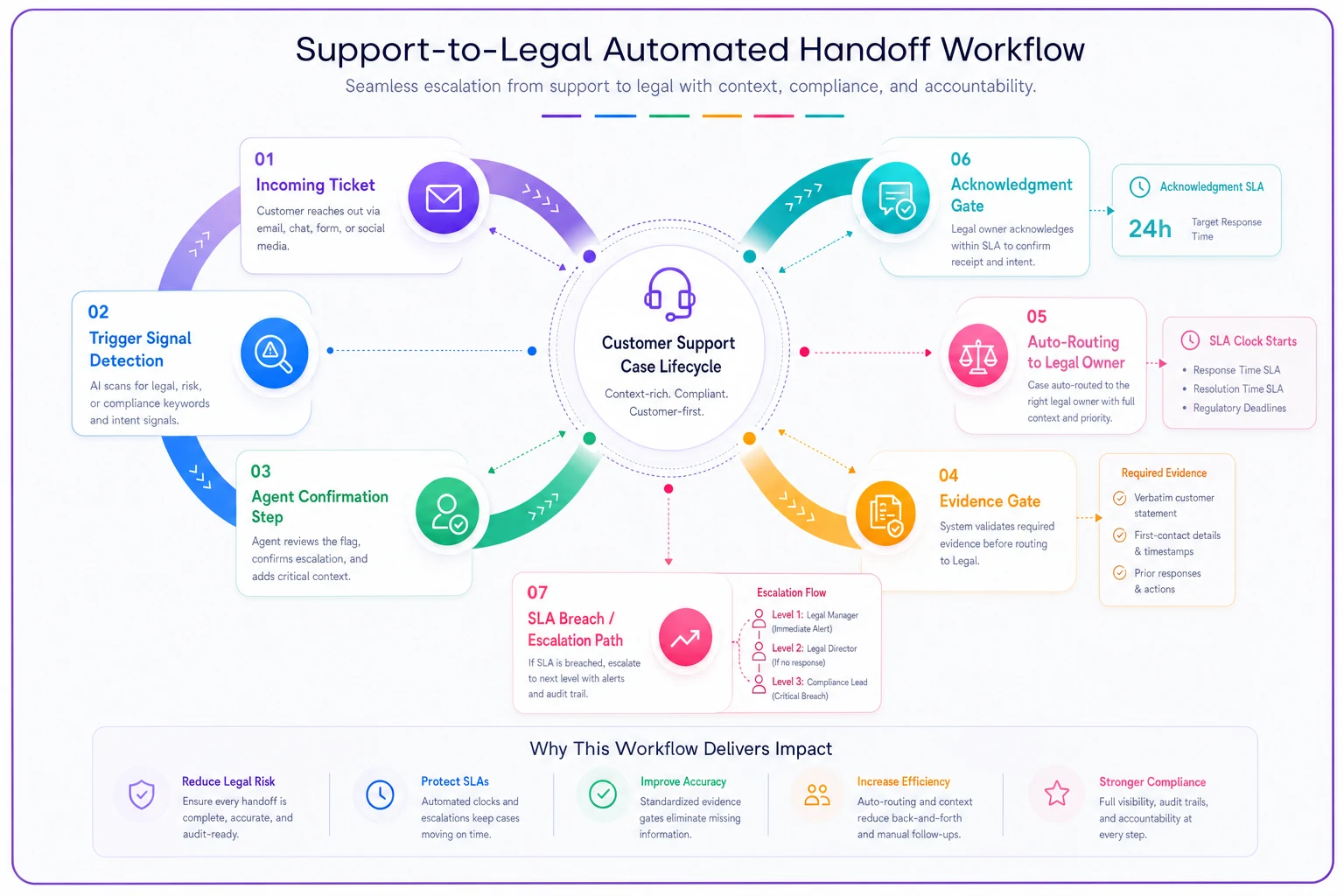
[Incoming ticket] ↓ [Trigger signal detected] ↓ [Agent confirms or overrides flag] ↓ [Evidence gate: verbatim + first-contact date + prior responses filled?] No → gate stays closed, agent prompted Yes ↓ [Auto-route to flag owner with SLA clock] ↓ [Acknowledgment gate: owner confirms within tier window?] No → escalates up Yes → active handling begins
Where light automation earns its place here is in the mechanical parts: scanning incoming text for trigger phrases, pre-filling the first-contact date from conversation history, keeping the SLA clock visible, and enforcing that evidence fields exist before routing. The judgment stays human. The paperwork and the routing don't need to.
Templated communications that don't dig the hole deeper
The moment a ticket gets flagged legal, the tone of the reply matters more than usual. This is where a well-meaning agent writing freehand causes real damage — apologizing in a way that reads as an admission, promising a timeline nobody can keep, or offering a settlement without authority.
-
Confirm receipt and that the matter is being handled by the right team
-
Commit to a process timeline, not an outcome ("we'll respond within X business days")
-
Avoid admissions, avoid promises, avoid discounts or settlement language
-
Do not close the ticket or imply resolution
A simple pattern that holds up for a data request: "Thanks for your message. We've received your request regarding your account data and have routed it to the team responsible for handling these requests. We'll respond within [statutory window] business days. If we need to verify your identity first, we'll reach out separately."
That reply does three things: starts the documented response, commits to a process rather than a result, and flags the identity-verification step that protects you from responding to the wrong person. What it doesn't do is apologize, admit delay, or promise deletion before verification — all things an improvising agent tends to throw in.
The rule worth enforcing: on a flagged-legal ticket, agents send templates only. Free-text replies get disabled until legal takes ownership or explicitly clears the agent to respond. It feels restrictive, but the alternative is a customer-facing message you can't take back.
Audit logs: the part you'll be glad you have later
Everything above produces a byproduct that's easy to overlook until you need it urgently: a clean record.
An audit log for legal escalations should capture, per ticket: when the flag was applied and by whom, what evidence was attached and when, every response sent (and which template), when the owning team acknowledged, and every state change with a timestamp. Not because it's nice to have — because when a regulator or a court asks "what did you do and when," a reconstructed guess is a weak answer and an immutable log is a strong one.
Teams almost never build audit logging until after their first serious incident. The ones who add it proactively have usually already been through a bad escalation and never want to reconstruct a timeline from Slack messages again.
Keep the log append-only. If someone can edit the record of what was said and when, the record loses most of its value in exactly the situation you'd need it.
A real scenario
A mid-sized subscription software company, roughly 40k active accounts, was handling legal escalations informally — agents forwarded anything scary to a shared legal inbox with a short note.
Their problem surfaced during a data-request audit. Over about a quarter, they'd received around 60 GDPR-related requests. Legal could confirm proper, on-time handling for maybe two-thirds of them; the rest had unclear first-contact dates and no record of what support had already told the customer. Two requests had almost certainly blown the statutory window, though nobody could prove exactly when the clock started — which was its own problem.
They implemented a version of the setup above: a six-flag schema, a required evidence bundle, an evidence gate before routing, and template-only replies on flagged tickets. Nothing fancy on the detection side — mostly keyword surfacing plus agent confirmation.
The change over the next couple of months was mostly boring, which is the point. Flagged tickets arrived at legal with the verbatim statement and first-contact date already attached, so the back-and-forth dropped sharply. Legal reported that response prep that used to eat an afternoon now took a short review. The number of "we're not sure when this actually started" tickets dropped to roughly zero, because the first-contact date became a gate, not an afterthought. No dramatic revenue story — just a category of risk that stopped being invisible.
When this makes sense — and when it doesn't
When it's worth building: You're handling regulated data (privacy requests, health, financial), you operate across multiple jurisdictions with different statutory clocks, or you've already had one escalation ping-pong badly enough to notice. If legal keeps bouncing tickets back to support asking for more information, that's the signal.
When it's overkill: A very small team with a handful of legal-adjacent tickets a year probably doesn't need gates and template libraries. A single well-defined flag and a direct line to whoever handles legal is enough. Building the full schema for five tickets a year is process for its own sake.
Who should not do this: Teams that won't assign clear ownership. The entire system depends on each flag mapping to a specific owner with a real SLA. If "legal" is a vague shared inbox nobody actually monitors, adding gates just creates a nicer-looking queue that still gets ignored. Fix ownership first.
The one thing to get right
If you take only a single idea from this: make the evidence a gate, not a request. The difference between a legal escalation path that works and one that quietly fails is almost always whether the required information is enforced before handoff or merely hoped for after it.
Everything else — the flag schema, the templates, the audit log — is scaffolding around that one principle. Get the gate right, and legal starts trusting support's escalations. Skip it, and you're back to reconstructing timelines from a thread at exactly the moment you can least afford to.
Ready to elevate your customer support?
Join 2,000+ support teams using Helpyly to reduce response times, automate workflows, and deliver outstanding customer experiences.