


Most support teams write a runbook once, drop it in Confluence or a Google Doc, and then treat it like scripture. The refund-exception process. The account-recovery flow. The "how to handle a data-deletion request" doc. Someone spent an afternoon writing it, it got reviewed once, and now it just... exists. Nobody knows if agents actually follow it. Nobody knows if it still matches the product. Nobody notices when it starts producing wrong answers.
That's the core problem. Code gets tests, version control, deploy logs, and rollback plans. Playbooks get a "last edited 8 months ago" timestamp and a prayer.
The teams that get support runbook observability right treat their playbooks the way engineering treats production services: instrumented, owned, reviewed on a cadence, and rollback-able when a change goes sideways. This isn't about adding bureaucracy. It's about knowing whether the processes you depend on are actually healthy — before a customer or an auditor tells you they aren't.
The failure mode nobody catches until it's expensive
Here's how playbook rot actually plays out, and why it's so hard to see.
A product team ships a change to the billing flow. Nobody tells support. The refund runbook still references the old admin panel path. Agents hit that step, it doesn't match reality, so they improvise. Some route to a Slack channel. Some escalate to a senior agent. Some just guess. The playbook says one thing, but the actual process running in your queue is now five different improvised versions.
From a manager's chair, everything looks fine. Tickets close. CSAT is roughly where it always is. But underneath, resolution time on that flow crept from around 14 minutes to 26, escalations doubled, and three refunds went out at the wrong amount because someone misread their own improvisation.
What breaks isn't the playbook itself. It's the gap between the written playbook and the real one running in people's heads. And with no instrumentation, that gap stays invisible until it produces a refund error, a compliance miss, or an escalation spike that finally forces someone to ask "wait, how are we even handling this?"
The playbooks that fail hardest are consistently the ones everyone assumes are stable. The rarely-triggered ones. The compliance-sensitive ones. The ones that only run 30 times a month, so nobody notices the failure rate climbing.
What "observability" actually means for a runbook
Observability isn't a dashboard you glance at. It's the ability to answer specific questions about a process without having to dig through tickets manually. For a runbook, the questions that matter:
Never let a customer request slip through the cracks.
Helpyly helps you track, resolve, and optimize every support interaction effortlessly.
- Centralized ticket management
- Automated customer notifications
- Performance analytics dashboard
No credit card required
-
How often is this playbook actually triggered?
-
How often does an agent complete it as written vs. deviate?
-
Where in the flow do agents get stuck, escalate, or abandon?
-
What's the resolution time and reopen rate for tickets that ran through this playbook?
-
Did those numbers change after the last edit?
To answer those, you have to instrument the playbook itself — which means treating each step as something you can measure, not just read.
Instrumentation patterns that work
You don't need heavy tooling to start. The pattern is: attach signals to the playbook, not just the ticket.
| Instrumentation pattern | What it captures | What it warns you about |
|---|---|---|
| Trigger tagging | Every ticket that entered a playbook gets tagged with the playbook ID | Volume shifts, playbooks nobody uses anymore |
| Step-completion checkpoints | Agents mark which steps they actually did (macros, checklist items) | Steps people skip or can't complete |
| Deviation logging | A one-click "I deviated because…" option | Where reality no longer matches the doc |
| Outcome linkage | Tie reopen/CSAT/escalation to the playbook that ran | Whether the playbook produces good outcomes |
| Edit markers | Timestamped change events overlaid on the metrics | Regressions introduced by a recent edit |
The most underrated one is deviation logging. When an agent goes off-script, that's not a discipline problem — it's your single best signal that the playbook is wrong. A playbook with a 40% deviation rate isn't being ignored; it's broken. Most teams punish the symptom instead of reading it.
Ownership: the reason playbooks rot in the first place
The uncomfortable pattern: when everyone owns the playbooks, nobody does. Docs live in a shared space, "the team" maintains them, and maintenance becomes whoever happens to notice something's wrong — which is nobody, until it's a fire.
-
Each playbook has one accountable owner (usually a team lead or senior agent), whose job is the health of that playbook, not writing every word of it.
-
The owner watches its metrics. Trigger volume, deviation rate, reopen rate, time-since-last-review. If deviation spikes, they investigate.
-
Owners rotate quarterly for high-volume playbooks so knowledge doesn't concentrate in one person who then leaves.
-
A single "playbook health lead" (often the support ops manager) owns the system — the review cadence, the templates, the KPIs across all playbooks.
Pro-tip: Give the outcome owner authority to act on metric regressions rather than treating them as a documentation problem.
The insight most teams miss: ownership of the document and ownership of the outcome are different jobs. Plenty of teams have someone who "owns the doc" and keeps the formatting clean while the actual process it describes drifts miles from reality. Owning the outcome means watching the numbers, not the paragraphs.
CI-style review cadence, without the ceremony
Engineering doesn't review code once and ship forever. Changes go through review, and even unchanged code gets re-validated when the environment around it shifts. Playbooks need the same rhythm, scaled to how critical and how volatile they are.
-
Classify each playbook by risk and volatility. High-volume + compliance-sensitive (refunds, data deletion, account recovery) = tight cadence. Low-volume + stable (rare edge cases) = light cadence.
-
Set review triggers, not just calendars. A playbook gets pulled into review when any of these fire: it hasn't been reviewed in 90 days, its deviation rate crosses a threshold, its reopen rate climbs, or a product change touches its dependencies.
-
Require a reviewer who isn't the author. Same as a code PR. The author is blind to their own assumptions. A second set of eyes catches the "wait, this step assumes admin access most agents don't have" problems.
-
Test before merge. For meaningful changes, have one or two agents actually run the updated playbook on live-or-recent tickets before it becomes the standard. A "shadow run."
-
Log the change with a reason. Not "updated refund flow" — "step 4 removed because billing panel moved; verified with 5 tickets, deviation dropped from 38% to 6%."
That last habit is what makes the whole system compound. When every change carries a reason and a before/after, your playbook history becomes a diagnostic record instead of a mystery.
One caution here that overlaps with automation: if you're using AI to draft or suggest playbook updates, the review gate matters even more, because a plausible-but-wrong AI edit reads cleaner than a messy human one. We've written more about keeping humans in the loop and audit rules in Don't let AI create work: governance, fallbacks and audit rules for human-in-the-loop support, and the same discipline applies to playbook changes.
A simple playbook change workflow:
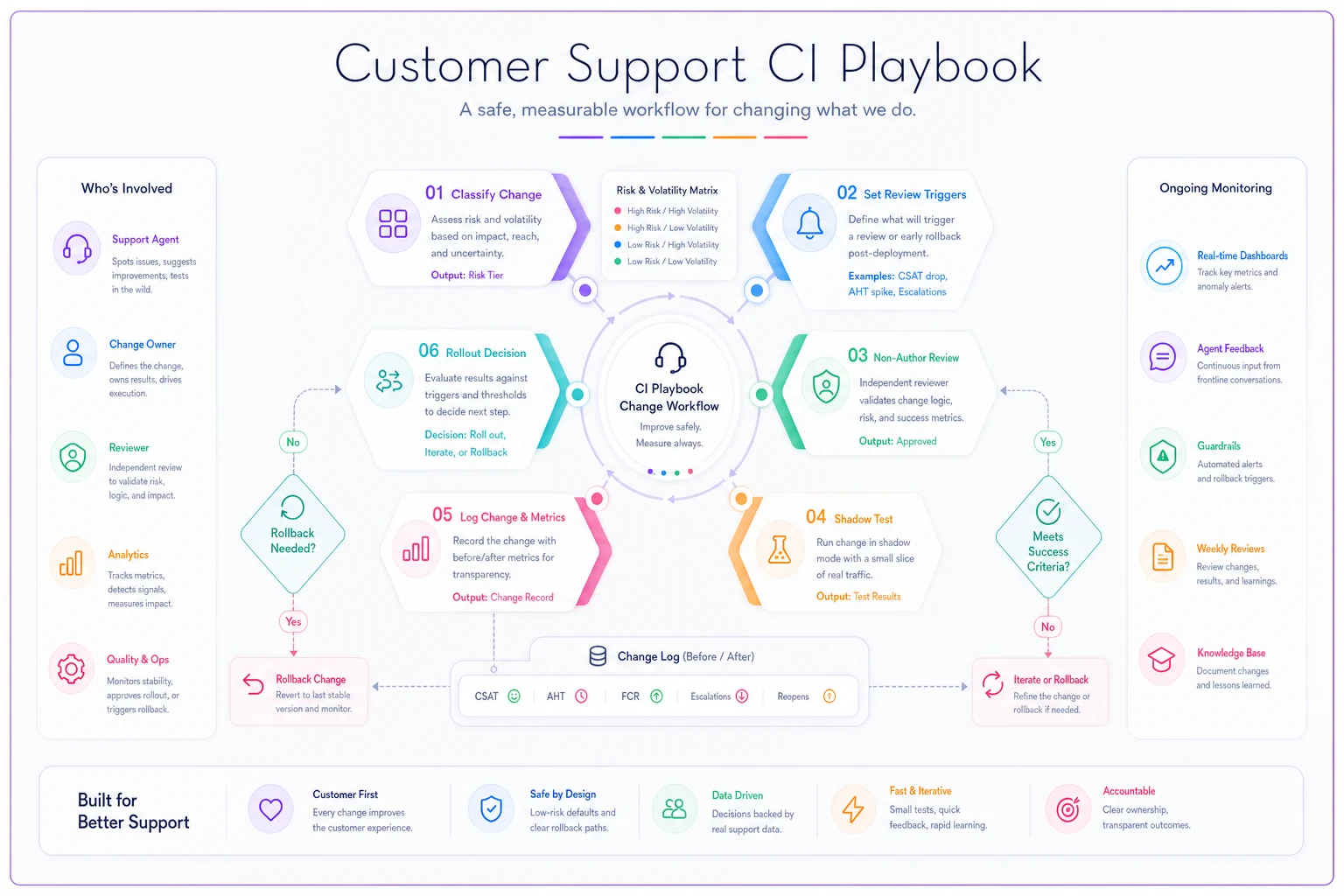
This maps the CI-style steps to a support playbook update and can serve as a quick checklist when you change a playbook.
Rollback rules: the part almost nobody has
Ask a support manager what their rollback plan is for a playbook change, and you'll usually get a blank look. Engineering can revert a bad deploy in minutes. Support teams change a playbook, discover it made things worse, and then spend two weeks slowly realizing it and arguing about how to fix it.
-
Define the regression signal. "If deviation rate on this playbook rises above X, or reopen rate rises by more than Y within two weeks of an edit, we roll back."
-
Keep the previous version instantly recoverable. Version the playbook. Rolling back should mean reverting to the last known-good version, not reconstructing it from memory.
-
Assign who can pull the trigger. The owner should be able to roll back without a meeting. Fast reversibility is the whole point.
-
Communicate the rollback. Agents who adopted the new steps need to know they're going back. Otherwise you get a third version — half the team on old, half on new.
The mindset shift: a playbook change is a deploy. Deploys can be bad. Bad deploys should be cheap to undo. If undoing a change is slow and painful, people stop making changes at all — and then you're back to rot, just cautiously.
Playbook-level KPIs and what a dashboard should actually show
Most support dashboards measure tickets and agents. Almost none measure playbooks. If a playbook is a process you depend on, you should be able to look at it the way you'd look at a service's health page.
-
Trigger volume (30-day, with trend) — is this still being used?
-
Deviation rate — the leading indicator of drift.
-
Median resolution time — with edit markers overlaid so you can see the effect of changes.
-
Reopen rate — did the "resolution" actually resolve it?
-
Escalation rate out of this playbook — where the process hands off (or gives up).
-
Days since last review — freshness.
-
CSAT for tickets that ran this playbook — the outcome, tied back to the process.
An example of what a single playbook's health row looks like in practice:
| Playbook | Triggers (30d) | Deviation | Reopen | Median time | Last review | Status |
|---|---|---|---|---|---|---|
| Refund exception | ~210 | 9% | 4% | 15m | 22 days | Healthy |
| Data deletion request | ~35 | 31% | 11% | 41m | 140 days | ⚠️ Review |
| Account recovery | ~180 | 18% | 7% | 19m | 61 days | Watch |
The data-deletion row is exactly the kind of thing that stays invisible without playbook-level KPIs. Only 35 triggers a month, so it never surfaces in aggregate ticket metrics — but a 31% deviation rate and a 140-day-old review on a compliance-sensitive process is a genuine risk. The small, dangerous processes stop hiding inside your averages when you instrument at the playbook level.
A real scenario
A mid-sized subscription software company — support team of about 14 — kept getting burned by their cancellation-and-refund flow. It ran maybe 200 times a month. On paper it was documented. In practice, three product changes over a year had quietly broken two steps, and agents had each invented their own workarounds.
Nobody had numbers on it because nothing was instrumented at the playbook level. What they did have was a slow bleed: refund errors that finance caught after the fact (roughly 6–8 wrong-amount refunds a month), escalations on that flow creeping up to around a fifth of its tickets, and resolution time that had drifted from the mid-teens of minutes to the high 20s.
They did three unglamorous things. Tagged every ticket that entered the refund flow with the playbook ID. Added a one-click deviation log. Put a named owner on it with a rule: review triggered automatically if deviation crossed 20%.
Within the first few weeks the deviation log made the problem obvious — most agents were flagging the same two broken steps. They fixed those steps, logged the change with a before/after, and did a short shadow run. Over the next couple of months, deviation on that flow dropped to single digits, wrong-amount refunds fell to roughly one or two a month, and escalations on that specific playbook came down noticeably. Nothing dramatic in isolation. But the process stopped silently rotting, because for the first time someone could actually see it.
When this makes sense — and when it doesn't
This level of rigor isn't free, so be honest about where it pays off.
When it's worth it:
-
You have playbooks tied to money or compliance (refunds, deletions, legal, security).
-
You're past roughly 8–10 agents, where informal knowledge-sharing stops keeping everyone aligned.
-
Product changes frequently and support is often the last to know.
-
You've been burned by a "we thought that process was fine" incident.
When it's overkill:
-
You're a 3-person team where everyone runs every process and drift is visible in the room. Instrument later, when headcount hides things.
-
The playbook is genuinely trivial and low-stakes. Not everything needs a KPI. Tracking deviation on "how to reset a password" is busywork.
Who should NOT start here:
If your playbooks aren't even written down consistently yet, don't jump to observability — you'll be instrumenting chaos. Get them documented and consolidated first, then instrument the handful that carry real risk. Trying to measure processes that don't formally exist just produces noisy dashboards nobody trusts.
How this connects to the rest of your operation
Playbook observability isn't a standalone project. It plugs into everything else support does. Your QA process feeds it — deviation patterns are a QA signal. Your product feedback loop feeds it — a product change should automatically flag the playbooks that depend on the thing that changed. Your incident response leans on it hard: when a surge hits, the last thing you want is to discover your surge playbook drifted months ago. If you run structured surge response, the runbook you reach for during an incident should be one you already know is healthy, not one you're about to test for the first time under pressure — which is exactly why the ticket surge response playbook for incidents is only as reliable as its last verified state.
At small scale, all of this lives in someone's head, and that's fine. The problems start when the number of playbooks, agents, and product surface area outgrows what any single person can track. That's the transition where "we have runbooks" quietly becomes "we have runbooks that may or may not describe reality," and nobody can tell you which is which.
Treating playbooks like code fixes that. Not by adding process for its own sake, but by making the health of your processes visible — instrumented, owned, reviewed on a cadence, and reversible when a change goes wrong. The teams that do this don't have fewer playbook problems. They just find out about them in week one instead of after the refund errors, the compliance gap, or the escalation spike forces the question. That's the entire difference between a process you maintain and one that's quietly maintaining a fiction.
Ready to elevate your customer support?
Join 2,000+ support teams using Helpyly to reduce response times, automate workflows, and deliver outstanding customer experiences.