
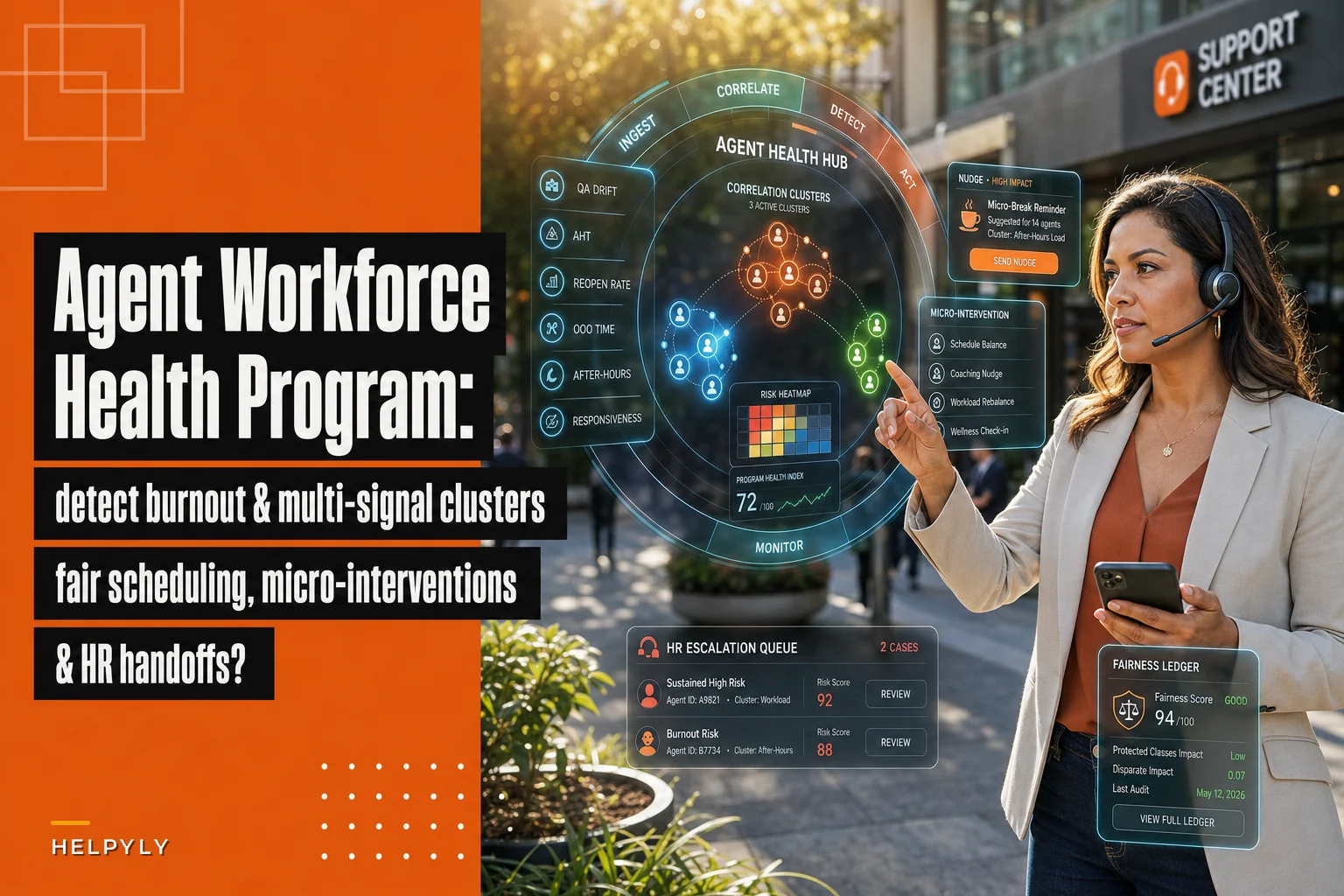

By the time an agent gives notice, the damage has been building for six to ten weeks. You can usually trace it backward through the data if you know where to look — a QA score that slid three points over a month, a sudden cluster of out-of-office requests, a shift in how many tickets someone reopens. None of these mean anything alone. Together, they're a burnout signature.
Most support teams don't have a system for reading these signals. They have a manager who "has a feeling something's off with Dana" and then a resignation email that confirms it two months too late. An agent workforce health program is just the operational discipline of turning those vague feelings into tracked signals, thresholds, and defined responses — before the person is already halfway out.
This isn't a wellness-poster initiative. It's a workflow. And the teams that run it well treat it with the same rigor they use for SLA monitoring.
The signals that actually predict decline
Everyone tracks QA and CSAT. Fewer teams track the movement of those numbers per agent, which is where the real signal lives. A steady 88 QA score tells you nothing. A drop from 91 to 85 over four weeks tells you a lot.
| Signal | What it looks like when healthy | What decline looks like | Usually indicates |
|---|---|---|---|
| QA drift | Stable within ±2 pts month over month | Sustained 4–6 pt drop over 3–4 weeks | Disengagement, cognitive fatigue |
| Handle time creep | Steady or improving | Gradual 15–25% increase without complexity change | Slowing down, checking out, or overwhelmed |
| Reopen rate | Flat baseline | Climbing while volume is flat | Rushing, cutting corners, low motivation |
| OOO / late clock-ins | Predictable, planned | Clustered unplanned absences | Stress, avoidance, early job search |
| After-hours activity | Minimal | Spiking off-shift work to catch up | Workload doesn't fit the schedule |
| Internal chat responsiveness | Normal cadence | Going quiet in team channels | Withdrawal, a common pre-attrition sign |
The mistake most teams make is treating each of these as a performance problem to correct. QA dropped? Coaching plan. Handle time up? Efficiency talk. That's backwards. When several of these move together, you're not looking at a skill gap — you're looking at a person whose bandwidth is collapsing. Coaching a burned-out agent on "efficiency" is one of the faster ways to accelerate a resignation.
The pattern to watch for is correlation across three or more signals in the same two-week window. One drifting metric is noise. Three drifting together is a person.
Why the signals get missed
In real operations, this usually comes down to fragmentation. QA scores live in one tool, schedule adherence in the WFM system, absences in HR software, ticket metrics in the help desk, and the "vibe" only exists in a team lead's head. Nobody is looking across all of them for the same person at the same time.
Never let a customer request slip through the cracks.
Helpyly helps you track, resolve, and optimize every support interaction effortlessly.
- Centralized ticket management
- Automated customer notifications
- Performance analytics dashboard
No credit card required
A typical scenario: a lead notices Marcus's QA dipped and books a coaching session. Separately, the WFM report shows he's been clocking in late twice a week. Separately, HR sees he's burned through four unplanned PTO days this month. Three people each hold one piece of the picture. Nobody assembles it. Marcus resigns, and in the exit interview says he'd been overwhelmed since the schedule change in early spring — which, if anyone had connected the OOO cluster to the after-hours activity spike, would've been visible in week two.
The other reason it gets missed: managers with too many direct reports simply can't hold this many people in their head at once. If your leads are running spans of twelve or fifteen, they're firefighting queues, not reading burnout signatures. This connects directly to how you structure oversight — worth reading alongside support career ladders that actually retain agents, because span-of-control thresholds and workforce health are really the same problem from two different angles.
Fairness-aware scheduling: the root cause nobody audits
Here's the uncomfortable part. A lot of what gets labeled "burnout" is just unfair scheduling that accumulated quietly over a quarter.
-
Surge-shift rotation. No agent covers the Monday-morning or post-outage surge windows more than a set number of times per month. Track it and rotate deliberately.
-
Weekend equity. Count weekend days assigned per agent per quarter and cap the spread. If one person has worked nine weekend days and another has worked two, that gap is a burnout debt you're quietly accruing.
-
Consecutive high-intensity caps. Nobody works more than two back-to-back peak-volume days without a lighter day between.
-
Undesirable-slot ledger. Keep a running tally of who took the late closes, the holidays, the graveyard shifts. Use it to bias next quarter's assignments toward people who've been carrying more.
-
Preference-honoring floor. Every agent gets at least a set number of their stated shift preferences honored per month. If someone's preferences are honored zero times in a row, that's a flag on its own.
Export surge and weekend assignment counts each quarter to validate your fairness rules.
The insight most teams miss: fairness isn't about making everyone happy — it's about making the distribution auditable. If you can't pull a report showing how surge shifts and weekend days were spread across the team last quarter, you have no idea whether your scheduling is quietly burning out your best people.
Micro-interventions: the cheap moves that actually work
When a health signal trips, most teams reach for something too big. They escalate to a formal HR conversation, which feels heavy and defensive to the agent, or they do nothing because it doesn't yet "warrant" a formal step. There's a significant gap between those two, and that gap is where micro-interventions live.
-
Pulling an agent off the queue for a two-hour "reset" block — knowledge base cleanup, no live tickets.
-
Temporarily lowering their complex-ticket routing weight for a week so they get more routine, lower-stress volume.
-
A 15-minute unstructured check-in that is explicitly not a performance review. No forms, nothing in the file.
-
Swapping their next surge shift with a volunteer.
-
Front-loading a microlearning module they've been struggling with, so the QA drift has a concrete fix instead of vague pressure.
The point is that a micro-intervention costs almost nothing and can be triggered fast. A single well-timed schedule adjustment in week two can prevent a week-eight resignation entirely. The trick is timing, not intensity.
If your onboarding already builds strong competency gates, some of these interventions plug in naturally — a struggling newer agent might just need a targeted module rather than a coaching escalation. That's part of why the 30-day onboarding syllabus with competency gates matters here; the assessment data tells you whether a QA dip is a burnout signal or a genuine skill gap that never got closed.
Where automation quietly helps
The reason most teams don't run this program isn't that they don't care. It's that manually cross-referencing QA drift, schedule adherence, OOO clusters, and reopen rates across thirty agents every week is effectively a full-time job nobody has bandwidth for.
This is where an AI-assisted operational layer earns its keep — not by making decisions about people, but by surfacing correlations a busy lead can't realistically track. A workflow platform that pulls signals from your help desk, WFM, and HR system into a single health view can flag "three signals drifting together on the same agent" automatically, so the lead gets a nudge in week two instead of noticing in week eight. The scheduling-fairness ledgers — surge counts, weekend spread, honored preferences — are exactly the kind of tedious tracking that automation handles without complaint.
Here's a simple workflow to visualize how signals are pulled together and nudges get issued.
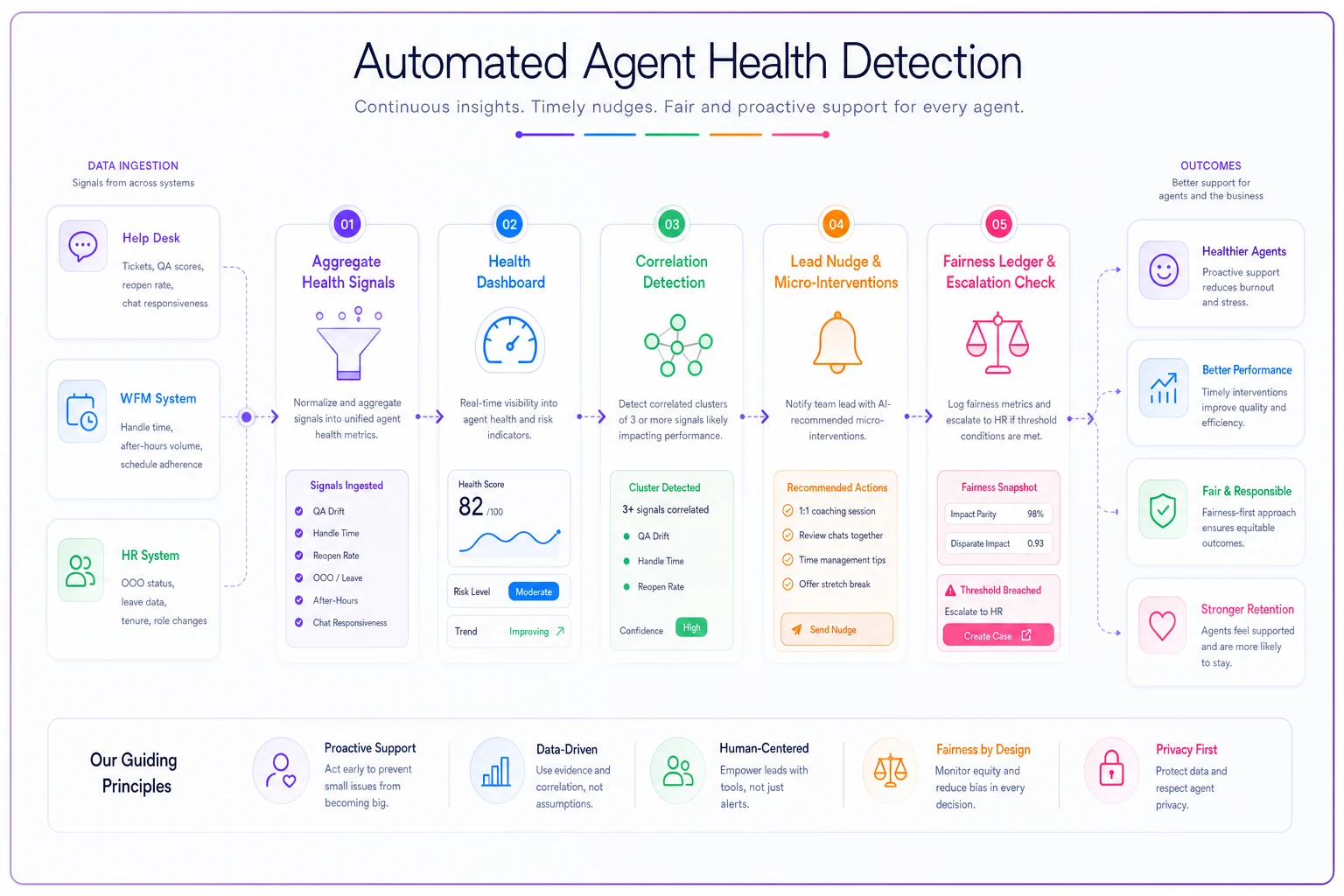
The judgment stays human. The pattern detection and ledger-keeping don't have to be.
The HR handoff: when a micro-intervention isn't enough
Not everything stays at the micro level. You need clear remediation thresholds so leads know exactly when to escalate to HR, and so that decision isn't left to gut feel or personal discomfort.
A workable threshold ladder:
-
Single signal drift (Tier 1) Lead observes, logs it, watches for two weeks. No action beyond attention.
-
Two signals, or one signal persisting past three weeks (Tier 2) Trigger a micro-intervention. Adjust schedule, offer a reset block, run an informal check-in.
-
Three or more signals correlated, or micro-intervention showing no improvement after two weeks (Tier 3): Structured conversation with the lead, documented, with a concrete support plan and a defined follow-up date.
-
Tier 3 with no improvement, or signals involving attendance, health, or conduct dimensions (Tier 4): Formal HR handoff with a documented signal history.
The critical rule for the handoff: HR should receive the signal history, not a verdict. Hand them the timeline — "QA down 6 points since week 1, four unplanned OOO days, two micro-interventions attempted, here are the dates" — and let them assess. Teams that hand HR a conclusion ("this person is burning out and might quit") instead of evidence tend to produce defensive, adversarial conversations. Teams that hand over a clean signal history produce supportive ones.
Teams that hand HR a conclusion ("this person is burning out and might quit") instead of evidence tend to produce defensive, adversarial conversations. Teams that hand over a clean signal history produce supportive ones.
A real scenario
A mid-sized SaaS support team, around 28 agents across two time zones, kept losing tenured agents at a rate that didn't match their engagement survey scores. On paper people seemed fine. In practice they were leaving after 14 to 18 months.
When they finally mapped exits backward against their data, a pattern showed up: nearly every departing agent had absorbed a disproportionate share of surge and weekend shifts in the two quarters before leaving, and each showed the same QA-drift-plus-OOO cluster starting roughly six weeks out.
They did two things. First, they built a surge-and-weekend ledger and capped the spread — no agent more than four weekend days ahead of the team median per quarter. Second, they set the Tier 2 threshold and started running micro-interventions in week two instead of waiting.
Over the following two quarters, tenured attrition dropped noticeably — from roughly one senior-agent loss per month down to a couple over the entire period. The interventions themselves were cheap: a schedule swap here, a reset block there. What changed wasn't the budget. It was catching the signal early enough that a small move could actually matter.
When this program makes sense — and when it doesn't
This works when you have enough agents that patterns become statistically meaningful and enough signal sources to correlate. Below ten or twelve agents, a decent lead who actually talks to their people can hold most of this in their head, and a formal program just adds overhead you don't need.
It's a bad idea if you treat the signals punitively. The fastest way to poison this is for agents to discover that "QA drift" or "OOO clusters" get logged into some system that's used against them. The moment it feels like surveillance, people start managing the metrics instead of doing the work, and your signals go dark. This has to run as a support mechanism — framed and used as one — or it backfires completely.
And it's not for teams that won't commit to the fairness side. If you build the detection but keep dumping surge shifts on your most reliable people, you're just building a very precise instrument for measuring the burnout you're causing.
A workforce health program isn't a soft initiative bolted onto operations. It's the same discipline you already apply to SLAs and QA, pointed at the people doing the work: track the right signals, notice when three drift together, distribute the load fairly, and intervene while the fix is still small. The teams that do this don't lose their best agents to surprises. They see the decline coming with weeks to spare — and weeks is all you need.
Ready to elevate your customer support?
Join 2,000+ support teams using Helpyly to reduce response times, automate workflows, and deliver outstanding customer experiences.