


Support teams bleed talent at a brutal rate. Industry benchmarks sit around 30-45% annual turnover, but plenty of teams I've worked with were pushing 80% churn inside their first year. The costs stack up fast—recruiting, retraining, lost institutional knowledge, degraded customer experience.
Most support organizations approach retention backwards. They throw perks at the problem: nicer chairs, pizza Fridays, wellness stipends. Meanwhile, agents quit because they see no path forward. No clear progression. No measurable milestones. Just an endless ticket queue stretching into a vague, undefined future.
The real driver behind agent decisions isn't always pay or culture—it's visibility. Agents don't leave bad jobs, they leave invisible futures. When promotion criteria live in a manager's head instead of documented frameworks, when skill development happens randomly, when tenure means nothing beyond a LinkedIn update, your retention infrastructure is fundamentally broken.
A properly built support career ladder functions as operational infrastructure, not HR decoration. It creates measurable checkpoints, clear competency gates, and documented progression triggers that turn support from a transitional gig into an actual career path.
The span-of-control breakdown that kills team growth
Support organizations tend to fall apart at their first structural transition: the jump from individual contributor to team lead. The math looks clean on paper. Eight agents, one lead. Neat org chart. But operational reality doesn't respect org charts.
What tends to happen: your best agent gets promoted. They inherit seven direct reports while still covering a partial ticket queue because "we need the coverage." No documented delegation framework. No clear escalation thresholds. No separation between IC work and management responsibilities. Three months in, they're drowning in both roles, doing neither well, and eyeing that competitor job posting that looks like a cleaner setup.
Operational thresholds by team maturity:
| Team Size | Direct Reports | Ticket % for Lead | Management Time |
|---|---|---|---|
| 3-5 agents | 3-4 max | 40-50% | 2-3 hrs/day |
| 6-10 agents | 5-6 max | 20-30% | 4-5 hrs/day |
| 11-20 agents | 6-8 max | 0-10% | 6+ hrs/day |
| 20+ agents | 7-9 max | 0% | Full-time |
These aren't theoretical limits. They come from measuring actual management overhead: one-on-ones, performance reviews, escalation handling, shift coordination, knowledge transfer. Each direct report adds roughly 3-5 hours of weekly management work when done properly. Stack eight reports on someone still handling tickets and the math falls apart fast.
The fix isn't motivation or better time management—it's operational boundaries. Document explicit handoff triggers. Create escalation thresholds that automatically route complex issues away from new leads. Build time-boxing rules that protect management activities from constant ticket interruptions.
Competency matrices that actually measure capability
Generic competency frameworks are mostly useless. "Communication skills: meets expectations." What does that actually mean? Can they handle an angry enterprise client? Do they know when to escalate versus push through? Can they explain a technical issue to someone non-technical without making it worse?
Never let a customer request slip through the cracks.
Helpyly helps you track, resolve, and optimize every support interaction effortlessly.
- Centralized ticket management
- Automated customer notifications
- Performance analytics dashboard
No credit card required
Real competency measurement needs operational specificity. Not "good at problem-solving" but "identifies root cause in multi-system issues within 15 minutes" or "escalates security concerns within 5 minutes of detection." Observable behaviors tied to actual business outcomes.
Teams that build tiered competency matrices with specific, measurable outputs—rather than personality assessments or soft-skill checkboxes—tend to see real retention improvements. The difference is concrete capability mapping versus vague evaluation.
Three-tier competency framework:
Tier 1: Foundational (0-6 months)
-
Resolve standard ticket types independently (password resets, basic troubleshooting)
-
Maintain 85% first-contact resolution on assigned ticket categories
-
Follow documented workflows without supervision
-
Identify when to escalate versus attempt resolution
Tier 2: Advanced (6-18 months)
-
Handle complex multi-touch issues across product lines
-
Mentor new agents through shadowing sessions
-
Contribute to knowledge base improvements (minimum 2 articles/month)
-
Achieve 90% CSAT on technical support tickets
Tier 3: Expert (18+ months)
-
Lead incident response for service disruptions
-
Design workflow optimizations based on ticket patterns
-
Train team on new product features or processes
-
Maintain sub-2-hour resolution time on escalated issues
Each tier has specific, measurable checkpoints. Not "demonstrates leadership potential" but "successfully leads weekly team sync meetings with documented action items and follow-through rates above 80%."
Transparency is what makes this work. Agents see exactly what skills they need. Managers have clear promotion criteria. Your onboarding process feeds directly into these competency levels, creating a development pipeline from day one rather than leaving early-stage growth to chance.
Promotion checklists that eliminate favoritism
Subjective promotion decisions destroy team morale faster than almost anything else. When agents see colleagues advance based on proximity to management rather than actual performance, the entire career ladder loses credibility—and you lose your best people.
The fix: documented promotion checklists with binary criteria. Either the agent meets the requirement or they don't. No interpretation needed.
L1 to L2 Support Promotion Checklist:
-
12+ months tenure in current role
-
Maintained 88% CSAT over last quarter (minimum 50 rated tickets)
-
Completed advanced product certification
-
Mentored 2+ new hires through onboarding
-
Submitted 5+ process improvement suggestions (2+ implemented)
-
Zero critical escalations in last 60 days
-
Passed L2 technical assessment (score 85%+)
-
Available for modified shift coverage (evenings or weekends)
Link checklists to an automated tracking dashboard so gaps are visible and objective.
The checklist becomes the contract. Meet all criteria, promotion follows. This isn't about making promotions robotic—it's about making them predictable. Agents know exactly where they stand, what gaps exist, and what closing them looks like.
Some managers push back on this level of structure, claiming it removes their discretion. But discretion without a framework breeds inconsistency, and inconsistency kills retention. Strong performers won't sit around hoping for recognition—they'll find organizations with clearer advancement paths.
The checklist also protects against premature promotion. That eager agent pushing for advancement after six months? Point to the tenure requirement. The high performer with great metrics but weak mentoring skills? Show them the specific gap. It depoliticizes hard conversations.
Tenure-linked interventions beyond anniversary emails
Most retention strategies activate too late. By the time an agent schedules that one-on-one to discuss "concerns about growth," they've probably already interviewed somewhere else.
Effective retention requires proactive intervention tied to tenure milestones. Not generic check-ins, but targeted operational adjustments at predictable inflection points.
The 30-60-90 day reality check
New agents don't quit because the job is hard—they quit because reality doesn't match expectations. The first 90 days determine whether someone becomes a long-term contributor or another turnover statistic.
At 30 days: audit their actual workload versus training expectations. Are they getting buried in complex tickets they're not ready for? Are response time pressures cutting into learning? Adjust ticket routing to maintain appropriate complexity progression.
At 60 days: look at confidence indicators. How often are they escalating versus attempting resolution? High escalation rates signal insufficient preparation. Unusually low rates might signal dangerous overconfidence. Both need attention.
At 90 days: run a formal trajectory review—not a performance review, but an actual career conversation. Where do they see themselves in 12 months? What skills interest them? What drains them? That conversation shapes the next nine months of their development.
The 6-month plateau
Around month six, initial enthusiasm runs into operational reality. Tickets feel repetitive. Career progression seems far off. This is the inflection point where agents either find their rhythm or start browsing job boards.
The intervention here is variety, not encouragement. Rotate them into special projects. Assign them to QA calibration sessions as observers. Let them shadow senior agents on complex escalations. The goal isn't busy work—it's exposure to what growth actually looks like inside the organization.
The 12-month decision point
One year is the critical retention threshold. Agents have enough experience to be valuable elsewhere but may not see a clear internal path forward. This is when outside offers look most attractive.
The intervention needs to be substantive. Not a congratulations email—a concrete development plan. If they're not ready for promotion, document exactly what's missing and build a 90-day sprint to close it. If they are ready, move fast. Waiting another six months for budget approval or headcount planning will cost you the person.
Measurable support outcomes that justify advancement
Promotions without performance correlation create entitled teams and resentful managers. But performance without visible advancement creates turnover. The balance requires linking career progression to measurable outcomes that actually matter to the business.
Standard metrics like tickets closed or average response time don't capture real agent value. They push volume over quality and speed over actual resolution. Advanced career ladders need better measurements.
Outcome-based metrics by level:
Entry Level (L1): Individual efficiency
-
First-contact resolution rate
-
Average handle time within category benchmarks
-
Workflow adherence score
-
Knowledge base article usage
Mid Level (L2): Quality and complexity
-
Complex ticket resolution rate
-
Customer effort score reduction
-
Cross-functional issue coordination
-
Escalation prevention rate
Senior Level (L3): Team multiplication
-
Knowledge transfer effectiveness (mentee performance)
-
Process improvement impact (measured ticket reduction)
-
Incident response leadership (MTTR improvement)
-
Proactive issue identification (prevented escalations)
The metrics evolve with the role. Entry-level agents optimize individual performance. Senior agents optimize team performance. That shift in measurement reinforces that advancement means expanding impact, not just clocking years.
This approach also surfaces hidden talent. The quiet agent who never pushes for promotion but consistently prevents escalations through thorough investigation? Their metrics justify advancement even without self-advocacy. The chatty agent who seems helpful but rarely closes complex issues? The numbers reveal the gap without anyone having to make it personal.
Building systematic retention infrastructure
Career ladders fail when they exist as documents instead of operational systems. The framework needs real infrastructure: tracking, triggered interventions, progression visibility.
Start with progression tracking. Every agent should be able to see their exact position on the ladder—which competencies they've mastered, which remain, and their timeline to eligibility. Not an annual review surprise, but continuous visibility. Build dashboards showing promotion checklist progress. Create automated alerts when agents approach milestone tenure. Generate reports showing competency gaps across the team.
Then systematize the interventions. Don't rely on managers remembering to check in at six months. Build operational triggers:
-
30-day onboarding completion audit
-
90-day trajectory planning session
-
6-month variety assignment
-
9-month pre-promotion assessment
-
12-month advancement review
Each trigger should include templates, checklists, and measurement criteria. That consistency matters, especially as teams grow and more managers get involved.
Finally, measure retention impact. Track cohort retention by intervention completion. Compare promotion velocity between teams using structured versus ad-hoc advancement. Monitor which competency gaps correlate most with turnover. The data shows which parts of the framework actually move the needle versus which parts just create administrative work.
Modern operational software can handle a lot of this infrastructure. AI-powered analytics can flag agents showing early retention risk signals based on activity patterns. Automated workflows can trigger manager notifications for milestone reviews. Intelligent ticket routing can adjust complexity based on competency progression. When the career ladder gets embedded into daily operations rather than living in a separate HR document, it actually gets used.
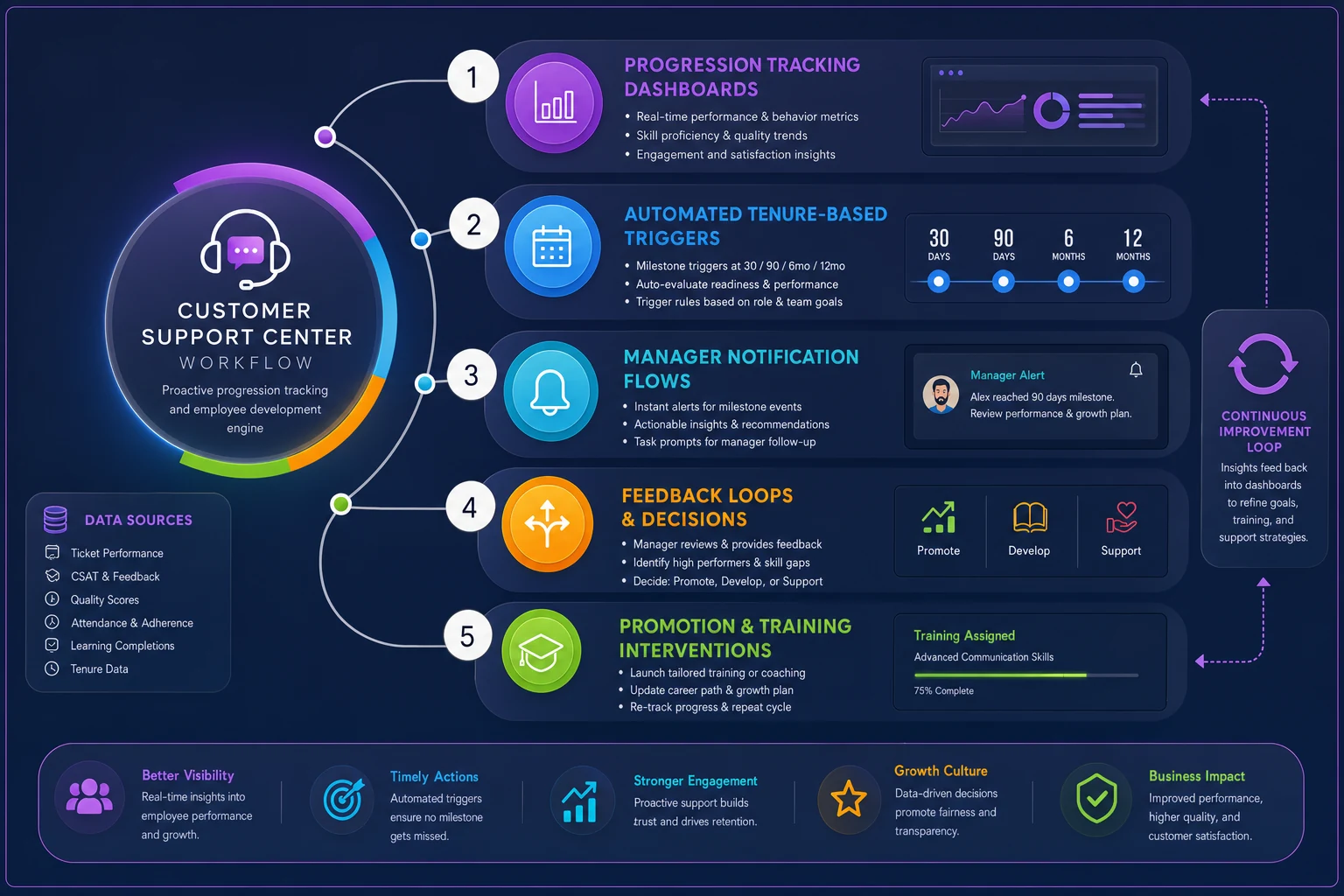
The diagram shows how dashboards, triggers, and automated workflows connect to operationalize progression and interventions.
The compound effect of structured progression
When support career ladders function properly, the operational impact compounds. Experienced agents stop leaving, which reduces recruiting and retraining costs. Institutional knowledge builds instead of walking out the door every few months. Customer experience stabilizes. Quality metrics improve as agents develop real expertise instead of your team constantly restarting from scratch.
The framework also changes how you recruit. Instead of vague promises about "growth opportunities," you present a concrete progression path. Instead of competing on salary alone, you're showing candidates a professional development structure they can actually use. The career ladder becomes a recruiting advantage, not just a retention tool.
Culturally, the shift is meaningful. Support stops feeling like a temporary job people do between real opportunities. It becomes a professional discipline with clear advancement and measurable development. Agents invest in their skills because they see the return. Managers invest in their teams because the framework rewards that behavior.
Support organizations that commit to structured career frameworks—not salary increases, not office perks, just operational clarity around progression—consistently see turnover drop significantly within 12-18 months of implementation. Agents don't need ping-pong tables. They need to see their future.
The path forward requires structure over flexibility, transparency over discretion, and measurement over intuition. Build the framework, embed it operationally, and track it consistently. The results show up in retention numbers, customer satisfaction scores, and a support team that scales with growth instead of fighting against it.
Ready to elevate your customer support?
Join 2,000+ support teams using Helpyly to reduce response times, automate workflows, and deliver outstanding customer experiences.