


Most support teams don't govern their AI. They babysit it.
There's a difference. Babysitting is what happens when a manager reads a few AI-suggested replies each week, winces at one that sounds off, mentions it to the vendor rep, and moves on. Governance is a repeatable system — one that tells you what the model is allowed to do, what it's supposed to disclose, how you check it for fairness, when a human has to step in, and how you prove all of that later when someone asks.
The gap between those two shows up fast once AI moves past the "draft suggestion" phase and starts doing real work: deflecting tickets before an agent sees them, routing based on predicted intent, suggesting refunds, ranking which customers get priority. Every one of those is a decision. And decisions made at volume, without a governance layer, quietly accumulate risk you can't see until a customer, a regulator, or your own legal team surfaces it.
This is a playbook for support AI governance that a real manager can actually run — not a compliance document that lives in a shared drive and gets opened twice a year.
Why "the vendor handles that" is the most expensive assumption in support
The common pattern across support orgs adopting AI goes like this: you buy a suggestion or deflection model, the vendor demos its accuracy, you turn it on for a pilot queue, and governance becomes an unspoken assumption — "the vendor handles that."
They don't. Or more precisely, they handle their obligations: model uptime, general accuracy claims, their own data handling. They don't handle your acceptable-use boundaries, your disclosure obligations to customers, your fairness posture toward specific customer segments, or your audit trail. Those are operational responsibilities that sit inside your team whether you've written them down or not.
What breaks at scale is subtle. In a 6-agent team, an unusual AI suggestion gets caught because everyone reads carefully and the volume is low. Push that same model across 40 agents handling thousands of tickets a week, and the weird cases stop being visible. A deflection model that handles the top intents beautifully might quietly mishandle a narrow category — accessibility-related requests, or customers writing in a second language — and nobody notices because it's 2% of volume buried under a great overall CSAT number.
That's the core governance problem. Aggregate metrics hide the failures that matter most. A model can look 94% helpful and still be systematically worse for the customers you can least afford to fail.
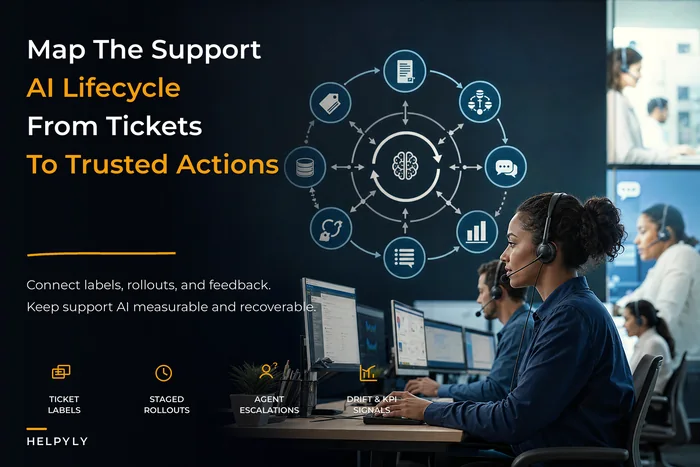
We covered the foundation of where these models sit in the broader system in mapping the operational AI lifecycle for support, and this playbook picks up where that leaves off: once the model is live and making decisions, how do you keep it honest.
The five layers of a support AI governance system
Governance isn't one document. It's five connected layers, and skipping any one of them leaves a hole the others can't cover.
Never let a customer request slip through the cracks.
Helpyly helps you track, resolve, and optimize every support interaction effortlessly.
- Centralized ticket management
- Automated customer notifications
- Performance analytics dashboard
No credit card required
| Layer | Question it answers | Who owns it | Cadence |
|---|---|---|---|
| Acceptable-use policy | What is the model allowed and forbidden to do? | Support ops + legal | Reviewed quarterly |
| Agent-facing disclosure | Do agents know when AI touched a ticket, and how confident it was? | Support ops | Built into tooling |
| Fairness & explainability checks | Does the model perform evenly across customer segments? | QA + analytics | Monthly sampling |
| Human-in-the-loop oversight | When must a person approve, override, or review? | Team leads | Continuous + weekly review |
| Audit & verification | Can we prove what happened, months later? | Support ops | Logged always, audited monthly |
The layers depend on each other. An acceptable-use policy with no audit trail is unenforceable. Human-in-the-loop rules with no explainability mean your reviewers are approving decisions they can't actually evaluate. Governance fails at the seams, not in the middle of any single layer.
We covered the foundation of where these models sit in the broader system in mapping the operational AI lifecycle for support, and this playbook picks up where that leaves off: once the model is live and making decisions, how do you keep it honest.
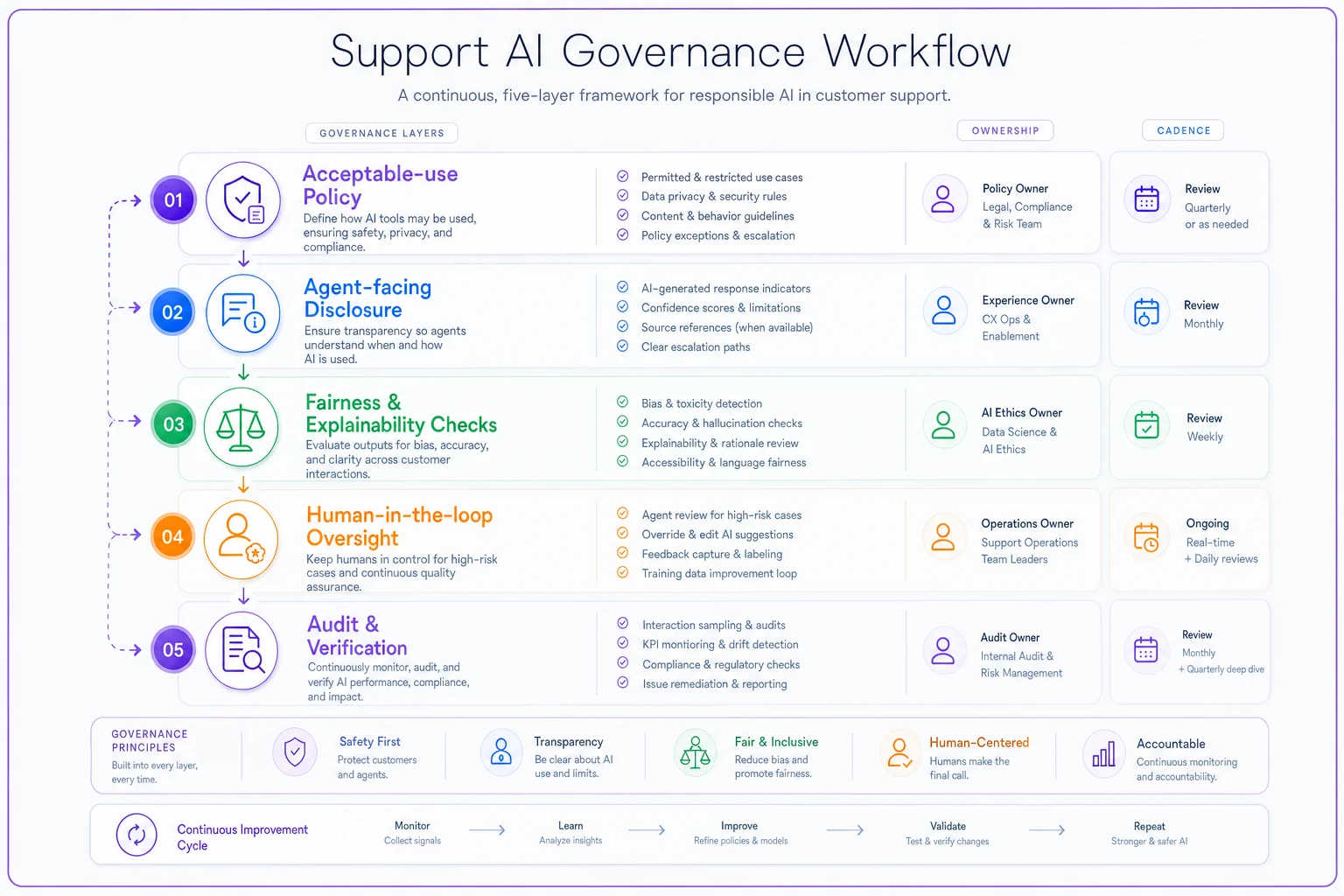
A visual that lays out the five layers and the handoffs makes it easier to assign owners and set cadences.
Layer 1: Acceptable-use policy that agents actually read
Most AI acceptable-use policies are written for lawyers and ignored by the people using the tool daily. A support-specific version needs to be concrete enough that an agent knows, mid-ticket, whether they're allowed to do something.
The useful format isn't a policy essay. It's a permission table your agents can scan. Break every AI capability into three buckets:
-
Green (auto-allowed) Drafting replies for standard how-to questions, suggesting KB articles, summarizing long threads, translating routine responses.
-
Yellow (allowed with human confirmation) Refund suggestions under a set threshold, tone adjustments on sensitive tickets, deflecting a ticket the customer has already replied to once.
-
Red (never automated) Anything touching account termination, legal threats, billing disputes above a threshold, self-harm or safety language, or any request from a customer who has explicitly said they want a human.
The mistake that keeps coming up: teams write the red list and stop. But the yellow list is where governance actually lives, because that's the zone where the model is helpful and dangerous. A refund suggestion model that's right 90% of the time still needs a confirmation gate, because the 10% it gets wrong are exactly the tickets that turn into escalations and chargebacks.
One practical rule that saves a lot of pain: if a customer explicitly asks for a human, that permanently moves the ticket to red for the rest of the conversation. No re-deflection, no "let me suggest an article first." This single rule prevents the most common AI-related complaint — the customer who feels trapped in an automation loop.
Layer 2: Agent-facing disclosures — the part everyone forgets
Almost every disclosure conversation focuses on the customer. Should you tell customers when AI is involved? Usually yes, and depending on your jurisdiction, increasingly required.
-
That the content is AI-generated — not silently pre-filled as if a colleague wrote it.
-
The model's confidence — a rough band is fine (high / medium / low), but the agent must know when the model is guessing.
-
What the suggestion is based on — which KB article, which past ticket, which policy. This is the explainability hook.
The pattern that goes wrong: teams deploy AI suggestions that look identical to human-written text. Agents, under handle-time pressure, send them with a quick skim. Six weeks later, a policy changes, the model keeps citing the old article, and nobody catches it because the agents were never shown why the model said what it said — only what it said.
Confidence disclosure changes agent behavior in a measurable way. When agents can see a "low confidence" flag, edit rates on those suggestions go up sharply — which is exactly what you want. If your tooling doesn't surface confidence, every suggestion gets the same level of trust regardless of how shaky it is, and that's a governance blind spot you're paying for in quality.
Layer 3: Fairness and explainability checks that don't require a data science team
This is the layer support managers dread because it sounds like it needs statisticians. It doesn't. It needs a sampling habit.
The core fairness question for a support model is simple: does it perform evenly across customer segments? Not just overall accuracy — accuracy within slices. The slices that matter most in support:
-
Language / locale (does deflection work for non-native English writers?)
-
Customer tier (are enterprise and free-tier customers getting comparable model quality?)
-
Channel (email vs chat vs social — models often degrade badly outside their trained channel)
-
Ticket sentiment (does the model handle angry customers worse, and does that compound?)
A workable monthly check in plain workflow terms: pull a stratified sample of AI-touched tickets — say 50 per segment — and have QA score them on the same rubric you'd use for a human agent. Then compare resolution quality across segments, not just the average. If one segment is running 15+ points lower than the others, you have a fairness issue regardless of how good the aggregate number looks.
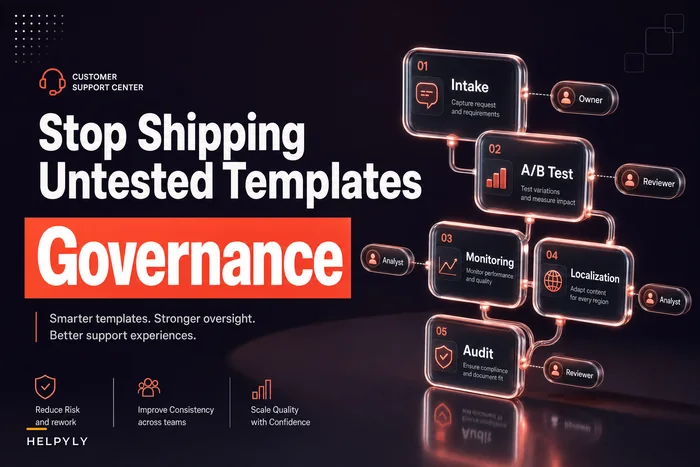
Explainability ties directly in. When a segment scores poorly, you need to be able to ask why the model made those calls. If the answer is "we can't tell, it's a black box," that's a vendor selection problem worth escalating. A model you can't interrogate is a model you can't govern. The same discipline applies to model outputs as it does to template testing — something worth reading alongside this in shipping untested templates and personalization safety checks.
The thing that surprises most managers: fairness problems are almost never intentional. They're artifacts of training data. A deflection model trained mostly on your English-language, mid-tier tickets will be quietly worse everywhere else — and it'll stay that way until someone samples the slices and looks.
Layer 4: Human-in-the-loop oversight cadence
"Human in the loop" gets said constantly and defined almost never. In practice it collapses into one of two useless extremes: a human reviews everything (which kills the efficiency you bought the AI for) or a human reviews nothing (which is what happens by default three weeks after launch when the novelty wears off).
The workable version is tiered oversight tied to the acceptable-use buckets:
-
Green actions No pre-review. Sampled after the fact — pull a small random percentage weekly for QA.
-
Yellow actions Mandatory human confirmation before the action executes. The human approves or edits, and both the model output and the human decision get logged.
-
Red actions The model never acts. It can flag, draft internal notes, or suggest an escalation, but a human owns the outcome entirely.
The cadence is what keeps this alive. A realistic rhythm:
-
Continuous Yellow confirmations happen in real time, in the flow of work.
-
Weekly A lead reviews a sample of green-tier AI actions and all flagged low-confidence cases, looking for drift.
-
Monthly Fairness sampling across segments, plus a review of override patterns — what are agents overriding, and why?
-
Quarterly Acceptable-use policy review against actual usage, plus any policy or regulatory changes.
Track override reasons weekly to detect blind spots early.
That override-pattern review in the monthly step is the most underrated signal you have. When agents consistently override the model in a specific scenario, that's not noise — that's your frontline telling you the model has a blind spot the metrics didn't catch. Teams that track override reasons find problems weeks earlier than teams that only track accuracy. The deeper mechanics of keeping humans genuinely in control — instead of letting AI quietly generate more work — are worth reading in don't let AI create work: governance, fallbacks and audit rules for human-in-the-loop support.
Layer 5: Audit templates and verification checklists
The audit layer is the one nobody wants to build and everybody wishes they'd built the first time legal, a regulator, or an angry enterprise customer asks "what exactly did your AI tell my customer on March 14th?"
If you can't answer that from a log in under ten minutes, you don't have governance. You have hope.
-
Which model version acted
-
What it produced (the actual output, not a summary)
-
Its confidence at the time
-
What it based the output on (source article/policy/ticket)
-
Whether a human reviewed, approved, or overrode it — and who
-
The final action taken
A monthly verification checklist a manager can actually run in an afternoon:
-
[ ] Pull the fairness sample across all defined segments and score it
-
[ ] Confirm all yellow-tier actions in the period had a logged human confirmation
-
[ ] Confirm zero red-tier actions were auto-executed
-
[ ] Review the top 10 override reasons from the month
-
[ ] Check for any suggestions citing deprecated KB articles or old policies
-
[ ] Spot-check 5 low-confidence cases for whether agents actually edited them
-
[ ] Confirm every AI-touched ticket has a complete audit record
-
[ ] Log any policy exceptions or incidents and their resolution
Worth internalizing: audit isn't a punishment you run after something breaks. It's the sampling loop that catches breakage before it becomes an incident. A team running this checklist monthly finds the deprecated-article problem in week four. A team without it finds out from a customer complaint in month three.
A real scenario: the deflection model that looked great and wasn't
A mid-sized SaaS support team — around 25 agents, roughly 8,000 tickets a month — rolled out a deflection model on their chat channel. The dashboard looked excellent: deflection rate climbed to about 30%, and overall CSAT held steady near where it had been.
The problem surfaced through override tracking, not the dashboard. Agents kept manually re-opening deflected chats from a specific segment — customers on their annual enterprise plan writing in from non-US locales. The aggregate CSAT hid it completely because that segment was maybe 6–7% of volume, and their scores were dragged into "fine" by the large, happy self-serve base.
When the team ran a proper fairness sample, the picture was ugly: for that enterprise-international slice, the model was deflecting tickets it had no business deflecting, and resolution quality was running roughly 20 points below the other segments. Their highest-value customers were getting their worst experience.
The fix wasn't complicated. They moved that segment to a "red — never deflect" rule in the acceptable-use policy, added a confidence gate that routed low-confidence deflections straight to a human, and started the monthly slice-sampling habit. Deflection dropped a couple of points overall — a trade they happily made. Re-opens from that segment fell to almost nothing over the following couple of months, and the enterprise renewal conversations stopped opening with complaints about the bot.
Nothing about that outcome required advanced tooling. It required looking at the slices — which is exactly what aggregate metrics train you not to do.
When strict governance makes sense — and when it's overkill
Not every team needs all five layers running at full intensity on day one. Some honesty about proportionality:
When full governance is worth it:
-
You're automating anything with money, legal, or safety implications
-
You operate in a regulated industry or handle sensitive data
-
Your AI is taking actions (deflecting, routing, refunding), not just drafting
-
You're past roughly 15 agents, where aggregate metrics start hiding segment failures
When lighter governance is fine:
-
The AI only drafts suggestions that a human always sends manually
-
Volume is low enough that a human genuinely reviews every AI touch
-
You're in a short, contained pilot with a defined end date and close monitoring
Who should not rush this: teams that haven't yet defined what "good" looks like for their human agents. If you don't have a QA rubric for people, you have nothing to hold the model to. Governance borrows your existing quality standard — build that first, then extend it to the AI.
Bringing the layers together
The teams that govern AI well aren't the ones with the biggest compliance departments. They're the ones who treated their AI the same way they'd treat a new hire with unusual strengths and unpredictable blind spots: clear rules about what it's allowed to do, transparency about what it did and why, regular checks that it's treating every customer fairly, a human owning the decisions that matter, and a record they can point to afterward.
The single biggest governance mistake in support AI is trusting the aggregate number. A model can be great on average and quietly failing the exact customers who cost you the most to lose. Everything in this playbook — the acceptable-use buckets, the confidence disclosures, the slice sampling, the override tracking, the audit log — exists to pull those hidden failures into the light while they're still small enough to fix. Build the sampling habit first. The rest of the system gives that habit something to catch.
The single biggest governance mistake in support AI is trusting the aggregate number. A model can be great on average and quietly failing the exact customers who cost you the most to lose. Everything in this playbook — the acceptable-use buckets, the confidence disclosures, the slice sampling, the override tracking, the audit log — exists to pull those hidden failures into the light while they're still small enough to fix. Build the sampling habit first. The rest of the system gives that habit something to catch.
Ready to elevate your customer support?
Join 2,000+ support teams using Helpyly to reduce response times, automate workflows, and deliver outstanding customer experiences.