
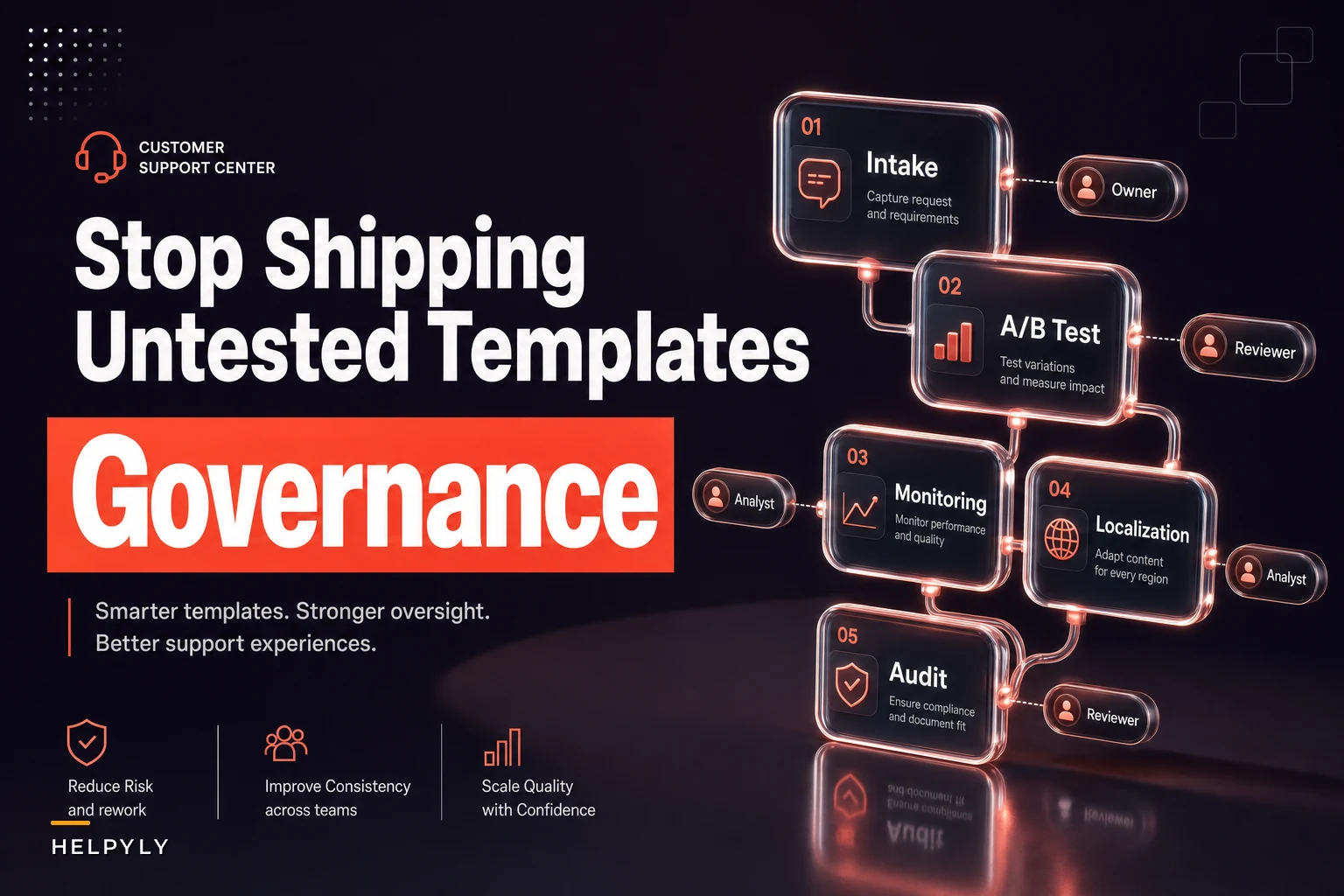

Support teams ship broken templates every day. An agent writes a new macro for refund requests. Nobody tests whether the {{customername}} token actually populates. Nobody checks if the Spanish version matches the English tone. Nobody measures if customers actually understand the message. Three weeks later, a customer screenshots your template with "Hello {{customername}}" in their inbox and posts it on Twitter. The damage compounds. Agents lose confidence in templates and start writing everything from scratch. Response times balloon. Quality gets inconsistent. Meanwhile, your knowledge base has 847 templates—half outdated, many duplicated, most untested. Template governance isn't about controlling agents. It's about building systematic testing that makes templates reliable enough that agents actually want to use them.
The hidden cost of ungoverned templates
Most support teams discover template problems through customer complaints. One enterprise SaaS company had 1,200+ templates across 14 languages. Their wake-up call came when their largest client received an apology template meant for a different product line—complete with competitor pricing accidentally left in from a copy-paste job.
The investigation revealed deeper issues. Agents had created unofficial template variants because the official ones didn't handle edge cases. The localization team translated templates word-for-word, missing cultural context entirely. Nobody tracked which templates actually resolved issues versus generating follow-up tickets. They were running blind experiments on live customers.
Template sprawl creates real operational chaos:
Version confusion: Agents bookmark personal copies of templates, each slightly modified. When the official template updates for compliance reasons, hundreds of outdated versions stay in circulation.
Token failures: Dynamic tokens like {{subscriptionenddate}} work perfectly in test accounts but fail on grandfathered plans with different data structures.
Tone drift: Templates written by senior agents get modified by newer team members who don't understand the original intent. Professional language becomes overly casual. Empathetic phrasing turns robotic.
Localization gaps: Direct translations miss context. A template that says "We'll circle back within 24 hours" translates literally into languages where that phrase means nothing.
The real cost shows up in your metrics. First response time increases because agents don't trust templates. Resolution rates drop because customers need clarification. CSAT scores fall when personalization tokens fail and customers receive obviously automated responses.
Building your experiment framework
Template governance starts with treating every template like a product feature—test before shipping, measure after launch, iterate based on data.
Never let a customer request slip through the cracks.
Helpyly helps you track, resolve, and optimize every support interaction effortlessly.
- Centralized ticket management
- Automated customer notifications
- Performance analytics dashboard
No credit card required
Core experiment structure
Your testing framework needs clear ownership and measurable outcomes.
1. Template intake process
Before any template goes live, it passes through structured validation:
-
Business case (what problem does this solve?)
-
Success metrics (how do we know it works?)
-
Failure conditions (when should agents NOT use this?)
-
Localization requirements (which markets need this?)
2. A/B test design
| Test Element | Control | Variant | Measurement Window | Success Metric |
|---|---|---|---|---|
| Opening line | "Thanks for contacting support" | "I can help with that" | 500 conversations | Time to resolution |
| Closing CTA | "Reply if you need anything else" | "Mark resolved if this helps" | 300 conversations | Reopen rate |
| Tone | Formal professional | Conversational friendly | 1,000 conversations | CSAT score |
| Length | 3-paragraph explanation | Bullet points | 400 conversations | Follow-up questions |
3. Measurement windows
Different template types need different evaluation periods:
-
Password reset
24-hour window (immediate action)
-
Billing explanation
7-day window (customer needs time to check)
-
Feature request response
30-day window (long consideration cycle)
4. Statistical significance
Small sample sizes lie. A template that looks great after 20 uses might fail at scale. Minimum sample sizes depend on your baseline metrics:
-
High-volume templates (>100 daily)
1-week minimum test
-
Medium-volume (10-100 daily)
2-week minimum test
-
Low-volume (<10 daily)
30-day minimum or 200 uses
Good experiment design isn't glamorous work, but it's what separates teams that actually improve their templates from teams that just swap one bad version for another.
Personalization token safety checks
Personalization failures destroy trust fast. A customer named Sarah receiving "Hello [FIRSTNAME]" knows immediately they're just another ticket number. But failures get worse—imagine sending someone's internal account notes in a template because someone used the wrong token.
Token validation framework
Every personalization token needs three layers of protection:
Layer 1: Data availability check
``
IF customer.firstName exists AND length > 0:
   Use {{customer.firstName}}
ELSE:
   Use "there" (generic fallback)
``
Layer 2: Content appropriateness
-
Never include payment amounts in public-facing social media responses
-
Never include email addresses in templates going to shared inboxes
-
Never include one customer's data when replying about general issues
Layer 3: Fallback cascades
When personalization fails, degrade gracefully:
-
Try primary token
{{customer.firstName}}
-
Try secondary token
{{account.companyName}}
-
Try generic friendly
"there"
-
Use formal approach
Remove personalization entirely
Common token failures to prevent
The timezone disaster: A template says "We'll call you at 2 PM" using {{agent.timezone}}. Customer is in Tokyo, agent is in New York. Customer waits up until 3 AM local time.
The currency confusion: Template shows "$500 credit" when the customer pays in euros. The actual credit is €460, but now you've implied more than intended.
The plan mismatch: Template references features from the Enterprise plan. Customer is on Starter. Now they expect features they haven't paid for.
The language mix: Customer writes in Spanish. Agent responds with a template that has English tokens embedded: "Hola {{firstName}}, your refund of {{amount}} has been processed."
Build validation rules for each failure pattern:
| Token Type | Validation Rule | Fallback Strategy | Test Case |
|---|---|---|---|
| Names | Check for special characters, length > 20 | Use "there" or remove | "Princess Consuela Banana-Hammock" |
| Dates | Verify timezone conversion | Show in UTC with timezone label | Customer in DST vs non-DST region |
| Currency | Match customer's billing currency | Show USD equivalent in parentheses | Multi-currency accounts |
| Product names | Confirm customer has access | Use generic "your subscription" | Grandfathered plans |
Most of these failures are preventable with upfront validation logic. The ones that aren't are usually caught fast if you have any kind of monitoring in place—which is exactly why monitoring matters.
Localization variant rules
Translation isn't localization. A perfect word-for-word translation can completely miss cultural context and business norms. Companies have lost entire markets because their templates came across as aggressive in translation when the original English was just direct.
Cultural adaptation framework
Each market needs templates adjusted for local expectations:
Formality levels:
-
Japanese templates need honorific language for customer-facing messages
-
German templates require formal pronouns (Sie) unless the customer explicitly switches to informal
-
American English can be conversational from the first line
-
British English maintains more professional distance initially
Response timeframe expectations:
-
US customers expect "within 24 hours"
-
European customers understand "within 2 business days"
-
Asian markets often expect immediate response or a clear queue position
Apology and accountability patterns:
-
American templates
"We apologize for the inconvenience"
-
Japanese templates
Deep apology even for customer-caused issues
-
German templates
Factual explanation before any apology
-
Latin American templates
Personal responsibility expression
Variant testing methodology
Test localized templates with native speakers AND cultural context experts:
Step 1: Native speaker review
-
Grammar and spelling
-
Natural phrasing
-
Idiom translation
Step 2: Cultural expert review
-
Tone appropriateness
-
Business norm alignment
-
Potential offense points
Step 3: Market-specific A/B testing
-
Test formal vs informal variants
-
Test different explanation depths
-
Test different resolution paths
Step 4: Regional performance tracking
Create separate performance dashboards by region:
-
CSAT by language/region
-
Resolution rate by template variant
-
Escalation rate differences
-
Cultural misunderstanding indicators
Localization is where most teams cut corners because it's slow and expensive. That's usually a mistake. A template that alienates customers in one market can cost more to fix than the localization investment would have been upfront.
Sample experiments with real metrics
Here are three template experiments from actual support operations:
Experiment 1: Refund confirmation clarity
Hypothesis: Customers reopen refund tickets because they don't understand processing time.
Control template: "Your refund has been processed and will appear in your account soon."
Variant template: "Your refund was approved today. Your bank will show the credit in 3-5 business days (weekends don't count). You'll see it by [specific date]."
Results after 1,200 uses:
-
Reopen rate
31% → 8%
-
Follow-up questions
89% reduction
-
CSAT on refund tickets
3.2 → 4.6
Experiment 2: Technical issue acknowledgment
Hypothesis: Customers want immediate validation that their issue is understood.
Control template: Generic "We're looking into this issue" response.
Variant template: Specific repetition of their problem + investigation steps.
Results after 800 uses:
-
Customer replies before resolution
2.3 → 0.9 per ticket
-
"Did agent understand" survey
67% → 94% positive
-
Average handle time
Increased by 45 seconds (acceptable trade-off)
Experiment 3: Feature request responses
Hypothesis: Customers feel ignored when feature requests go into a black hole.
Control template: "Thanks for the suggestion. We'll share with our product team."
Variant template: Detailed explanation of the feature review process, monthly status email opt-in, and similar existing features they might not know about.
Results after 400 uses:
-
Follow-up tickets about the same feature
73% reduction
-
Customer effort score
4.8 → 2.1 (lower is better)
-
Feature request rage-quit rate
12% → 2%
None of these experiments required fancy tooling. A spreadsheet, a consistent measurement window, and clear success criteria were enough.
Measurement windows and statistical significance
Template testing requires patience. A template might look perfect after 50 uses but reveal failures at 500. Setting appropriate measurement windows prevents false positives.
Minimum viable data requirements
High-frequency templates (password resets, order status):
-
Minimum 500 uses or 1 week
-
Check hourly for critical failures
-
Daily metric reviews
-
Statistical significance at 95% confidence
Medium-frequency templates (billing issues, technical problems):
-
Minimum 200 uses or 2 weeks
-
Check daily for issues
-
Weekly metric reviews
-
Statistical significance at 90% confidence
Low-frequency templates (escalations, legal issues):
-
Minimum 50 uses or 30 days
-
Check weekly
-
Monthly metric reviews
-
Directional data acceptable (not always statistically significant)
Early warning signals
Some problems need immediate action, not statistical significance:
-
Personalization token failing more than 5% of the time
-
Customer explicitly mentioning the template in a complaint
-
Legal or compliance language errors
-
Major tone misalignment with brand
Create automatic flags for these issues:
``
IF templatecomplaintmentioned = true
   OR tokenfailurerate > 0.05
   OR compliancekeyworddetected = true
THEN immediatereviewrequired
``
The goal isn't to wait for perfect data before acting. It's to know the difference between a pattern worth fixing and noise worth ignoring.
When to break your own rules
Template governance shouldn't become template prison. Sometimes you need to move fast.
Break the testing rules when:
-
Legal or compliance requires immediate changes
-
A security incident needs customer notification
-
A major outage needs status updates
-
A PR crisis needs a coordinated response
Don't break the rules for:
-
Agent preference without supporting data
-
A single customer complaint without a pattern
-
Cosmetic changes that don't affect meaning
-
A regional manager wanting things done their way
Emergency template protocol:
-
Document why you're bypassing normal process
-
Set a review date within 48 hours
-
Track performance more closely than usual
-
Prepare a rollback plan
-
Notify all stakeholders of the temporary template
The distinction matters because "we need to move fast" becomes a catch-all excuse if you don't define what actually qualifies. Most urgent template changes aren't actually that urgent.
Building your governance operations
Template governance needs operational infrastructure, not just good intentions. Small teams start with spreadsheets. Larger operations need proper tooling. The key is starting somewhere.
Minimum viable governance
Even a 5-person support team needs basic governance:
Weekly template review (30 minutes):
-
Which templates did agents skip?
-
Which templates generated complaints?
-
Which templates need updates?
Monthly metrics review (1 hour):
-
Template usage rates
-
Performance by template category
-
Agent feedback themes
-
Customer satisfaction correlation
Quarterly template audit (half day):
-
Remove unused templates
-
Consolidate duplicates
-
Update outdated information
-
Plan next quarter's experiments
Scaling governance operations
10-25 agents: Part-time template coordinator (around 10 hours/week)
-
Manages experiment calendar
-
Collects agent feedback
-
Runs basic A/B tests
-
Maintains template library
25-100 agents: Full-time governance role
-
Designs comprehensive experiments
-
Analyzes performance data
-
Coordinates with localization
-
Trains agents on new templates
100+ agents: Governance team
-
Template governance manager
-
Localization coordinator
-
Data analyst for experiments
-
Technical writer for template creation
The investment pays for itself. One enterprise reduced average handle time by just over 2 minutes per ticket after implementing template governance. With 50,000 monthly tickets, that's roughly 1,900 hours saved—around $68,000 monthly in agent costs. That math is hard to argue with.
Here's a quick workflow diagram showing how templates move from intake to A/B testing to localization and auditing.
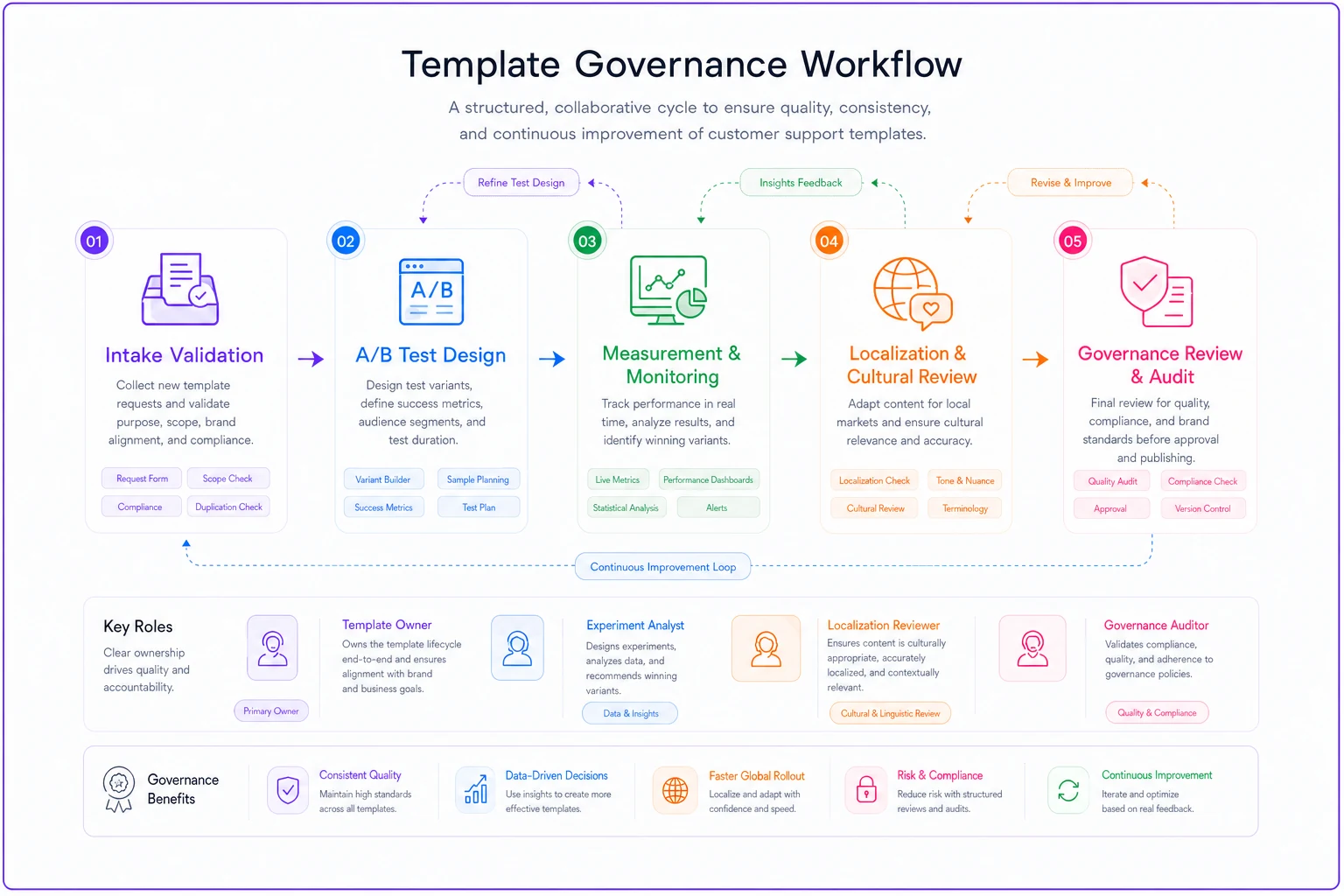
Start small and iterate on the workflow above as you scale.
Integration with your existing operations
Template governance can't exist in isolation. It needs to connect with your other operational systems.
Connect governance with your agent onboarding process. New agents should learn about template testing during training, not after they've developed bad habits. Include template usage in competency assessments.
Your ticket routing system should factor in template availability. If only senior agents have access to certain templates, route appropriate tickets accordingly. Track which agent skills correlate with successful template usage.
Template performance data feeds back into your knowledge base, agent training, and even product development. When templates consistently fail to resolve certain issues, that usually signals a deeper problem—and no amount of template tweaking will fix it. That's useful information to surface early rather than paper over with another template variant.
The path forward
Most support teams will read this and think "we should do this someday." The teams that actually implement template governance see improvements fast. Start with one high-volume template. Run one simple A/B test. Measure one clear metric.
A subscription box company started with just their cancellation template. They tested eight variants over two months. The winning version reduced save attempts from 4.2 to 1.8 per cancellation while actually improving save rates. Agents stopped dreading cancellation conversations. Customers stopped complaining about aggressive retention tactics.
Template governance isn't about perfect process. It's about systematic improvement. Every tested template makes your support operations slightly better. Every caught token failure prevents a frustrated customer. Every localization review respects your global audience.
The alternative is hoping your untested templates don't blow up on social media—and hope isn't an operational strategy. Pick your highest-volume template, design a simple A/B test, set a two-week measurement window, and start fixing your template chaos before it fixes you.
Ready to elevate your customer support?
Join 2,000+ support teams using Helpyly to reduce response times, automate workflows, and deliver outstanding customer experiences.