


Most support orgs don't fail at handling tickets. They fail at everything that happens after a ticket needs someone else. A customer reports a billing bug that turns out to be a refund policy problem, which turns out to be a compliance exposure, which finance needs to reconcile — and by the time it's touched four teams, nobody owns the outcome and the customer is emailing for the third time.
That gap between "support did its part" and "the problem is actually closed" is where money and trust leak out. Not because people are lazy — because there's no shared operating agreement about who owns what, what evidence has to travel with the work, how often teams sync, and how anyone verifies the loop closed.
This is the part almost nobody writes down. Support gets a runbook. Product gets a backlog. Legal gets a queue. Finance gets a spreadsheet. But the seams between them run on tribal memory and Slack pings. That works at 200 tickets a week. At 2,000 it quietly falls apart.
Why the seams break before the teams do
Individual teams can each be performing fine while the cross-functional system is failing. Support hits its SLA. Product ships fixes. Legal reviews what lands in its queue. Yet customers still churn on issues that "were handled."
Each team optimizes for its own definition of done, and those definitions don't line up.
-
Support's "done" = ticket resolved or escalated.
-
Product's "done" = code merged.
-
Legal's "done" = reviewed and cleared.
-
Finance's "done" = adjustment posted.
-
Security's "done" = no active exposure.
None of those definitions includes the customer's problem is verifiably gone and won't come back. That outcome lives in the space between the teams, and space between teams is nobody's job unless you make it somebody's job.
In practice this shows up as the "resolved-but-not-really" ticket. Support closes it because they did what they could. Three weeks later the same customer reopens, or twelve other customers hit the same thing and support treats each as new. The org is now paying to rediscover a problem it already found.
The failure scales nonlinearly. Double the volume and handoff failures more than double — more concurrent cross-team threads, more context that needs to be reconstructed, more chances for something to sit in a queue with no owner.
What actually breaks at scale
Ownership evaporates at the boundary. A ticket gets flagged for legal review and moves into a shared inbox. Support assumes legal has it. Legal assumes it's still being triaged. It sits for nine days. Nobody was wrong; nobody owned it.
Never let a customer request slip through the cracks.
Helpyly helps you track, resolve, and optimize every support interaction effortlessly.
- Centralized ticket management
- Automated customer notifications
- Performance analytics dashboard
No credit card required
Evidence gets stripped in transit. Support has the reproduction steps, the customer's plan tier, the affected region, the screenshots. It hands the issue to product with two sentences. Product asks for the details support already had. Now you've got a round trip that adds days and irritates everyone.
Meetings become theater or disappear entirely. Either there's a weekly cross-functional sync where 14 people watch two people talk, or there's no cadence at all and everything happens in ad-hoc DMs that leave no record.
Nobody verifies the fix from the customer's side. Product marks the bug fixed. Did support confirm the original customer is unblocked? Did finance confirm the wrongly-charged accounts were credited? The verification step is usually assumed, not performed.
Audit trails are reconstructed after the fact. When legal or security needs to know "what did we tell customers and when," support scrapes it together from memory and screenshots. Fine until it isn't — and when it isn't, it's a very bad day.
The common thread: these aren't knowledge problems. Everyone knows handoffs should be clean. They're structural problems. The operating model doesn't enforce the behavior, so under pressure the behavior degrades.
The single operating charter
The fix isn't more meetings or more tools. It's one document that every team signs — a support operating model governance charter that defines four things and enforces a fifth.
-
RACI for every cross-functional workflow — who's Responsible, Accountable, Consulted, Informed for each type of escalation.
-
Evidence contracts — the minimum information that must travel with a handoff before the receiving team is obligated to act.
-
Meeting cadences — what syncs exist, who owns them, and what decision each one produces.
-
Audit checks and verification rules — how you prove the loop actually closed.
The fifth thing it enforces is the closed loop: nothing is "done" until the originating problem is verified resolved from the customer's side.
RACI that survives contact with reality
Most RACI charts are useless because they're built for org-chart neatness, not for the messy reality of who actually does the work. The trick is to build RACI per workflow type, not per team.
A billing-dispute-with-compliance-flag is a different workflow than a reproducible-bug-affecting-enterprise-tier, and they need different owners. Writing one RACI for "escalations" produces something so generic it gets ignored.
A compact version of what workflow-level RACI looks like across a few common cross-functional situations:
| Workflow | Responsible | Accountable | Consulted | Informed |
|---|---|---|---|---|
| Reproducible product bug | Support engineer | Product PM | Support lead | Finance (if refund exposure) |
| Billing dispute + policy question | Support agent | Finance ops | Legal | Support lead |
| Suspected data exposure | Security on-call | Security lead | Legal, Support lead | Product, Finance |
| Regulatory / disclosure question | Support lead | Legal | Product | Finance |
| Bulk refund / credit event | Finance analyst | Finance lead | Support lead, Legal | Product |
Here's a simple workflow diagram for a cross-functional escalation.
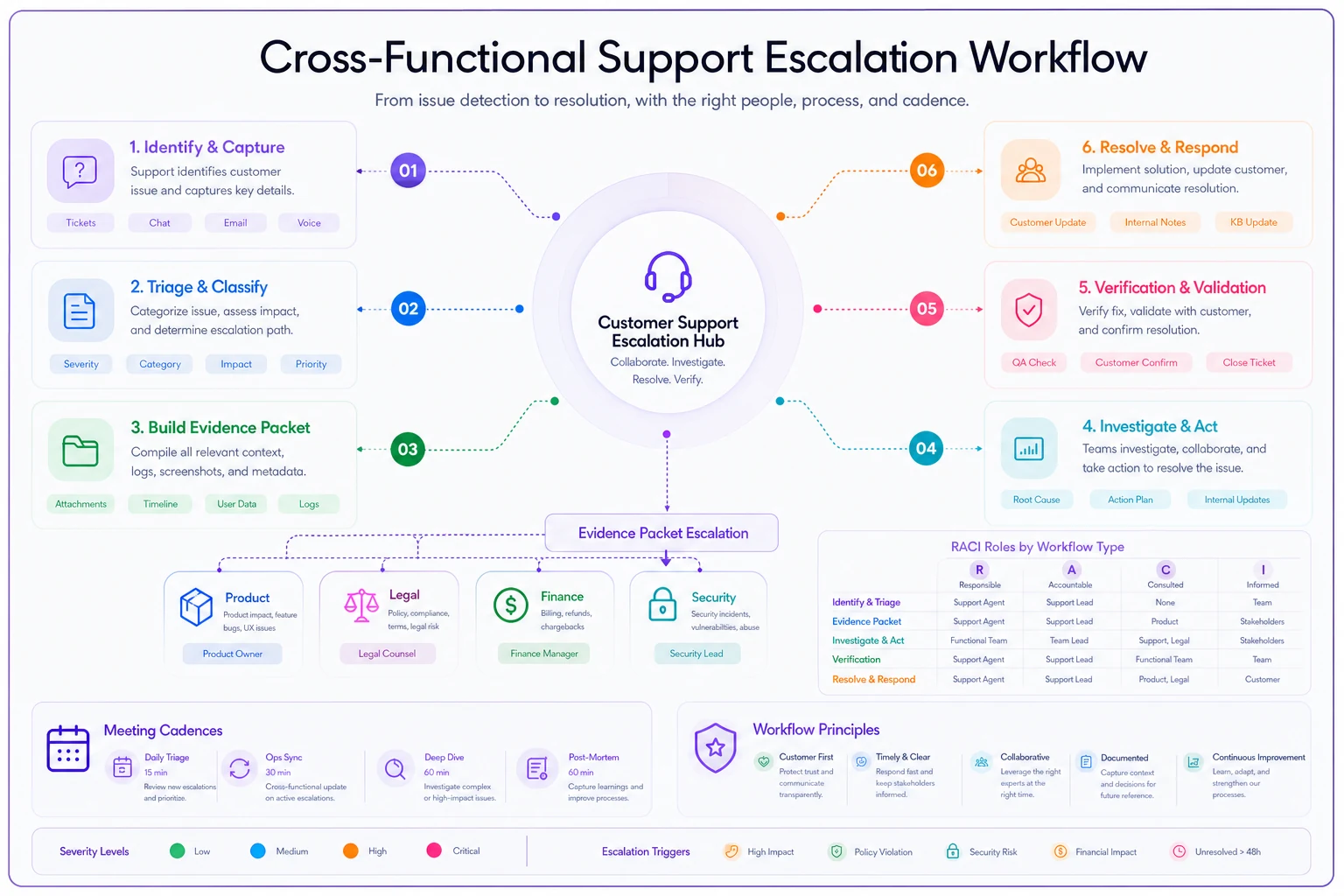
The single most important column is Accountable — and the rule is exactly one name per row. The moment two people are accountable, nobody is. If a workflow's Accountable owner isn't obvious, that's a signal the workflow isn't actually understood yet.
Evidence contracts: the part that saves the most time
An evidence contract is the agreement that a handoff isn't valid — the receiving team isn't on the hook — until a defined evidence packet arrives. This stops the endless "can you send me the details" round trips, and it forces the sending team to do the diagnostic work upfront instead of lobbing a half-formed problem over the wall.
Different receiving teams need different packets:
-
To product reproduction steps, affected version/build, customer plan tier, frequency (how many tickets), business impact, and whether it's a regression or something new.
-
To legal the exact customer wording, what support has already said, the policy or clause in question, jurisdiction, and any deadline.
-
To finance account IDs, amounts, date range, root cause of the discrepancy, and number of affected accounts.
-
To security what data, how many records, exposure window, detection method, and whether it's still active.
This connects directly to work support teams should already be doing on the product side. If you've built a clean reproducible-bug handoff process, the evidence contract for product is basically already written — you're just making it mandatory rather than aspirational. The same logic underpins how support and product close the loop with an operational contract: the contract only works when the evidence requirement is enforced, not requested.
Teams resist evidence contracts at first because they feel like extra bureaucracy on the sending side. In practice the sending team wins the most — they stop getting bounced tickets back with "need more info." The friction moves from the middle of the process, where it's expensive, to the front, where it's cheap.
Meeting cadences that produce decisions, not updates
A cadence is only worth the calendar space if it produces a decision or a state change. Status readouts belong in a doc, not a meeting.
A workable set of cadences for a mid-sized support org connecting to four other functions:
-
Daily (15 min, support + product on-call) triage anything flagged critical in the last 24 hours, assign the Accountable owner, nothing else.
-
Weekly (30 min, support + finance) reconcile open billing/refund threads, confirm what's been posted vs. pending.
-
Biweekly (45 min, support + legal) review the compliance-flagged queue, deprecation of outdated disclosures, anything with a deadline.
-
Monthly (60 min, all functions) review closed-loop metrics — what got "resolved" but reopened, where evidence contracts were skipped, which workflows lost their owner.
The monthly is the governance meeting. It's the only place the system gets inspected rather than individual tickets. Skip it and the charter slowly rots, because nobody notices the small violations until they've become the norm.
Audit checks and verification rules
This is the enforcement layer, and it's the piece most orgs skip entirely. Verification rules answer one question: how do we know the loop actually closed?
Concretely:
-
Support-side verification the originating customer is contacted and confirms resolution before the ticket moves to a terminal state. Not "we deployed a fix" — "the customer says it works."
-
Finance verification for any refund/credit workflow, a second person confirms the amount posted matches the amount owed, across all affected accounts, not just the reporting one.
-
Legal verification anything customer-facing that legal touched is logged with the exact language and timestamp, so the audit trail exists before you need it, not after.
-
Security verification exposure is confirmed closed and the detection gap that let it through is documented.
For legal specifically, this ties directly into building review into the workflow rather than bolting it on. If you've already worked on how to embed legal review into support workflows with compliance flags and evidence requirements, your verification rules for the legal lane are mostly a matter of making the evidence and logging automatic instead of manual.
A real scenario: the refund that touched four teams
A B2B SaaS company doing roughly 1,400 support tickets a month had a recurring pattern: a pricing change had been applied incorrectly to a subset of annual accounts. Support saw the individual complaints. Each agent handled their ticket, issued a case-by-case credit, and moved on.
Nobody connected the tickets. Over about six weeks, support issued credits to maybe 40 accounts one at a time — while there were closer to 130 affected accounts that hadn't complained yet. Finance didn't know the full scope. Legal didn't know there was a disclosure question about the overcharge. The "resolution" was happening one leaky bucket at a time.
Once they put a charter in place, the same class of issue got handled differently. A billing discrepancy flagged with a compliance concern triggered the defined workflow: finance owned it, legal was consulted, support was informed, and the evidence contract required the full count of affected accounts before anyone posted a single credit. Finance ran the query once, found all 130-odd accounts, and issued corrections in one batch. Legal reviewed the customer notification language once. Support sent one consistent message.
The before-and-after that mattered wasn't the credit amount — it was the rework. The uncoordinated version consumed somewhere around 60–80 support hours across six weeks in repeated diagnosis, plus finance re-work, plus the risk of an inconsistent story reaching customers. The coordinated version closed the whole thing in under two weeks with a fraction of that labor and left a clean audit trail.
The lesson isn't "batch your refunds." It's that the charter surfaced the pattern that the ticket-by-ticket process was structurally blind to.
When this makes sense — and when it's overkill
This makes sense when:
-
You're regularly handing tickets to three or more other functions.
-
"Resolved" tickets reopen or duplicate at a meaningful rate.
-
Something touching legal, finance, or security has already burned you, or nearly did.
-
Volume is climbing and the informal coordination that worked last year is visibly straining.
This is overkill when:
-
You're small enough that everyone's in one channel and handoffs are a tap on the shoulder.
-
Your escalations almost never leave support.
-
You'd spend more time maintaining the charter than the coordination costs you today.
A five-person support team handling a single simple product doesn't need workflow-level RACI. Writing one creates ceremony that outweighs the problem. The charter is a scale response, not a starting point — introduce it when the seams start showing, not before.
Building it without turning it into a binder nobody reads
The failure mode of governance is that it becomes a document written once, celebrated, and never opened again. Keep it thin and make the enforcement live where the work happens.
A practical sequence to stand it up:
-
Map your top five cross-functional workflows — the ones that actually recur. Ignore the edge cases for now.
-
Assign one Accountable owner per workflow. If you can't, that workflow isn't understood; fix that before moving on.
-
Write the evidence contract for each receiving team. Keep it to the minimum that prevents round-trips.
-
Set the cadences and, for each, define the one decision it exists to make.
-
Define verification rules — the specific proof that each workflow's loop closed.
-
Run it for one month, then inspect it in the monthly governance meeting and cut whatever nobody used.
A quick checklist to sanity-check whether your charter is real or decorative:
-
Every recurring cross-functional workflow has exactly one Accountable owner.
-
No handoff is accepted without its evidence packet.
-
Every meeting on the calendar produces a decision, not a status update.
-
"Resolved" requires customer-side confirmation, not just an internal fix.
-
Refund/credit events verify all affected accounts, not just the reporting one.
-
Legal-touched customer language is logged automatically with timestamps.
-
The monthly review actually inspects skipped contracts and orphaned workflows.
If you can't check most of those, you don't have governance yet — you have good intentions with a nice diagram.
Where an operational platform earns its place here is in making enforcement automatic rather than dependent on people remembering. Evidence contracts as required fields before a handoff can proceed, verification steps that block a ticket from closing until confirmed, audit logs that write themselves, ownership that routes based on workflow type — those are exactly the checks that quietly degrade when they live only in a document. The charter defines the rules; the platform's job is to make skipping them harder than following them.
The real point
The teams around support are usually fine. Product ships, finance reconciles, legal reviews, security responds. What breaks is the connective tissue — the handoffs, the evidence that should travel with them, the verification that the customer's problem is genuinely gone.
A support operating model with real governance doesn't add process for its own sake. It turns the boundaries between teams into defined, owned, verifiable seams instead of hopeful gaps. Once you can see the loop — who owns it, what evidence moved, whether it actually closed — the failures that used to hide in the spaces between teams stop being invisible. That visibility, more than any single rule in the charter, is what changes the outcomes.
A support operating model with real governance doesn't add process for its own sake. It turns the boundaries between teams into defined, owned, verifiable seams instead of hopeful gaps. Once you can see the loop — who owns it, what evidence moved, whether it actually closed — the failures that used to hide in the spaces between teams stop being invisible. That visibility, more than any single rule in the charter, is what changes the outcomes.
Ready to elevate your customer support?
Join 2,000+ support teams using Helpyly to reduce response times, automate workflows, and deliver outstanding customer experiences.