


Most support orgs don't have a knowledge problem. They have an ownership problem dressed up as a knowledge problem.
The pattern that shows up constantly: a team stands up a knowledge base, seeds it with 200 articles, and celebrates. Eighteen months later there are 900 articles, half of them stale, three of them describing the same refund flow in contradictory ways, and nobody can tell you who's responsible for any of them. When a customer gets the wrong answer, the post-mortem lands on "the KB was out of date"—as if the KB is a weather system that just happens to you.
It doesn't just happen to you. Knowledge decays because no one is actually on the hook for it in any way that shows up in a performance review. An enterprise knowledge strategy that holds together treats knowledge the same way finance treats inventory or engineering treats services: something with owners, service levels, a cost of neglect, and a return you can measure. This article is about the operational scaffolding that makes that real—ownership tiers, cross-team SLAs, incentives that don't backfire, and the ROI math that gets you budget.
Why knowledge rots the moment you scale past one team
At small scale, knowledge ownership is implicit and it mostly works. Twelve agents, one senior person "owns" the KB in the sense that they wrote most of it and remember what's wrong. Institutional memory carries you. The articles are imperfect but tribal knowledge fills the gaps.
Then you double headcount, add a second product line, split into tiers, open a second site in another timezone. The implicit model breaks in a specific way: the person who knew things is now managing, the people writing articles don't have context on why a policy exists, and the folks consuming articles have no idea which ones to trust. Tribal knowledge doesn't scale, and once you rely on it past a certain size, every gap turns into a misresolution.
-
Authorship without accountability. Anyone can create an article. No one is required to keep it correct. Creation is rewarded (it feels productive); maintenance is invisible.
-
No source of truth between teams. Product knows a feature changed. Support finds out from an angry ticket. Legal updated a disclosure requirement in a Slack thread that three people saw.
-
Silent staleness. Articles don't announce when they go wrong. A policy changes, the article doesn't, and the only signal is a slow rise in reopens and a few QA fails nobody connects to the root cause.
The deeper issue is that knowledge sits between teams—support, product, legal, ops—and anything that lives between teams belongs to everyone, which means it belongs to no one. That's the gap an ownership model exists to close.
Ownership tiers: who is actually on the hook
The fix isn't "assign an owner to every article." That's how you get a spreadsheet with 900 rows and a name next to each one that everybody ignores. Ownership has to be tiered, because different knowledge carries different risk and different decay rates.
Never let a customer request slip through the cracks.
Helpyly helps you track, resolve, and optimize every support interaction effortlessly.
- Centralized ticket management
- Automated customer notifications
- Performance analytics dashboard
No credit card required
-
Domain owner — owns a body of knowledge (billing, returns, a product area). Accountable for whether that whole area is accurate and complete. Usually a lead or senior IC. One person, not a committee.
-
Article steward — owns individual articles day-to-day. Writes, updates, responds to review triggers. Can be an agent who knows the topic cold.
-
Approver / gatekeeper — signs off on high-risk content before it goes live. For anything touching money, legal, or security, this is often outside support entirely.
Then you tier the content by blast radius, because that determines how much governance each piece deserves.
| Tier | Content type | Owner | Review cadence | Change control |
|---|---|---|---|---|
| Tier 1 – Critical | Refunds, billing, legal disclosures, security, data handling | Domain owner + named approver | Every 30–45 days, plus event-triggered | Approval required, change logged |
| Tier 2 – Operational | How-to flows, troubleshooting, common policies | Article steward, domain owner reviews | Quarterly, plus triggers | Steward can edit, owner notified |
| Tier 3 – Informational | FAQs, low-risk explainers, edge cases | Article steward | Twice a year or on signal | Open editing |
Here's a simple diagram of the ownership workflow.
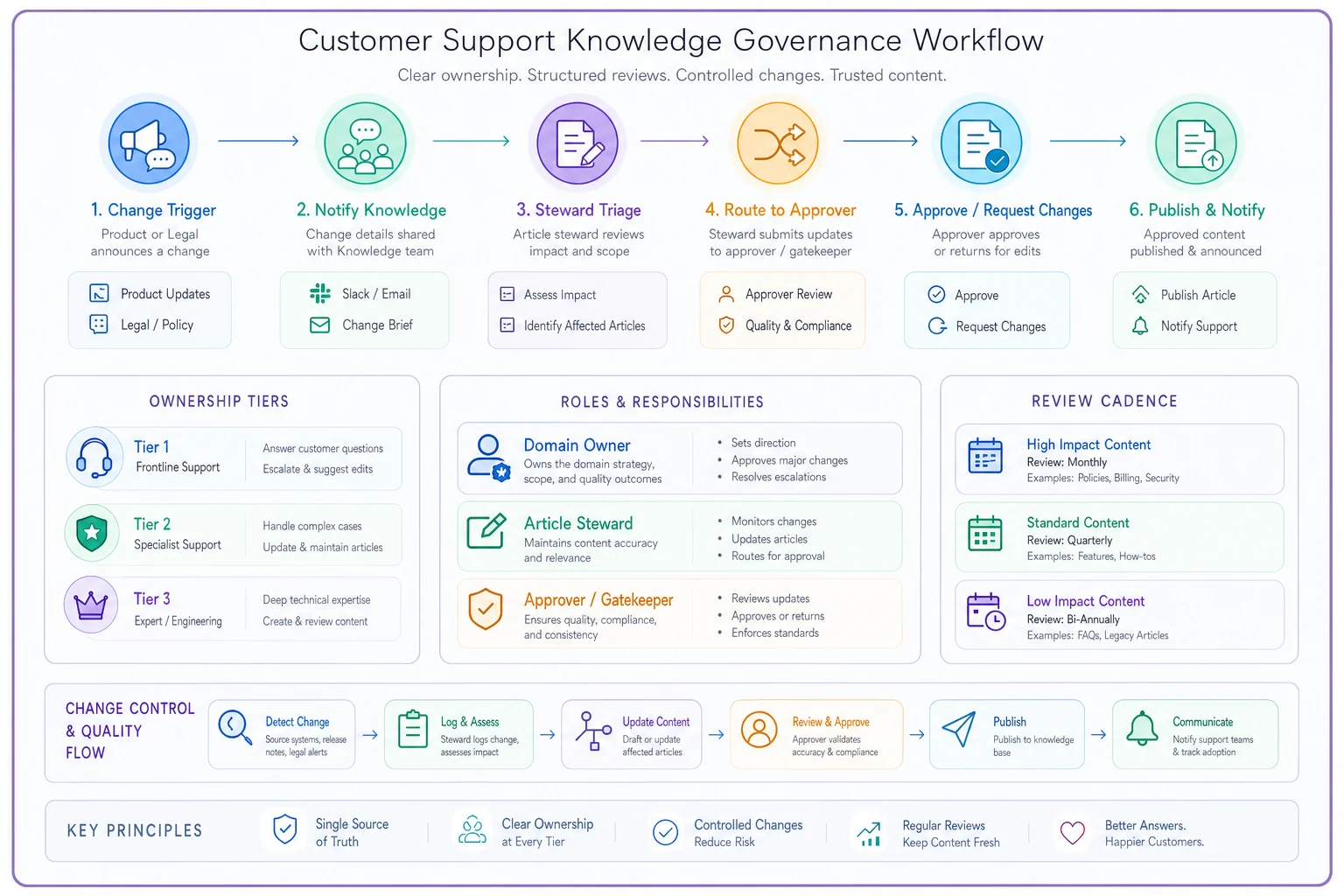
The mistake almost everyone makes is applying Tier 1 rigor to everything. You end up with an approval queue so slow that people route around it—updating a troubleshooting doc becomes a two-week project, so agents keep private notes instead, and now your "single source of truth" is competing with forty personal Google Docs. Match the governance weight to the risk, or people will quietly opt out.
Cross-team SLAs: the part that actually determines whether this works
Support can own the shelf, but it can't own the content for things it doesn't control. When a product feature changes, support isn't the source of truth—product is. When a compliance rule changes, legal is. If your knowledge strategy assumes support will magically find out about these changes, it's already broken.
This is where you need actual service-level agreements between teams, not inside support. The most valuable one is a simple commitment: when your team ships a change that affects customer-facing behavior, you tell knowledge owners before it goes live, within a defined window.
A realistic set of cross-team SLAs looks like:
-
Product → Knowledge any change to a customer-facing flow gets a heads-up with a 3–5 business-day lead time, tagged to the affected knowledge domain. This is the same discipline behind closing the loop between support and product—the knowledge version of a reproducible-fix contract.
-
Legal/Compliance → Knowledge any disclosure, policy, or regulatory change flags the affected Tier 1 articles and names a deadline for the update to be live.
-
Knowledge → Support floor once an article is updated on a material change, agents get a change note in-channel within 24 hours—not buried in a wiki changelog they never open.
The SLA that gets skipped most often is the reverse direction: support → the rest of the org. Support sees emerging problems first. There should be a committed path for "we're seeing a spike in confusion about X" to reach the domain owner and the upstream team fast, with a response-time expectation attached. Without it, knowledge stays reactive and you're always documenting yesterday's fire.
Attach SLAs to events, not calendars—event triggers produce updates when they matter.
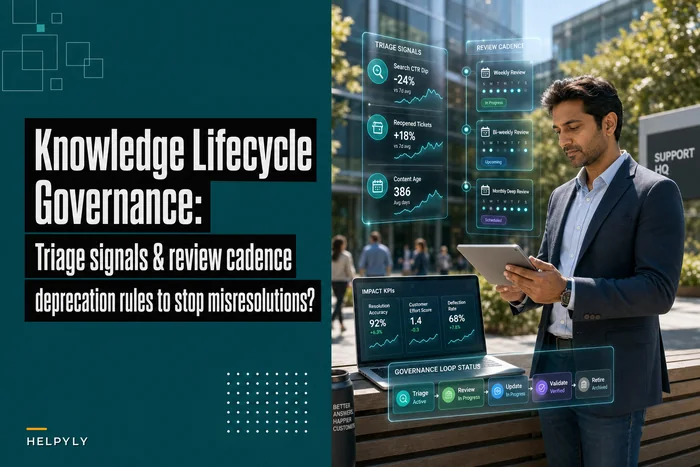
One pattern worth borrowing: attach SLAs to events, not calendars. "Review every article quarterly" produces box-checking. "Any Tier 1 change triggers a 48-hour review of linked articles" produces actual updates when they matter. Calendar reviews are a backstop; event triggers are the real engine. This connects directly to the mechanics in knowledge lifecycle governance—the triage signals and deprecation rules are what make event-driven review possible instead of aspirational.
Incentives: why owner contracts fail without them
You can assign owners and write SLAs and still watch the whole thing rot, because maintaining knowledge competes with everything else on a person's plate and it's the one thing with no visible customer waiting. Nobody escalates a stale article the way they escalate an angry VIP.
So incentive design matters more than the org chart. A few things that work, and a few that backfire:
-
Putting knowledge-ownership metrics into the same review as ticket metrics, with real weight. If your senior agents are measured 100% on handle time and CSAT, they will always deprioritize article upkeep—and honestly, they'd be rational to.
-
Rewarding deflection, not authorship. An article that quietly resolves 400 searches a month is worth more than ten articles nobody reads. Measure impact, credit the steward.
-
Giving domain owners a small, protected time budget—a few hours a week explicitly for knowledge work, not squeezed from ticket capacity. Ownership without protected time is a title, not a job.
-
Rewarding article volume. You get 900 articles and a discoverability nightmare. Volume incentives are how KBs become landfills.
-
"Contribution" leaderboards. They drive noise—duplicate articles, low-value FAQs—and punish the person who deprecates fifty stale docs even though that's often the highest-value work.
-
Making knowledge a pure volunteer effort on top of a full queue. It will lose every single time to the work that has a customer attached.
The concept that ties this together is an owner contract—a short, explicit agreement for each domain owner spelling out what they're accountable for, what SLAs apply, what protected time they get, and how it shows up in their review. Not a legal document. A one-pager that turns "you kind of own billing knowledge" into something with edges. When people leave or reorgs happen, the contract transfers; the accountability doesn't evaporate.
Measuring the ROI so knowledge stops being a cost center
Knowledge work loses budget fights because it's framed as overhead. Flip that. Knowledge is a deflection engine, and deflection has a dollar value you can defend.
Two metrics worth anchoring to:
-
Deflection — how many potential contacts a piece of knowledge resolves before a ticket is created. Approximate it with search sessions that end without a ticket, self-service resolution rates, and article-to-ticket ratios for a given topic.
-
First-contact resolution (FCR) — for tickets that do come in, how often the agent resolves it in one touch, which correlates directly with whether the underlying article is accurate and findable.
A grounded example. A mid-sized SaaS support team—around 25 agents, roughly 14k–16k tickets a month—found that their top three "how-to" topics were generating close to 1,800 tickets monthly between them, with articles that were technically present but outdated and buried. After assigning a domain owner, rewriting the three flows, and wiring an event trigger so the articles updated whenever the product changed, ticket volume on those topics dropped by roughly a third over two quarters. Call it 550–650 fewer tickets a month. At a loaded cost-per-ticket somewhere in the $6–$9 range, that's around $4k–$5k a month recovered—not from a heroic rewrite, but from ownership plus a trigger so it stopped rotting again.
Notice the two-part effect. The rewrite got the one-time drop. The ownership model kept it from creeping back, which is where most "we fixed the KB" projects fail—they fix the content once and skip the accountability, so decay resumes on day one.
To make the ROI honest, track a small, boring set of numbers per domain rather than a vanity dashboard:
-
Ticket volume on the domain's top topics (trend, not snapshot)
-
Deflection rate / article-to-ticket ratio for those topics
-
FCR and reopen rate on tickets in the domain
-
Percentage of Tier 1 articles within their review cadence
-
Time-to-update after an upstream change fired an SLA
That last one is the leading indicator everyone ignores. If your time-to-update on Tier 1 changes is measured in weeks, the misresolution rate is a lagging consequence you haven't seen yet.
The governance artifacts you actually need
You don't need a governance program with a steering committee and a charter. You need a handful of artifacts that make ownership legible and reviews automatic. Keep it to what people will actually use:
-
Domain ownership map — every knowledge domain, its owner, approver, and current health status. One page. Reviewed when people change roles.
-
Owner contracts — the per-domain one-pagers described above.
-
Cross-team SLA sheet — the commitments between product, legal, and knowledge, with lead times and response windows written down where both sides can see them.
-
Review cadence calendar + trigger rules — when calendar reviews happen and which events force an off-cycle review.
-
Change log — for Tier 1 especially
what changed, who approved, when it went live. This is your audit trail when a compliance question shows up.
-
Deprecation policy — the rules for retiring content, so the KB shrinks as often as it grows.
The single most underrated artifact is the deprecation policy. Everyone builds the "how do we add and update" side and nobody builds the "how do we delete" side, which is exactly why KBs bloat into unsearchable messes. A domain with 40 sharp, current articles beats one with 200 where a third are wrong. Deleting is knowledge work too—arguably the highest-leverage kind.
Where the tooling fits (and where it doesn't)
None of this requires exotic software, and buying a platform before you've defined ownership just gives you a nicer-looking mess. The model comes first. That said, once the model exists, a few things are painful to run manually and worth systematizing.
Event-driven review is one. Manually noticing that a product change should trigger an article review is exactly the kind of thing humans forget under load—which is why operational platforms that can watch for upstream change signals, flag the linked Tier 1 articles, and route them to the right owner with a deadline attached tend to be where the model stops leaking. Same with staleness detection: surfacing articles whose linked-topic ticket volume is climbing while the article hasn't been touched in six months is a signal humans won't catch scanning a wiki, but a system tracking article-to-ticket ratios will. The point isn't automation for its own sake—it's closing the gap between "an update is needed" and "an owner was actually told," which is where knowledge quietly dies.
Use tooling to enforce the cadences and surface the signals. Keep the judgment—what's accurate, what's risky, what to deprecate—with the owners. Systems that try to auto-generate or auto-approve Tier 1 content are how you get confidently wrong refund policies live in production.
When this level of rigor makes sense—and when it's overkill
When it makes sense:
-
You're past roughly 20–30 agents, or you have multiple teams and timezones touching the same knowledge.
-
Knowledge spans teams you don't control (product, legal, billing).
-
You have Tier 1 content where a wrong answer costs real money or creates compliance exposure.
-
Misresolutions and reopens are trending up and root-causing back to stale content.
When it's overkill:
-
You're a small team where one senior person genuinely holds the knowledge and updates are same-day. Formalizing owner contracts for eight people is bureaucracy theater—just keep the update discipline tight.
-
Your product barely changes and your policy surface is small. The whole machine here exists to manage change; low change means low need.
Who should not do this: teams that haven't yet fixed basic discoverability. If agents and customers can't find the right article, ownership tiers won't help—you'll be governing content nobody can locate. Fix findability first, then layer ownership on top. Governing an unsearchable KB is polishing a car with no engine.
The shift that actually matters
The move from "we have a knowledge base" to a real enterprise knowledge strategy isn't about writing more or buying a fancier tool.
It's about accepting that knowledge is an asset with a decay rate, and assets without owners lose value—quietly, continuously, until a customer gets a wrong answer and you're doing a post-mortem on something that was predictable months ago.
Ownership tiers tell you who's on the hook. Cross-team SLAs make sure the people who know things reach the people who document things before customers do. Incentives keep maintenance from losing to the queue every day. And deflection/FCR math turns the whole thing from a cost you defend into a return you report. Get those four pieces working together and knowledge stops being the thing that mysteriously rots—and starts being one of the few parts of your operation that gets more valuable as you scale.
Ready to elevate your customer support?
Join 2,000+ support teams using Helpyly to reduce response times, automate workflows, and deliver outstanding customer experiences.