

Most support orgs don't lose control of their data in one dramatic breach. It happens quietly. An analyst exports a ticket dump to a spreadsheet to answer a "quick question" from the VP. A dashboard gets built on a table nobody owns. A retention policy exists in a Confluence page that three people have read. Six months later you've got customer phone numbers sitting in a BI tool, two conflicting definitions of "resolved," and a legal team that can't tell you where a specific customer's data actually lives.
The frustrating part is that the thing causing the mess — wanting to analyze support data to run experiments and make decisions — is exactly the thing you should be doing. Governance usually gets framed as the enemy of analytics. In practice, good governance is what lets you keep analyzing data without quietly accumulating risk that eventually forces someone to shut the whole thing down.
This is a systems article. The goal isn't a list of privacy tips — it's how the pieces fit together: who owns the schema, how analytics patterns protect customers by default, how retention and audit actually run, and who's accountable when something slips. Get the system right and compliance stops being a quarterly fire drill.
Why support data is harder to govern than people expect
Support data is messier than most other business data, and that's the root of the problem.
A sales CRM record is reasonably structured. A support conversation is a blob of free text where customers paste anything — order numbers, home addresses, screenshots of their ID, sometimes their full card number even though you told them not to. The sensitive stuff isn't in a neat column labeled ssn. It's buried in message body #14 of a 30-message thread.
That creates a specific governance challenge most teams underestimate: you can't just protect the fields you expect to be sensitive, because the sensitive data doesn't respect your schema. A policy that redacts the "email" field does nothing about the email a customer typed into the message body.
The second thing that makes support data hard is how many systems touch it. A single ticket might flow through your helpdesk, a QA tool, a BI warehouse, a survey platform, and an AI summarization layer. Each hop is a chance for data to get copied, cached, or exported into somewhere with weaker controls. There are orgs where the helpdesk itself was locked down beautifully — and then a read-replica feeding a dashboard had no access restrictions at all because "it's just analytics."
That gap between "the system of record is secure" and "the twelve places the data flows to are secure" is where most real exposure lives.
The governance pillar, broken into its actual parts
When people say "we need better support data governance," they usually mean four different things that have to work together. Treating them as one vague initiative is why governance projects stall. Here's how they actually divide up.
Never let a customer request slip through the cracks.
Helpyly helps you track, resolve, and optimize every support interaction effortlessly.
- Centralized ticket management
- Automated customer notifications
- Performance analytics dashboard
No credit card required
| Pillar component | What it answers | Who feels the pain when it's missing |
|---|---|---|
| Canonical event/schema ownership | What does each field mean, and who decides? | Analysts pulling conflicting numbers |
| Privacy‑by‑design analytics patterns | How do we analyze without exposing raw PII? | Customers, and eventually legal |
| Retention & audit runbooks | How long do we keep it, and can we prove what we did? | Whoever answers the data‑deletion request |
| Ownership RACI | Who's actually accountable for each of the above? | Everyone, during an incident |
The mistake is tackling these in isolation. A team buys a redaction tool (privacy pattern) but never defines schema ownership, so the redaction logic breaks every time someone adds a custom field. Or they write a beautiful retention policy nobody is responsible for enforcing. The pillar holds up only when all four are connected.
Canonical event and schema ownership
Everything downstream depends on agreeing what the data is. If "first response time" is calculated three different ways across three dashboards, no experiment built on it is trustworthy — and no privacy classification is reliable either, because you can't consistently tag what's sensitive if you can't consistently define your fields.
Canonical ownership means one documented source of truth for each event and field: its definition, its type, its sensitivity classification, and a named owner who approves changes. This is the backbone, and it connects directly to building an operational support data platform with schema and SLOs — without a stable schema, governance is just guesswork layered on shifting ground.
The pattern that works: every field carries a sensitivity tag at the schema level — public, internal, pii, sensitive-pii. That tag isn't decoration. It drives what redaction runs, what retention window applies, and who can query it. When a new field gets added without a tag, the pipeline rejects it. Harsh, but it's the only way to stop silent leaks of untagged data.
Privacy‑by‑design analytics patterns
This is where you preserve analytic signal while killing exposure. The goal isn't "lock the data away." It's "let analysts answer real questions without ever touching raw customer PII."
-
Masking and tokenization. Raw values get replaced with consistent tokens. An analyst can still see that customer
tok_8842appears in 4 tickets this month — useful for repeat-contact analysis — without ever seeing the real identity. The deep version of this (how to actually detect and redact PII buried in ticket bodies) is covered in detail in the guide on practical PII redaction, retention policies and access controls. -
Synthetic and pre‑aggregated datasets. For experiment design and exploration, most analysts don't need row‑level data at all. A synthetic aggregate — bucketed counts, distributions, cohort rollups — answers the majority of questions with zero individual exposure. The rule of thumb that tends to work: default everyone to aggregates, and make row‑level access an explicit, logged exception.
-
Safe query templates. Instead of open SQL access to raw tables, analysts work through parameterized templates that enforce minimum cohort sizes (so a query can't return a group of 2 people and effectively re‑identify them) and automatically apply masking. This is the single highest‑leverage control for teams with hungry analysts and sensitive data.
Start by defaulting analysts to aggregates for the most common experiment queries to show immediate value and reduce friction.
The insight most teams miss: privacy‑by‑design doesn't reduce analytic power if you design the aggregates around the questions you actually ask. Signal loss happens when you bolt privacy on afterward and clumsily strip fields people needed. When you design the safe dataset for experiment work, you keep almost all the useful signal.
Retention and audit runbooks
Policies that live in a doc don't count. The question that matters is operational: when a customer asks you to delete their data, can someone execute that across every system within the legal window, and prove it happened?
A runbook turns the policy into steps anyone on call can run. It names the systems, the deletion order, the verification check, and the evidence that gets logged. The audit side is the twin: every access to sensitive data, every export, every deletion is recorded in a way you can replay months later. If a regulator or a customer asks "who looked at my data and why," silence is the worst possible answer.
The ownership RACI
The glue. Without clear accountability, governance becomes everyone's job and therefore no one's. A lightweight RACI across the pillar prevents the classic failure where the breach happens in the gap between "I thought analytics owned that" and "I thought platform owned that."
What breaks as you scale
Small support teams get away with loose governance because the blast radius is tiny. A 6‑person team with one shared dashboard and a sole analyst who knows where everything is — the informal system holds. The trouble starts at specific scale thresholds.
The first break: multiple consumers, no canonical definitions. Once you have more than one team pulling support data — product wants ticket trends, finance wants cost‑per‑contact, leadership wants CSAT — the definitions fork. Everyone builds their own version. Numbers stop matching. Trust erodes, and people start exporting raw data to "check for themselves," which is exactly the behavior governance is supposed to prevent.
The second break: the shadow copies multiply. As more tools connect, data sprawls into caches, exports, replicas, and someone's personal Google Sheet. A mid‑sized SaaS support org can easily discover 40+ places customer data has been copied to, none of them covered by their retention policy. Every one is a live liability.
The third break: AI enters the pipeline. The moment you feed tickets into a summarization or classification model, you've created a new data flow — often one that logs prompts, caches outputs, or sends content to a vendor. Teams that governed their warehouse carefully often let AI tooling bypass every control because it felt like a "feature," not a data pipeline. It is a data pipeline, and it needs the same schema tags and access rules as everything else.
The fourth break: the audit you can't produce. Early on, nobody asks for the audit trail. Then one day legal needs to show every access to a specific customer's record during a dispute, and you realize access was never logged. Reconstructing it after the fact ranges from painful to impossible.
The pattern across all four: governance debt is invisible until the exact moment it's expensive.
A sequencing that actually works
You don't fix this all at once, and trying to tends to produce a huge policy doc nobody follows. Here's an order that builds the system without stalling the business.
-
Inventory the data flows. Map every place support data lands — helpdesk, warehouse, BI, QA tools, surveys, AI services, exports. You can't govern what you haven't found. Expect the list to be longer than you think.
-
Classify fields and tag the schema. Apply sensitivity tags to every field. This is the foundation that makes every later control automatic rather than manual.
-
Lock down raw access, open up safe access. Default analysts to aggregates and safe query templates. Make row‑level PII access an exception that's requested, approved, and logged.
-
Stand up masking and synthetic aggregates for the common experiment questions. Design these around real analyst needs so you don't bleed signal.
-
Write the retention and deletion runbooks as executable steps, per system, with verification.
-
Turn on audit logging for access, export, and deletion — before you need it, not after.
-
Assign the RACI so each of the above has a named owner and a clear accountable party.
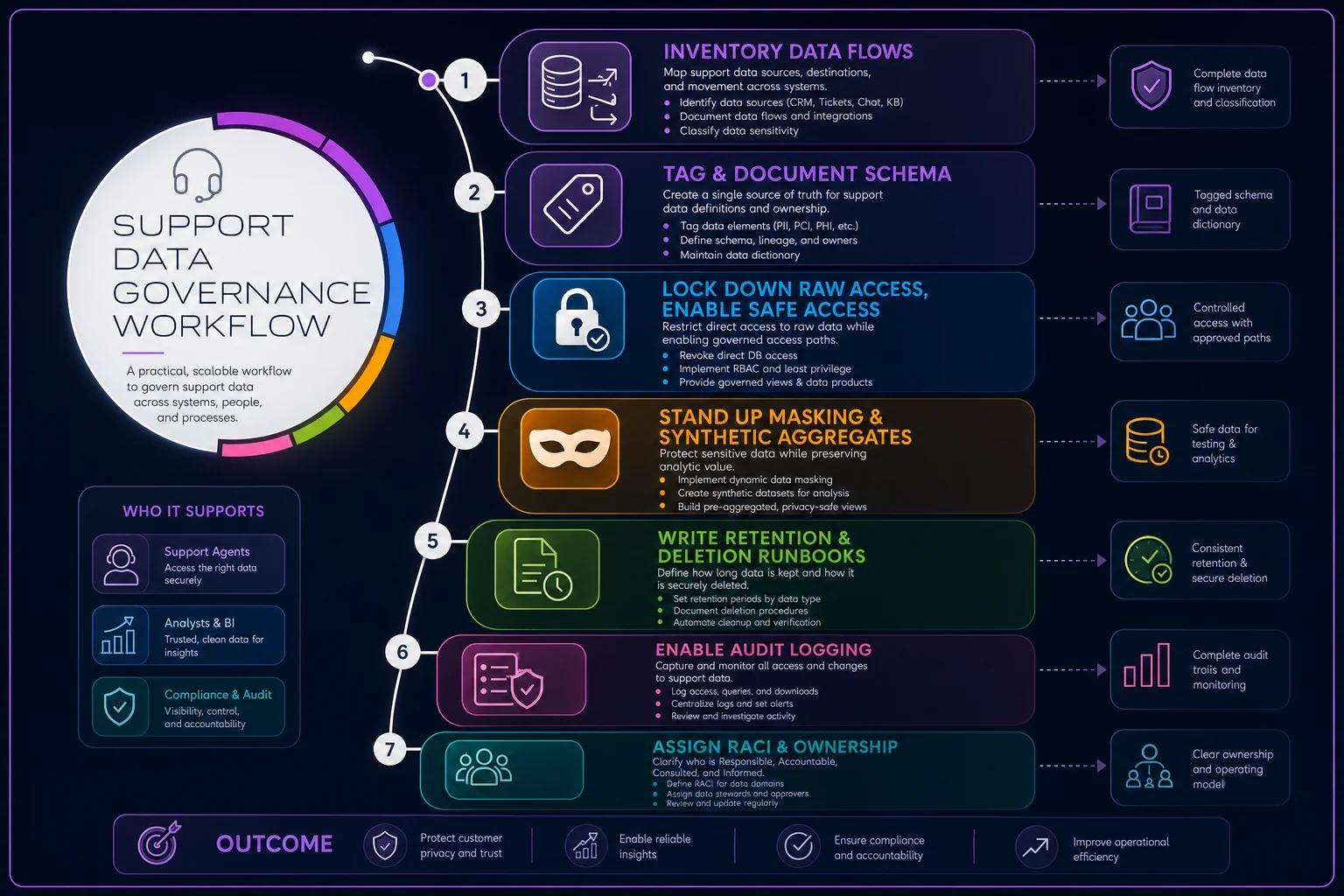
Notice the order: definitions and access control come before fancy privacy tooling. A masking tool on top of an unclassified, sprawling schema just gives you a false sense of safety.
A short real scenario
A fintech support team — around 25 agents handling roughly 18k tickets a month — ran into this hard. Their analysts had direct read access to the ticket warehouse because "we need the data to improve." Reasonable intent, terrible setup. Tickets were full of partial account numbers and transaction details in the message bodies, none of it masked.
The wake‑up call was a routine security review that flagged how many people could query raw ticket text. The fix took about a quarter. They tagged the schema, moved analysts onto parameterized query templates with a minimum cohort size, and built a set of pre‑aggregated tables for the handful of experiment questions the team asked repeatedly — contact drivers, repeat‑contact rates, resolution time by segment.
The outcome that surprised them: experiment velocity actually went up. Analysts stopped waiting on ad‑hoc export approvals and self‑served from safe aggregates, while direct PII access dropped to a handful of logged, approved exceptions a month. Time‑to‑answer on a typical analysis went from a few days to same‑day. The privacy win was the headline, but the operational win — faster, cleaner analytics — is what made the team actually keep using the system.
A pre‑launch governance checklist
Before you consider your support data governance "live," you should be able to check every one of these:
-
- [ ] Every field has a sensitivity classification tagged in the schema
-
- [ ] New untagged fields are rejected by the pipeline, not quietly accepted
-
- [ ] Analysts default to aggregates; raw PII access is an explicit, logged exception
-
- [ ] Safe query templates enforce a minimum cohort size
-
- [ ] You have a complete inventory of every system support data flows into — including AI tooling
-
- [ ] A deletion request can be executed across all systems within your legal window
-
- [ ] Access, export, and deletion events are logged and replayable
-
- [ ] Each pillar component has a named accountable owner
-
- [ ] Synthetic/aggregate datasets are designed around real experiment questions, not generic rollups
If more than two of these are unchecked, you don't have a governance gap — you have a governance absence that's currently just lucky.
When this level of rigor makes sense (and when it doesn't)
When it's worth it: You're handling regulated data (financial, health, anything under strict privacy law), you have multiple teams consuming support data, you're running experiments on real customer interactions, or you've introduced AI into the pipeline. Any one of those and the full pillar earns its keep.
When it's overkill: A small team with a single analyst, non‑sensitive data, and no external reporting obligations doesn't need parameterized query templates and a formal RACI on day one. Start with schema tagging and basic access control. Don't build enterprise governance for a problem you don't have yet — you'll just create process friction that makes people route around it.
Who should not attempt the full build at once: teams without a stable schema. If your field definitions still shift weekly, fix that first. Layering privacy tooling and audit on top of an unstable foundation produces governance theater — lots of policy, little actual protection.
Bringing it together
The teams that get support data governance right don't treat it as a compliance tax bolted onto analytics. They treat it as the operating system that enables analytics — the thing that lets them keep running experiments on real customer data for years without the slow accumulation of risk that eventually forces a painful lockdown.
The connective tissue is what matters. Schema ownership makes classification reliable. Classification makes privacy patterns automatic. Privacy patterns preserve the signal your experiments need. Retention and audit runbooks turn policy into something you can actually execute and prove. And the RACI makes sure none of it falls into the gap between teams. Pull any one thread and the others start to fray — which is exactly why so many governance efforts, done piecemeal, never quite hold.
Pull any one thread and the others start to fray — which is exactly why so many governance efforts, done piecemeal, never quite hold.
Ready to elevate your customer support?
Join 2,000+ support teams using Helpyly to reduce response times, automate workflows, and deliver outstanding customer experiences.