

Most cross-training plans die in a shared doc nobody opens after week one. Someone builds a beautiful skill matrix, assigns a few "buddies," then the queue spikes and everyone goes back to their lane. Six weeks later the matrix is stale and the team is exactly as siloed as before.
The problem usually isn't ambition. Cross-training gets treated like a side project instead of a scheduled rotation with hard start and end dates, explicit coverage rules, and a way to prove someone actually learned the thing. A time-boxed four-week cross-training support rotation fixes that by forcing three decisions upfront: what each person learns, who covers their normal work while they're learning it, and how you verify competency before you put them on live volume solo.
This is the plan I'd hand a support manager with, say, 8–15 agents split across two or three skill areas — billing, technical, onboarding, whatever — who wants genuine redundancy without torching SLAs during the training window.
Why four weeks, and why "micro"
Longer rotations sound thorough but they quietly break coverage. Pull an agent off their primary queue for eight weeks and you've created an eight-week staffing hole. By the time they're "trained," the product has shifted under them anyway.
Four weeks is short enough that backfill stays manageable and long enough to move someone from "watched a few tickets" to "can handle tier-1 volume in a second area with supervision." The "micro" part matters too: you're not trying to make a billing specialist into a full technical expert. You're trying to get them to safe, supervised competency on the top 60–70% of ticket types in a second area. That last 30% — the gnarly edge cases — stays with the specialists on purpose. Chasing full parity is where these programs balloon and collapse.
Teams that aim for "everyone can do everything" end up with everyone doing everything badly. The teams that actually hold up during a surge are the ones where each person has one deep area and one solid backup area. That's the target.
The structure: four weeks, four modes
Each week shifts the trainee further from observation toward independent handling. The modes stack — you don't abandon shadowing in week two, you just add more live work on top of it.
Never let a customer request slip through the cracks.
Helpyly helps you track, resolve, and optimize every support interaction effortlessly.
- Centralized ticket management
- Automated customer notifications
- Performance analytics dashboard
No credit card required
| Week | Primary mode | Daily live ticket target (new area) | Supervision level | Backfill on primary queue |
|---|---|---|---|---|
| 1 | Shadow + KB immersion | 0 (observe only) | Full — watch specialist | ~90% backfilled |
| 2 | Co-handle (reverse shadow) | 3–5 tickets, specialist reviews each | Review before send | ~75% backfilled |
| 3 | Supervised solo | 8–12 tickets, async QA sampling | Spot-check + escalation open | ~50% backfilled |
| 4 | Independent with gate | 15–20 tickets, QA gate at end | Escalation path only | ~25% backfilled |
The backfill column is the part people skip and then wonder why the rotation falls apart. If you pull someone into training without formally reassigning their primary work, one of two things happens: either their old queue rots, or they quietly keep doing both and learn nothing. More on backfill rules below — that's genuinely the make-or-break piece.
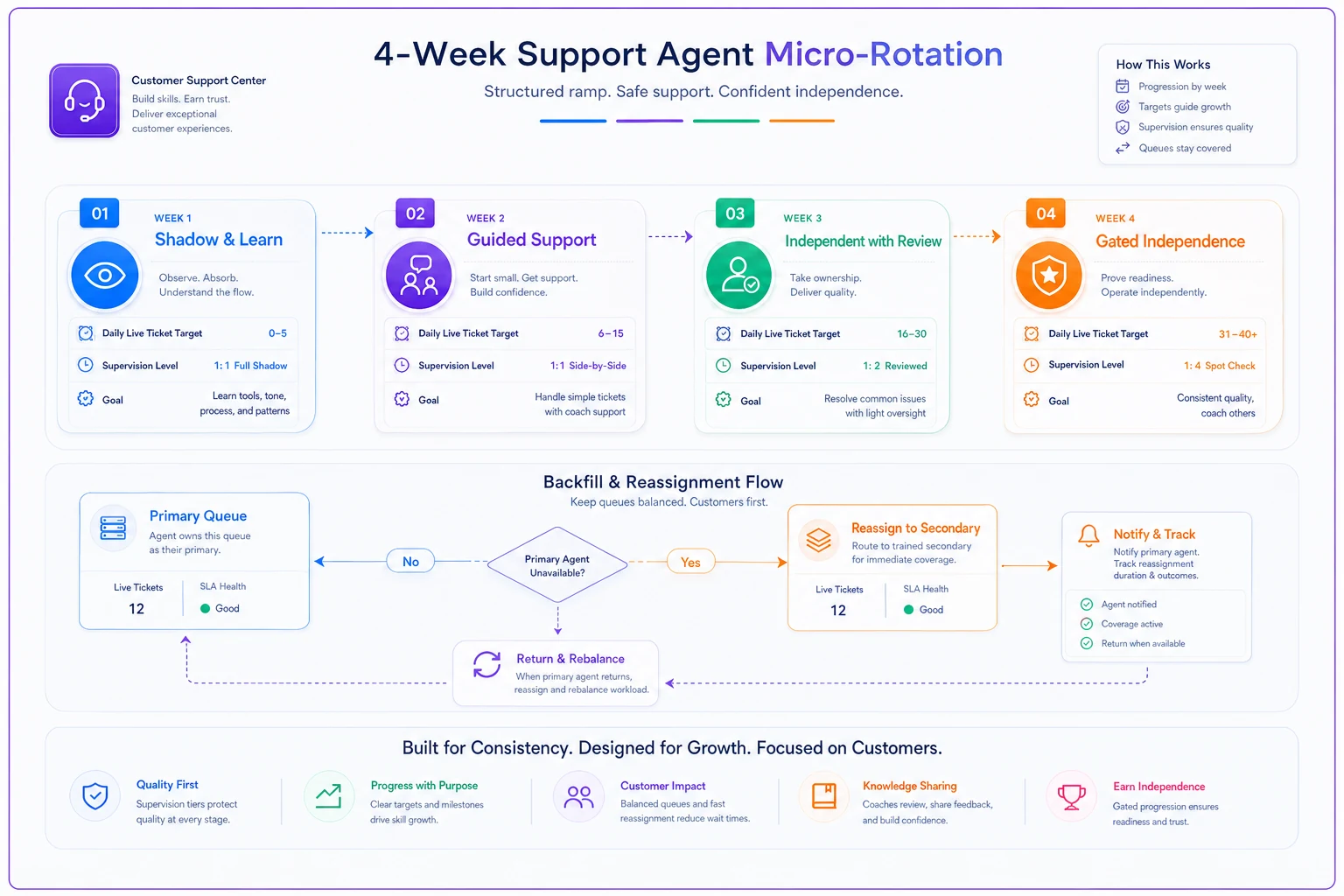
A visual overview helps teams align on timing, supervision, and who owns the primary queue at each stage.
Learning objectives per week (write these down, don't wing it)
Vague objectives like "understand billing" are useless for a QA gate. You can't test "understand." You can test "resolves a failed-payment ticket, including locating the decline reason and sending the correct dunning template, without escalating."
Week 1 — Context and vocabulary. By end of week, the trainee can explain the five most common ticket types in the new area, name the tools involved, and correctly tag and route a ticket they wouldn't handle themselves. No resolution expected. The win here is they stop being confused by the terminology.
Week 2 — Guided resolution. Trainee drafts responses for 3–5 common ticket types per day. The specialist reviews before anything goes to the customer. Objective: drafts need only minor edits, not rewrites. If the specialist is rewriting from scratch at the end of week two, the person isn't ready to advance — hold them.
Week 3 — Supervised independence. Trainee sends responses directly, but a QA reviewer samples 30–40% of their tickets async. Objective: QA score within roughly 10 points of the team baseline, and zero policy violations — refund thresholds, data access, that kind of thing.
Week 4 — Gated independence. Full volume for the week, with a formal QA gate at the end. Objective: pass rate that lets them handle the second area during surges without a specialist watching over their shoulder.
If this cadence feels familiar, it should — it's the same competency-gate logic behind a solid 30-day onboarding syllabus, just applied to an existing agent learning a second skill instead of a new hire learning their first.
Shadow schedules that don't wreck the specialist's day
The quiet cost of shadowing falls on the specialist's side. When you tell your best billing agent "Jordan's shadowing you this week," you've slowed that person down by 20–30% because now they're narrating their work. If you don't account for that, the specialist's numbers tank and they start resenting the program.
-
Block shadowing into windows, not whole days. Two 90-minute blocks a day — one morning, one afternoon — covers enough ticket variety without turning the specialist into a full-time tour guide. The rest of the day the specialist works normally and the trainee does KB reading or handles whatever's left of their backfilled-down queue.
-
Record-and-review for week 1. Instead of live over-the-shoulder narration for everything, have the specialist handle tickets normally and the trainee review a set of resolved tickets afterward with a short "why did you do X" list. Async, doesn't slow anyone down, and scales if you're rotating multiple people at once.
A sample week-1 daily shadow schedule:
-
9
00–10:30 — Live shadow block (specialist narrates 6–8 tickets)
-
10
30–12:00 — KB immersion + tag/route practice on closed tickets
-
12
00–1:00 — Lunch
-
1
00–2:30 — Async review of 10 resolved tickets, write questions
-
2
30–4:00 — Reduced primary-queue work (whatever wasn't backfilled)
-
4
00–4:30 — 15-min debrief with specialist on the day's questions
Schedule one morning block for high-variability new tickets and the afternoon for follow-ups to maximize learning without overwhelming the specialist.
Async, doesn't slow anyone down, and scales if you're rotating multiple people at once.
QA gates: the part that makes it real
Without a gate, "cross-trained" is just a checkbox someone ticked. The gate is what separates people who can genuinely cover from people who attended the rotation.
-
Volume threshold handled at least 50–60 live tickets in the new area across weeks 2–4.
-
QA score threshold within 10 points of the area's current team average on your existing rubric. Don't invent a new rubric for trainees — use the same one you use for everyone, otherwise the score means nothing.
-
Zero critical violations no unauthorized refunds, no data-access mistakes, no promises outside policy. One critical violation during week 4 equals a gate fail — extend by a week.
-
Escalation judgment did they escalate the right things and resolve the rest? A trainee who escalates everything hasn't learned; one who escalates nothing is dangerous.
If someone fails the gate, the default isn't "they washed out." It's a one-week extension on week-4 conditions, then a re-check. Most people who fail the first gate pass the extension — they just needed more live reps than four weeks gave them. Build that extension into the plan so it doesn't feel like a punishment.
Backfill rules (where most programs actually break)
Nobody wants to do this math, which is exactly why rotations fail quietly. When you pull an agent into training, their primary queue doesn't disappear. Someone absorbs it or SLAs slip.
-
Never rotate more than one person per skill area at a time. Three billing agents, two pulled into technical rotation simultaneously — the one left behind drowns. One at a time, always.
-
Pre-assign the backfill owner by name before week 1 starts. "The team will cover it" means nobody covers it. Write it down: "During Jordan's rotation, their billing overflow goes to Priya, who drops her side project for four weeks."
-
Scale backfill to the training week. In week 1 the trainee is mostly observing and can still carry maybe 10% of their normal primary load. By week 4 they're deep in the new area and need real relief. The backfill table above maps this out.
-
Set a surge circuit-breaker. If primary-queue volume spikes past a defined threshold — say, 30% over your two-week baseline — the rotation pauses and the trainee goes back to their main queue until it settles. Don't let cross-training sink your actual SLAs.
That last rule is the honest acknowledgment that cross-training is a good-weather activity. The staffing math behind which weeks are safe to run it in is the same forecasting work covered in predictable seasonal staffing — run rotations in your known-quiet windows, not into a seasonal peak.
A real scenario
A mid-sized SaaS support team — around 11 agents, split roughly 6 technical and 5 billing — kept getting wrecked during end-of-month billing spikes. Volume would roughly double in the last three business days of the month, and the technical folks could only stand around because none of them could safely touch a billing ticket.
They ran this four-week rotation with two technical agents, staggered rather than simultaneous, learning tier-1 billing over about six weeks total. Week 1 shadow, week 2 co-handle, weeks 3–4 supervised solo, QA gate on the existing billing rubric.
After the next two month-end cycles: the billing queue's peak backlog dropped from somewhere around 70–80 tickets at its worst down to the low 30s, because they now had two extra hands clearing the straightforward "why was I charged X" and failed-payment tickets. Billing specialists got freed up for the genuinely complex cases. First-response times during the spike came back inside SLA, where before they'd been slipping by a few hours. One of the two trainees failed the first gate, got the one-week extension, and passed — exactly how that rule is supposed to work.
Not a transformation. Just a team that stopped being helpless for three days every month.
When this makes sense — and when it doesn't
Run it when:
-
You have clearly separable skill areas with predictable volume imbalances — one area spikes while another goes quiet.
-
You have specialists stable enough to teach without their own numbers collapsing.
-
You have at least one genuinely quiet window in your calendar to run it in.
Skip it when:
-
You're already understaffed day-to-day. Cross-training a team that can't cover its current load just moves the fire around. Fix staffing first.
-
Your two "areas" are actually one area with different tags. If the overlap is 80%+, you don't need a rotation — you need an afternoon of KB reading.
-
You're in or near your peak season. Start a rotation into a surge and the circuit-breaker trips in week two, and you've burned momentum for nothing.
Who should not run this at all: very small teams — 3 or 4 agents — where everyone already touches everything by necessity. You're cross-trained by accident. Spend the energy on depth and documentation instead.
Deploying it without building everything from scratch
The calendars, objective sheets, shadow blocks, and gate checklists in this piece are deliberately lightweight so you can run the whole thing out of a spreadsheet and your existing QA tool. You don't need new software to cross-train a team.
Where tooling helps is tracking overhead once you're rotating more than one or two people at a time — keeping backfill assignments visible, surfacing QA samples for trainees automatically, and flagging when someone's primary queue is slipping so the circuit-breaker rule actually fires instead of getting noticed three days late. Operational platforms that already hold your ticket data and QA scores can automate the dull parts of that tracking, which mostly matters when a rotation is running quietly in the background and nobody's watching the dashboard. But the rotation itself — the schedule, the objectives, the gate — is people and judgment, not a tool.
Start with one skill area, one trainee, four weeks, a named backfill owner, and a gate on your existing rubric. Get one clean rotation done before you scale it to the whole team. The first one will show you where your specific coverage holes actually are — and that's worth more than any template, including this one.
Start with one skill area, one trainee, four weeks, a named backfill owner, and a gate on your existing rubric. Get one clean rotation done before you scale it to the whole team. The first one will show you where your specific coverage holes actually are — and that's worth more than any template, including this one.
Ready to elevate your customer support?
Join 2,000+ support teams using Helpyly to reduce response times, automate workflows, and deliver outstanding customer experiences.