


Support leaders lose budget fights for a boring reason: they show up with operational language and their CFO thinks in financial language. You talk about first response time, backlog, and CSAT. The CFO is staring at net revenue retention, gross margin, and cash runway. Nobody is lying, nobody is dumb — you're just speaking two different dialects, and the person controlling the budget doesn't have to learn yours.
This article is about closing that gap permanently. Not with a single killer slide, but with a repeatable way to frame support investment as something that moves the numbers the executive team already cares about. Get this right and you stop asking for headcount as a cost and start proposing support investments as levers on retention and expansion. That's a different conversation entirely, and you win it far more often.
The real reason support gets treated as a cost center
Walk into most finance reviews and support shows up as a single line: a salary bucket, maybe a tooling line, occasionally a BPO contract. It's expense. Something to be managed down. And that framing is mostly self-inflicted.
Support teams report activity — tickets handled, hours worked, queues cleared. Activity metrics answer "are we busy?" They don't answer "did this create or protect revenue?" So when budget season hits, finance has no model connecting an extra $200k in support spend to anything on the P&L that grows. In the absence of a link, the default assumption is that support is a fixed cost that scales linearly with customers. More customers, more tickets, more agents. Forever.
That linear assumption is the trap. It means every time you ask for more, you're confirming that support is a tax on growth. And a tax is exactly what a CFO is paid to reduce.
The teams that break out of this don't argue harder. They rebuild the relationship between what support does and what finance measures. The two anchors are almost always net revenue retention (NRR) and churn — because those are the metrics that determine company valuation, board conversations, and how much runway the business has. Tie support outcomes credibly to those two numbers and you stop being a line item and start being a strategic input.
Map support work to the metrics finance already lives in
Before you build any roadmap or slide, you need a translation table. Not a fancy one — just a clear mapping of what support influences to what finance tracks. This is the single most useful artifact you can build, and most support leaders have never actually sat down and written it out.
Never let a customer request slip through the cracks.
Helpyly helps you track, resolve, and optimize every support interaction effortlessly.
- Centralized ticket management
- Automated customer notifications
- Performance analytics dashboard
No credit card required
Here's the version that tends to work across B2B and subscription businesses:
| Support lever | What it actually moves | Finance KPI it maps to |
|---|---|---|
| Faster, cleaner resolution on at-risk accounts | Fewer cancellations from frustration | Gross churn / logo retention |
| Proactive outreach on usage drops | Accounts re-engage before they leave | NRR, gross churn |
| Support-surfaced expansion signals | Upsell/cross-sell closed by sales/CS | NRR (expansion component) |
| Deflection via better self-serve | Lower cost-to-serve per account | Gross margin, cost-per-ticket |
| Onboarding support quality | Faster time-to-value, fewer early churns | Early-life churn, NRR cohort curves |
| Reduced reopens and repeat contacts | Lower operational drag per customer | Contribution margin |
The point of this table isn't precision. It's shared language. When you sit down with finance and agree that "support influences the expansion side of NRR through these three specific mechanisms," you've done something most support orgs never do — you've made support legible to the people holding the checkbook.
Start by mapping two or three high-impact support levers to a single finance KPI to keep the conversation focused.
Worth flagging: don't overclaim. If you tell the CFO support "drives" NRR, they'll rightly push back that sales and product drive it too. The honest framing is influence and protection. Support protects retention and surfaces expansion. That's defensible, and defensible beats impressive in a budget room every time.
Build the roadmap as a quarter-by-quarter investment sequence
A roadmap that says "we want to be better at support" gets nodded at and forgotten. One that says "here's what we invest each quarter, here's the metric each investment targets, and here's how we'll know if it worked" gets funded.
Structure your ask as a rolling four-quarter sequence where each quarter has one primary financial thesis. You're not asking for everything at once — you're proposing a sequence where later investments depend on earlier ones proving out. CFOs like contingency. It caps their downside.
-
Q1 — Instrument and prove. The ask here is small
analytics tooling and one analyst's time, or a reallocation. The deliverable is the translation table above, backed by real data. You're proving that at-risk accounts touch support before they churn, and quantifying how often. Nobody funds a big program on a hunch, so Q1 buys you the evidence.
-
Q2 — Attack early-life churn. Once you can show which support interactions correlate with retention, invest in onboarding support and proactive outreach. The financial thesis: reduce early-life churn by protecting the first 90 days of each account.
-
Q3 — Fund deflection and margin. With retention stabilizing, shift to cost-to-serve. Invest in self-serve, knowledge, and routing so cost-per-ticket drops while volume grows. The thesis here is margin, not retention.
-
Q4 — Turn support into an expansion signal engine. Build the workflow where support-surfaced signals — feature interest, usage growth, workarounds — flow to CS and sales. The thesis: support contributes to the expansion side of NRR.
Notice the pacing. You lead with the cheapest ask that produces evidence, then escalate. Each quarter's success unlocks the next quarter's budget. This is how you avoid the all-or-nothing ask that finance instinctively distrusts.
If you want a deeper framework for sequencing investments as the org matures, the support operational maturity model breaks down how ad-hoc teams progress toward predictive operations — and it pairs well with this quarterly structure.
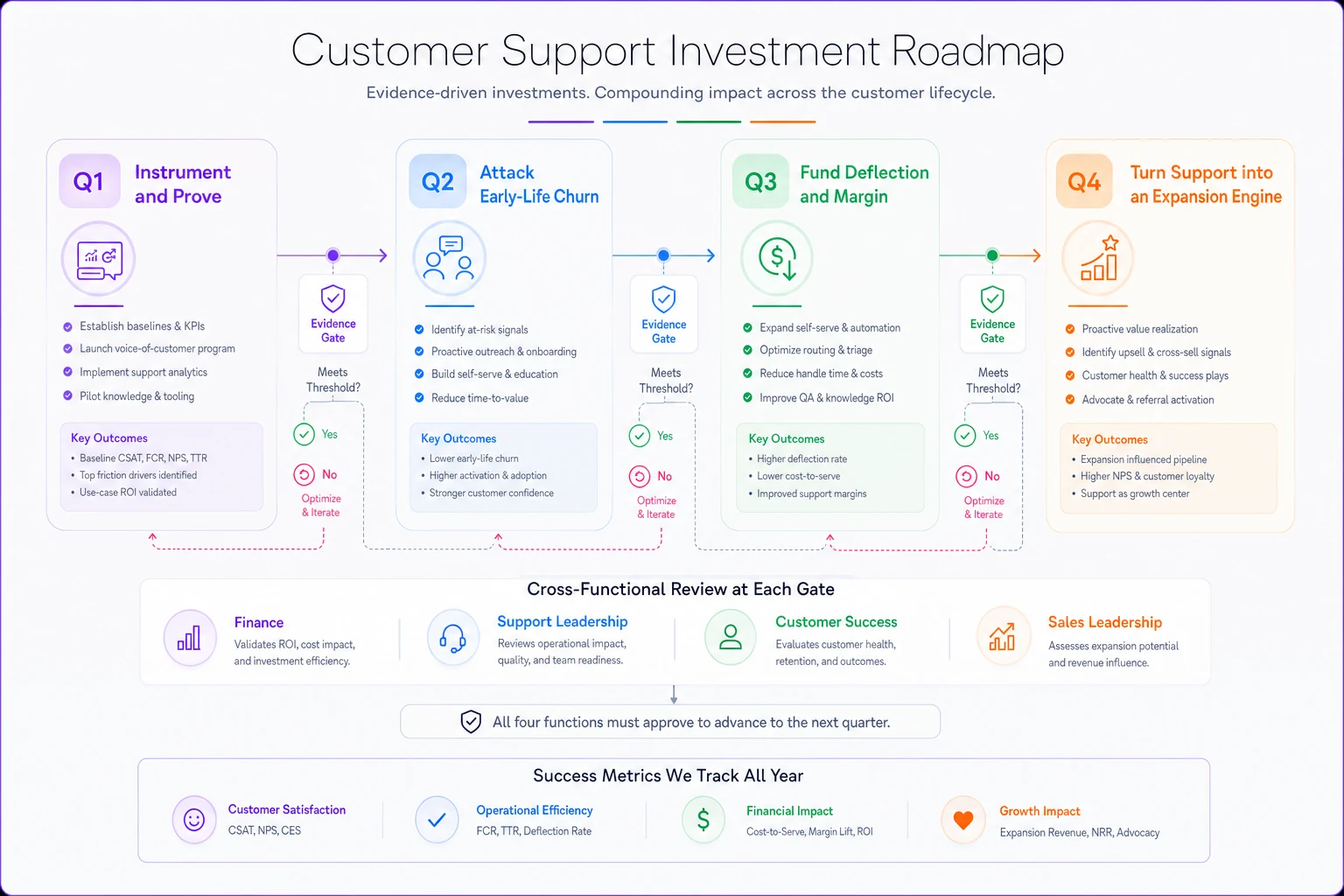
This visual summarizes the quarter-by-quarter flow and decision gates.
The budgeting narrative that actually lands
Numbers don't fund anything. Narratives fund things, and numbers support the narrative. Support leaders get this backward constantly — they bring a spreadsheet and expect it to do the persuading.
A budgeting narrative has three moves, and they go in this order:
First, name the risk in the CFO's language. Not "our backlog is growing." Instead: "We have roughly $1.4M of ARR sitting in accounts that showed a churn-warning support pattern last quarter, and we currently have no proactive workflow to catch them." Now the CFO sees exposure, and exposure is something they're wired to reduce.
Second, propose the investment as protection or leverage. "For about $180k in fully-loaded cost — two hires and a workflow build — we can put a proactive motion on those at-risk accounts. Based on the Q1 data, we believe we can retain a meaningful share of that ARR that would otherwise churn."
Third, tie the payoff to the experiment. This is what separates the strategic support leader from the hopeful one. You don't promise a fixed return. You commit to a test: "We'll run this on a defined cohort for one quarter and measure churn against a control group. If it works, we scale. If it doesn't, we've spent one quarter, not a year."
That third move is your credibility. Finance has been burned by every department that promised guaranteed returns. When you volunteer a measurement plan with a kill switch, you signal that you think like an operator, not a lobbyist.
A pattern worth noting: the strongest support asks are almost always framed around protecting revenue rather than generating it. Protection is easier to believe, easier to measure, and sits closer to what support actually does. Save the expansion story for later quarters once you've earned trust with the retention story.
Slide templates for the CFO conversation
You don't need a 30-slide deck. You need about six slides that a finance person can absorb without you talking through every line. Here's the skeleton:
-
Slide 1 — The revenue at stake. One number
ARR sitting in accounts exhibiting risk signals. This is your hook, and it should make the CFO lean in.
-
Slide 2 — The translation table. Support levers mapped to finance KPIs. This is where you establish that you speak their language.
-
Slide 3 — The quarterly ask. The four-quarter sequence, with the cost and financial thesis per quarter. Emphasize the contingency: later spend depends on earlier proof.
-
Slide 4 — The experiment design. Cohort, control group, duration, the metric you'll move, and the decision rule. This slide does more to build trust than any other.
-
Slide 5 — The downside. Explicitly state what happens if it doesn't work and how much you'll have spent before you know. Volunteering the downside is disarming and rare.
-
Slide 6 — The ask. The specific dollar figure and headcount for the next quarter only, plus the metric it targets.
The discipline here is restraint. Every extra slide dilutes the argument. A CFO reviewing twelve budget requests remembers the one that was crisp, honest about risk, and structured like an investment thesis.
For the underlying financial models — cost-per-ticket, automation NPV, run-rate math that feeds these slides — the breakdown on how to show support ROI in finance terms gives you the calculators to fill in real numbers.
Link every ask to an experiment, not a promise
This is the operating principle that changes how finance sees you: no investment without an attached experiment and a decision rule.
The reason is coordination, not just persuasion. When you tie an ask to an experiment, you create a natural checkpoint where support, finance, and often CS all look at the same result and decide together whether to continue. That shared checkpoint does something subtle — it makes support a participant in company-level decisions instead of a downstream recipient of them.
Here's what an experiment-linked ask looks like in practice:
You define a cohort — say, accounts under $50k ARR in their first 90 days. You split them into a treatment group that gets a new proactive onboarding-support motion and a control group that gets the current experience. You run it for a quarter. You measure churn and early expansion in both groups. Then a pre-agreed decision rule fires: if treatment churn is meaningfully lower, you scale and request the next quarter's budget with real numbers behind it. If it isn't, you stop, and you've spent one quarter learning something instead of a year defending a program nobody measured.
The next budget conversation is no longer a negotiation. It's a review of evidence you both watched happen. Over a few cycles, this is how support stops being the department that begs and becomes the department finance consults.
A real scenario: turning a churn problem into a funded program
A mid-sized B2B SaaS company — roughly 900 customers, around $9M ARR — had a support team that was constantly under-resourced and losing every budget cycle. Gross churn was sitting somewhere around 14% annually, painful for a company that size, and the exec team quietly blamed product and pricing.
The support lead did something different that year. Instead of asking for three more agents to clear backlog, she spent Q1 pulling the data connecting support interactions to churned accounts. What she found: a large share of churned accounts had logged two or more unresolved support issues in their final 60 days. Not proof of causation, but a strong, uncomfortable correlation nobody had surfaced.
She built the translation table, walked finance through it, and proposed a single-quarter experiment: proactive resolution and outreach on accounts showing that two-plus unresolved-issue pattern. The ask was modest — around $60k in reallocated and new spend for one quarter, plus a defined cohort and control group.
The result wasn't a miracle. Churn in the treatment cohort came in noticeably lower than the control — enough of a gap to be worth scaling. More importantly, the CFO had watched the experiment run. When she came back the next quarter asking for the full program, it wasn't a fight. It was a formality. Support moved from cost line to funded strategic function in about two budget cycles, mostly by changing what it measured and how it asked.
When this approach makes sense — and when it doesn't
This roadmap assumes a few things are true about your business. Worth being honest about when it fits.
It makes sense when:
-
You're in a subscription or retention-driven model where NRR and churn actually drive valuation
-
You have enough account and ticket data to establish correlations, even rough ones
-
Your leadership team makes decisions with financial framing rather than gut feel
-
Support genuinely touches at-risk or expansion accounts in a measurable way
It's a bad idea when:
-
You're pre-product-market-fit and churn is dominated by fundamental product gaps no amount of support can fix
-
Your data is so fragmented you can't reliably connect a support interaction to an account outcome (fix the data first)
-
You over-promise on causation — if you tell finance support causes retention and the experiment doesn't hold, you lose credibility for years
And a note on who should not run at this: if your support org is still firefighting daily with no room to instrument anything, don't start with the CFO deck. Get your operational baseline stable enough to measure first. The strategic conversation only works when you have something real to measure. Trying to skip to the boardroom framing before your data can back it up is how support leaders lose the very credibility they're trying to build.
The shift underneath all of this
The teams that reposition support successfully aren't better at support than everyone else. They're better at connecting support to the rest of the business — treating the budget ask as one node in a system that runs from ticket data, to account risk, to finance metrics, to executive decisions.
That connection is the whole game. When support activity flows into shared metrics that finance, CS, and product all read the same way, coordination stops being a series of arguments and becomes a series of reviews. The bottleneck was never headcount. It was translation — the gap between what support knows about customers and what the rest of the business can see.
Build the translation table. Sequence your asks by quarter. Tie every dollar to an experiment with a decision rule. Bring the CFO six honest slides that name the risk in their language. Do that for two or three cycles, and support stops defending its existence and starts shaping where the company invests. That's what positioning support as a strategic function actually looks like in practice — not a title change, but a change in what you measure and how you ask.
Ready to elevate your customer support?
Join 2,000+ support teams using Helpyly to reduce response times, automate workflows, and deliver outstanding customer experiences.