

Shadowing is one of those practices that looks productive but usually isn't. A newer agent sits next to a senior one for a few hours, nods at the right moments, maybe takes a page of notes, and then goes back to their own queue completely unchanged. Three weeks later their QA scores haven't budged, and nobody can explain why the "training" didn't take.
The gap is almost never the shadowing itself. It's everything that's supposed to happen after. Most teams have no rubric for what the shadower should be watching, no script for the conversation that converts observation into behavior change, and no follow-up loop that checks whether anything stuck. The whole thing collapses into vibes.
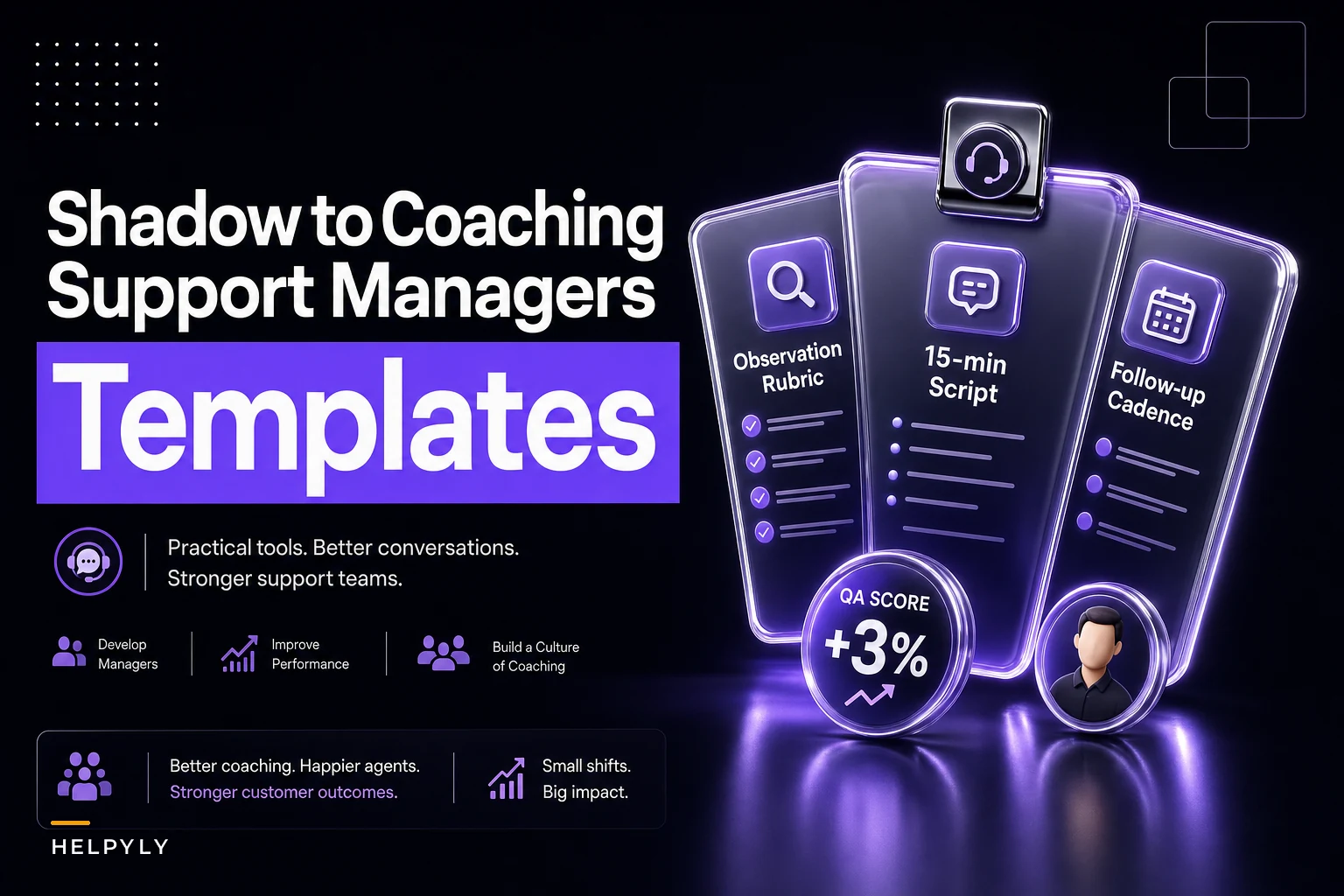
This post is about closing that gap with four concrete artifacts: a manager-ready observation rubric, a tight 15-minute coaching script, a follow-up cadence that doesn't rely on memory, and QA-score targets that tell you whether the coaching worked. The goal is to make shadowing produce repeatable microlearning instead of a pleasant afternoon that changes nothing.
Why shadowing usually fails to transfer
The core problem is that shadowing is passive by default. The person watching has no assignment. They absorb a general sense of "how Marcus handles angry customers" without isolating the specific moves that make Marcus good — the way he restates the problem before proposing a fix, the way he names the delay instead of apologizing vaguely, the way he closes with a verification question.
Without a rubric, those moves stay invisible. The shadower sees a smooth call and attributes it to personality or experience, which feels unteachable. In reality, most QA points live in four or five repeatable behaviors that you can name, score, and practice.
The second failure is timing. Teams schedule shadowing, then schedule the debrief "sometime this week." By the time the conversation happens, the specific moments are gone. Everyone remembers the general feeling, nobody remembers the exact ticket where the agent buried the resolution step in paragraph three. Coaching built on fuzzy memory produces fuzzy advice: "try to be a little clearer." That advice moves nothing.
A typical example looks like this: a 14-person SaaS support team runs quarterly shadowing days. Everyone enjoys them. QA scores stay flat at around 81–83 for two straight quarters. When the manager finally mapped what shadowers were actually writing down, it was mostly logistics — "watched 6 tickets, seemed good." No behavior, no score, no follow-up. The activity existed; the learning didn't.
The observation rubric: what the shadower actually scores
The rubric is the single highest-leverage piece. It converts passive watching into active scoring, which forces the shadower to notice specific behaviors in real time. Keep it to five or six dimensions — more than that and nobody fills it out honestly.
Never let a customer request slip through the cracks.
Helpyly helps you track, resolve, and optimize every support interaction effortlessly.
- Centralized ticket management
- Automated customer notifications
- Performance analytics dashboard
No credit card required
Here's a structure that holds up across most support teams:
| Dimension | What to watch for | Score (1–3) | Note the exact moment |
|---|---|---|---|
| Problem framing | Restated the issue before acting | Ticket #, timestamp | |
| Resolution clarity | Steps in order, no burying the fix | ||
| Tone under pressure | Named the issue, avoided empty apology | ||
| Account/context use | Checked history before asking | ||
| Close & verify | Confirmed resolution, set next step |
Two things make this rubric work. First, the 1–3 scale instead of 1–5 — three options force a decision (below, meets, exceeds) instead of a safe middle number. Second, the "exact moment" column. Requiring a ticket number and rough timestamp is what makes the later coaching conversation specific. Without it you get generalities; with it you get "on ticket 44821 you asked for the order number that was already in the account sidebar."
One pattern worth flagging: when shadowers can only find moments for two or three dimensions during a session, that's not a failed session — it's a signal about which behaviors are even observable in your ticket mix. If "tone under pressure" never comes up, the shadower was watching a quiet queue, and you should pair them on a different shift next time.
If you're already running structured QA, this rubric should borrow the same language as your scorecard. Teams that keep shadowing vocabulary separate from their asynchronous QA review process end up with two competing definitions of "good," and agents get whiplash. Align them so a shadowing note and a QA comment point at the same behavior.
The 15-minute coaching script
The debrief is where most of the value is either captured or lost. The mistake managers make is treating it like a performance review — long, evaluative, and overwhelming. A good shadow debrief is short, concrete, and focused on one or two changes.
-
Minute 0–2
Anchor on one strength.
Name one specific thing the agent did well, with the ticket number. This isn't a feel-good ritual — it tells the agent exactly which behavior to keep doing. "On 44902 you confirmed the resolution before closing. Keep that." -
Minute 2–7
Walk the one weakest moment.
Pick the single lowest-scoring moment from the rubric. Pull the ticket up. Read the actual response together. Ask the agent what they'd change now. Most of the time they'll spot it themselves, which makes it stick far better than being told. -
Minute 7–11
Model the alternative.
Show or co-write the better version. Not a lecture — an actual rewritten sentence or a different opening line they can copy next time. -
Minute 11–14
Agree on one practice target.
One behavior, measurable, for the next week. "Restate the problem in the first line on every billing ticket." Not three targets. One. -
Minute 14–15
Confirm the follow-up.
State when you'll check back and how. This is the part everyone skips, and it's why nothing sticks.
The discipline here is the "one target" rule. The temptation is to unload every observation because you finally have the agent's attention. Resist it. An agent working on one clear behavior for a week will improve that behavior. An agent handed five will improve none.
The follow-up cadence
A coaching conversation with no follow-up is just a conversation. The cadence is what converts it into actual behavior change — and it needs to be scheduled, not remembered.
The pattern that works across most teams is a three-touch loop after each debrief:
-
Day 2 A quick async check — one sentence in chat referencing the practice target. "How's the problem-restating going on billing tickets?" This early nudge is mostly about signaling you actually meant it.
-
Day 7 Pull 3–5 of the agent's recent tickets and look specifically at the one target behavior. Not a full review — just that one dimension. Was it present or not?
-
Day 14 Re-score that single dimension on the rubric. If it moved, name a new target. If it didn't, the issue isn't effort, it's understanding — go back and model it again, differently.
Behavior change decays fast without reinforcement. A single debrief creates a spike of intention that fades within days. The Day 2 and Day 7 touches catch the decay before it completes. Teams that skip to a Day 30 check almost always find the behavior reverted — not because the agent didn't care, but because nothing reminded them.
Where this gets heavy is at scale. A manager with 10 reports running three-touch loops on rolling shadowing sessions is tracking dozens of open coaching threads, each with its own target and check-in date. This falls apart in a spreadsheet fast. A workflow platform that logs each debrief, attaches the one target, and surfaces the Day 2 / Day 7 / Day 14 checks on your dashboard turns an impossible memory task into a queue you actually work through. The automation isn't doing the coaching — it's making sure the follow-ups don't quietly vanish, which is the actual failure point.
Here's a simple workflow to automate those checks.
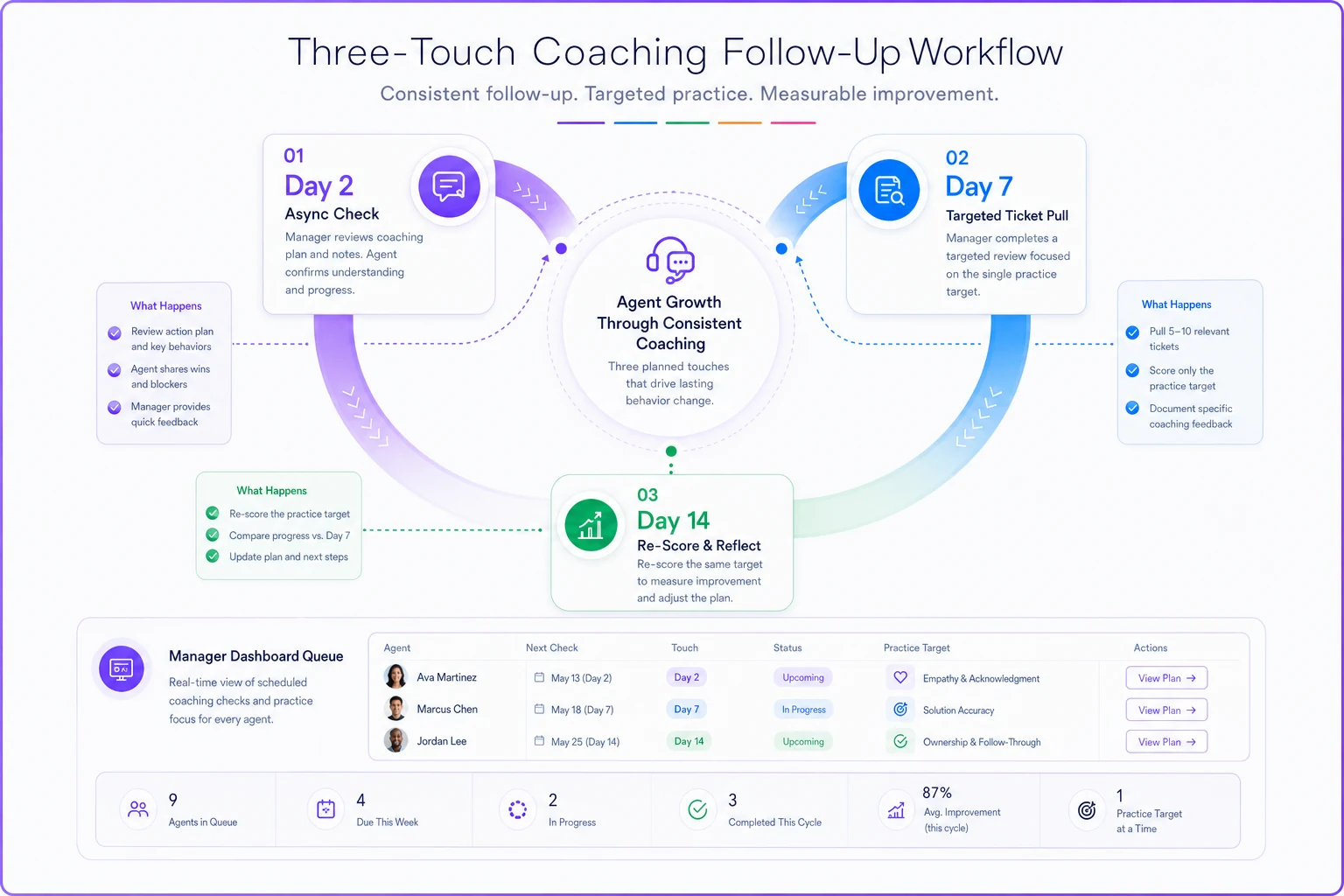
Record the one practice target and the Day 2/Day 7/Day 14 dates in the workflow so checks surface on a dashboard.
This is also where shadowing starts feeding your broader microlearning system. The weakest dimensions showing up across multiple agents tell you which microlearning modules to build and trigger next, so individual coaching and team-wide training stop living in separate universes.
Setting QA-score targets that mean something
Without a target, you can't tell whether shadowing works. "Improvement" is not a measurement. The point of the rubric and cadence is to move a number you've defined in advance.
Set targets at the dimension level, not the overall-score level. Overall QA is too noisy to attribute to one coaching session — too many variables. But if you coached "resolution clarity" specifically, you can measure whether resolution-clarity scores moved for that agent over two weeks. That's a clean cause-and-effect loop.
A reasonable target: for an agent scoring consistently below meets-expectations on one dimension, aim to get them to a stable "meets" across five consecutive tickets within 14 days. "Stable across five" matters more than a single good ticket — one clean ticket is luck, five is a habit forming.
A real scenario
A mid-sized e-commerce support team — around 18 agents, QA hovering in the low 80s — had run shadowing for over a year with nothing to show for it. They rebuilt around the four artifacts above: a five-dimension rubric, the 15-minute script, the three-touch cadence, and dimension-level targets.
The change they tracked most closely was "resolution clarity," which had been their weakest dimension across the whole team. After roughly two months of running debriefs this way, that single dimension moved from averaging about 2.0 to around 2.5 on the three-point scale. Reopen rates on affected tickets dropped noticeably — not dramatically, but consistently over several weeks. The overall QA number only ticked up a few points, but the targeted dimension moved clearly, which is exactly what you'd expect when coaching is specific instead of general.
None of the artifacts were complicated. The win came from making the invisible parts — what to watch, what to say, when to check back — explicit and repeatable.
When this is worth building, and when it isn't
This full system makes sense when you've got enough agents that coaching can't live in your head, and when QA scores are flat despite people being generally competent. If your team is under five people and you're reviewing tickets with everyone daily, formal shadow-to-coaching templates are overkill — you're already doing the coaching conversationally.
It's also a bad fit when the real problem is knowledge, not behavior. If agents score low because the documentation is wrong or the product keeps breaking, no amount of coaching rubrics will fix it. You're coaching people on how to deliver bad information gracefully. Diagnose whether you have a skill gap or a system gap before investing in shadowing infrastructure.
And it genuinely won't help if your QA scoring itself is inconsistent. If two reviewers score the same ticket three points apart, your rubric targets are meaningless because the baseline is noise. Fix calibration first, then layer shadowing on top.
Make the handoff from watching to doing
The reason shadowing disappoints isn't that it's a bad practice. Most teams run the watching part and skip the conversion part — the rubric, the script, the follow-up, the target. Watching is where the opportunity appears. The four artifacts are how you actually capture it.
Start with the rubric, because it changes what the shadower does during the session and makes everything downstream specific. Add the 15-minute script so the debrief produces one clear target instead of ten fuzzy ones. Then protect the follow-up cadence, because that's the step everyone cuts and the step that determines whether any of it holds. Do those three consistently and the QA numbers will tell you it's working — one dimension at a time.
Start with the rubric, because it changes what the shadower does during the session and makes everything downstream specific. Add the 15-minute script so the debrief produces one clear target instead of ten fuzzy ones. Then protect the follow-up cadence, because that's the step everyone cuts and the step that determines whether any of it holds. Do those three consistently and the QA numbers will tell you it's working — one dimension at a time.
Ready to elevate your customer support?
Join 2,000+ support teams using Helpyly to reduce response times, automate workflows, and deliver outstanding customer experiences.