


You know that sinking feeling when a customer says "I already explained this three times"? I watched it happen at a mid-sized electronics retailer running support across email, chat, SMS, and phone. Their team was drowning in context switches. Every channel was its own silo, agents spent 12–15 minutes per ticket hunting for previous interactions, and customers were getting angrier with each handoff.
Cross-channel conversation continuity isn't about fancy technology. It's about treating every customer interaction as part of one continuous conversation, regardless of where it happens. Most support teams struggle here because they're stitching together systems that were never designed to talk to each other. The real fix means rethinking how you structure conversation data from the ground up.
The hidden architecture of conversation chaos
Support conversations break down for predictable reasons. Your email system tracks threads one way. Chat software stores sessions differently. Phone logs sit in a separate database. SMS floats somewhere else. Each system has its own ID structure, timestamp format, and metadata schema.
The typical workflow looks simple until you dig in. Customer emails about an order issue. Gets frustrated waiting, starts a chat. Chat agent can't see the email, asks the same questions. Customer calls instead. Phone agent has no visibility into either previous interaction. Three touchpoints, zero context carried forward.
What makes this worse is that most teams don't realize how much time is disappearing. Agents develop workarounds—keeping personal notes, searching multiple systems, asking customers to forward old emails. These band-aids mask the real cost. At a 40-person contact center I worked with, agents spent close to 30% of handle time just searching for context. Nearly two hours per agent per day, gone.
The metadata problem compounds everything. Email might track subject lines and thread IDs. Chat captures session duration and page URLs. Phone logs record call duration and IVR paths. SMS truncates everything. Even when you find related conversations, the data doesn't align in useful ways—different timestamp formats, different timezone handling, different field names for the same concept.
Building canonical conversation objects that actually work
A canonical conversation object is your single source of truth for any customer interaction across all channels. Think of it as a container that holds every piece of context about a conversation, structured consistently regardless of which channel it came from. This isn't just copying messages into a database—it's designing a data model that preserves meaning while enabling cross-channel correlation.
Never let a customer request slip through the cracks.
Helpyly helps you track, resolve, and optimize every support interaction effortlessly.
- Centralized ticket management
- Automated customer notifications
- Performance analytics dashboard
No credit card required
The core structure needs five things.
-
First, a universal conversation ID that persists across channels—not a ticket number that changes with each interaction, but a stable identifier tied to the continuous dialogue.
-
Second, normalized timestamps in UTC with the original timezone preserved.
-
Third, channel-agnostic message content with original formatting retained but searchable text extracted.
-
Fourth, participant identifiers that map to both customers and agents consistently.
-
Fifth, conversation state tracking
active, waiting, resolved, or handed off.
The mistake most teams make is trying to force-fit existing ticket IDs into this model. Tickets and conversations aren't the same thing. A conversation might spawn multiple tickets. A ticket might reference several conversations. You need both concepts, clearly separated but properly linked.
The metadata layer sits on top of this core structure. Every conversation object needs standard fields—customer ID, order numbers, product SKUs, issue categories. But you also need channel-specific metadata preserved: email headers, chat referrer URLs, phone ANI/DNIS data, SMS short codes. The challenge is storing both without building a bloated mess that's impossible to query.
| Metadata tier |
|---|
| required fields that every conversation must have |
| channel fields specific to each communication type |
| custom fields for business-specific data like subscription tier or shipping preferences |
For a subscription box company processing around 1,200 support contacts daily, we structured conversation objects with three metadata tiers: required fields that every conversation must have, channel fields specific to each communication type, and custom fields for business-specific data like subscription tier or shipping preferences. That hierarchy kept queries fast while preserving full context.
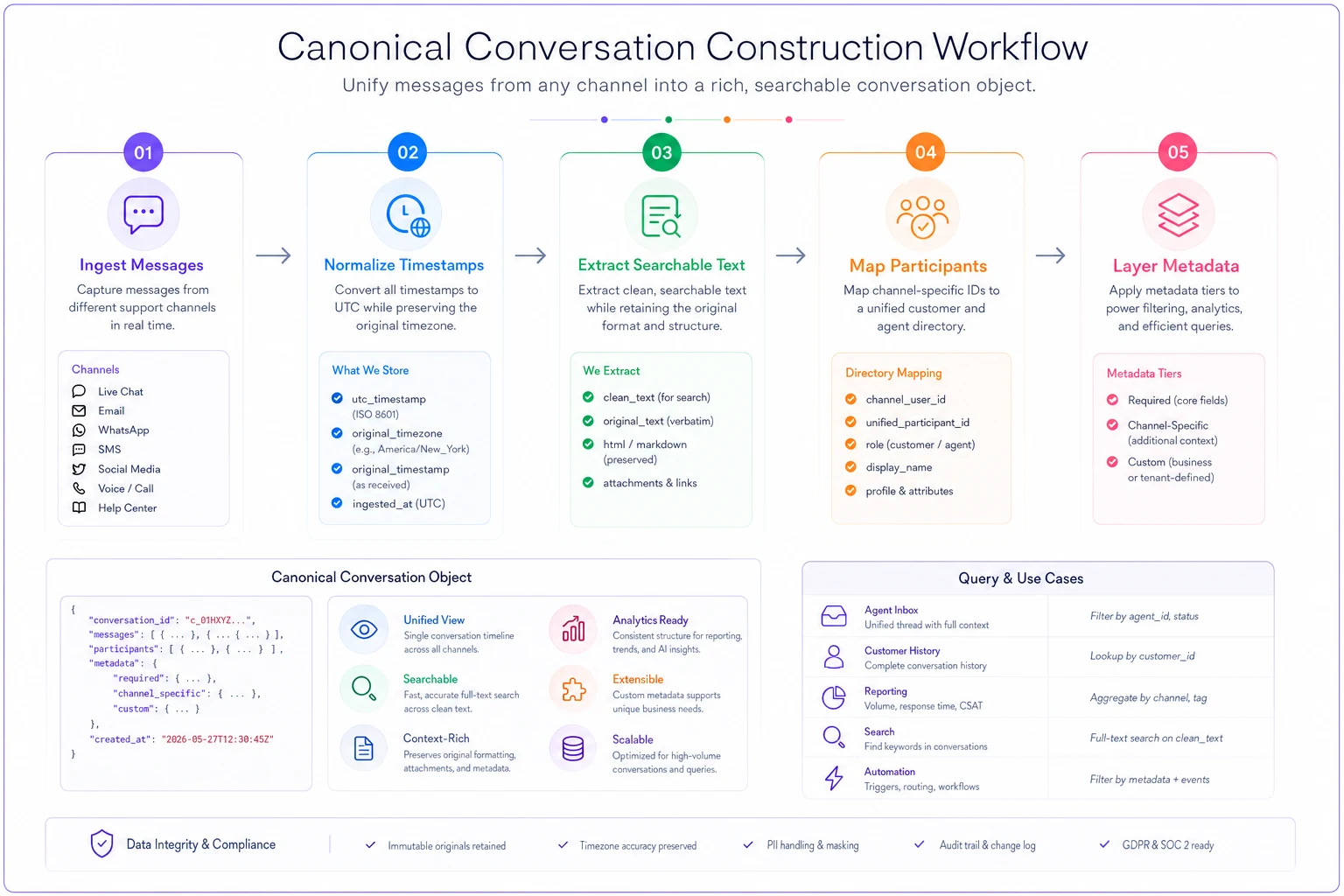
This illustrates how messages from different channels get normalized and combined into a single conversation object.
Metadata propagation rules that preserve context without creating noise
Raw metadata is useless if it doesn't flow intelligently between interactions. You need explicit rules about what carries forward, what gets transformed, and what stays behind. Most teams either propagate everything (noise) or nothing (lost context). The sweet spot is selective, rule-based propagation.
Start with identity propagation. When a customer switches from email to chat, their identity should carry forward automatically—not just name and email, but customer ID, account status, recent order history, open issues. This seems obvious but requires careful field mapping. Email identifies by address, chat by browser cookie, phone by number. Your propagation rules need to reconcile these into a single identity.
Pro-tip: Map email addresses, browser cookies, and phone numbers to a single customer ID early to simplify identity propagation.
Context propagation is trickier. Previous message summaries should flow forward, but not entire conversation histories. Key data points like order numbers, ticket IDs, and error messages should persist. But you don't need every "thanks" and "you're welcome" cluttering the context. Build rules that extract meaningful information and filter the noise.
State propagation prevents repetitive verification. If a customer already authenticated via email, they shouldn't need to re-verify in chat. If they confirmed a shipping address on the phone, don't ask again via SMS. These state flags need to propagate with security awareness—authentication status might expire after 30 minutes, shipping confirmation might persist for the full conversation.
Channel-specific transformations matter too. Phone call notes need to be converted to searchable text. Chat sessions need to be condensed. Email threads need to be parsed for the actual customer message versus quoted history. These transformations happen during propagation, not storage, which keeps your canonical objects clean.
At an online furniture retailer handling around 850 tickets daily, implementing propagation rules cut average handle time by roughly 4 minutes on complex issues. The biggest gain came from propagating product SKUs and order numbers automatically. Agents stopped asking customers to repeat reference numbers they'd already provided in a previous channel.
Timeline stitching patterns for complex customer journeys
Real customer journeys don't follow neat linear paths. They loop back, branch, go dormant, suddenly reactivate. Your timeline stitching needs to handle this messiness while maintaining a coherent conversation flow.
The foundation is temporal correlation—connecting interactions that happen close together in time. But "close" varies by channel and behavior. Email responses might come days apart. Chat messages happen in seconds. A phone call after an email might be an immediate escalation or a week-later follow-up. Stitching logic needs channel-aware time windows.
Customer signal patterns help identify related conversations. Same customer, same product, within 72 hours? Probably related. Same technical error message across different channels? Almost certainly related. Similar problem description with matching order numbers? Connect them. These patterns become your correlation rules, but they need confidence scoring, not binary decisions.
The tricky part is handling splits and merges. A customer might start with two different order issues in one email, then split them into separate chats. Or three issues across channels might turn out to be symptoms of one root problem. Your stitching needs to support both divergence and convergence without losing track of the relationships.
For a consumer electronics company, we built stitching patterns around common journey types. Returns typically started with email, escalated to chat for label generation, then moved to phone for refund confirmation. Technical issues began in chat, moved to email for documentation, sometimes ended in phone for advanced troubleshooting. Each pattern had different correlation windows and confidence thresholds.
Manual correction mechanisms are essential. Sometimes agents need to link conversations your rules missed. Other times they need to split conversations your system incorrectly merged. These corrections should feed back into your correlation patterns, improving accuracy over time.
Handoff protocols that maintain conversation context
Channel handoffs are where most conversation continuity breaks. The customer explains their issue to a chat agent, gets transferred to phone support, and suddenly they're starting from scratch. Even when agents can see previous interactions, they often don't know what to focus on or what to trust.
Structured handoff protocols define exactly what information moves between channels and how it's validated. This isn't just passing notes—it's a formal handshake between systems that ensures nothing critical gets lost.
The handoff package should include four things. A conversation summary in 2–3 sentences max—not a transcript, but the essential context. Verified data points the receiving agent can trust: confirmed identity, validated order numbers, authenticated account status. A record of attempted resolutions showing what's already been tried. And the escalation reason explaining why the handoff is happening.
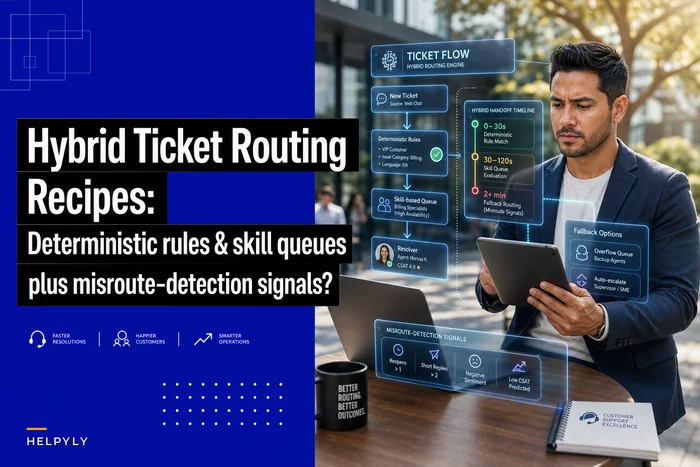
Hybrid ticket routing recipes become more powerful when they can leverage proper handoff context. Instead of routing based solely on keywords or categories, you can route based on conversation history, previous agent skills, and accumulated context complexity.
Handoff timing affects success rates too. Synchronous handoffs (customer stays connected while switching channels) preserve more context but require coordination. Asynchronous handoffs need stronger context preservation but offer more flexibility. Your protocols should support both, with clear indicators of which type is happening.
The validation step most teams skip: confirming the handoff was received correctly. The receiving system should acknowledge receipt, validate data completeness, and flag any missing required fields. Without this confirmation loop, handoffs fail silently and context evaporates.
For a travel booking platform handling around 2,400 daily interactions, we implemented handoff protocols with automatic context verification. When chat transferred to phone, the phone system validated that order numbers were real, dates made sense, and customer identity matched across systems. Invalid handoffs got flagged immediately instead of wasting everyone's time.
Audit mechanisms to catch context loss before customers complain
You can't fix conversation continuity problems you can't see. Most teams only discover context loss when customers complain, which means always playing defense. Proactive audits catch issues before they hit the customer.
Start with conversation reconstruction audits. Randomly sample 50–100 customer journeys weekly. Can you reconstruct the full conversation across all channels? Are there gaps? Missing metadata? Broken links between interactions? This isn't about perfect reconstruction—it's about finding systematic failures in your continuity chain.
Metadata completeness checks should run continuously. Every conversation object should have required fields populated. Every handoff should include minimum context. Every timeline stitch should meet confidence thresholds. Automated checks that flag incomplete data before it causes problems are worth building early.
Context verification happens at critical points. When an agent says "I can see your previous conversation," can they actually see it? When a customer references something they explained earlier, does that context exist in the system? These become audit triggers that flag potential continuity breaks.
Ticket surge response playbooks help when audits reveal systematic problems. If context loss spikes for a specific channel or integration, you need rapid response protocols to minimize customer impact while fixing root causes.
The most valuable audit is repeat contact analysis. When customers contact you multiple times about the same issue, trace back through the journey. Where did context get lost? Which handoffs failed? What metadata didn't propagate? Repeat contacts are the canary warning you of systemic continuity failures.
When cross-channel continuity actually pays off (and when it's overkill)
Perfect conversation continuity sounds great in theory. The cost-benefit varies a lot depending on your business model, customer expectations, and volume.
High-value, complex customer journeys justify the investment. Enterprise software with six-figure contracts, subscription businesses with multi-touch onboarding, anything where customer lifetime value exceeds $1,000—the math usually works in your favor. Losing context during a technical escalation could cost you a renewal.
For transactional support with simple one-touch resolutions, full continuity is probably overkill. If 90% of your tickets are password resets and shipping status checks, complex conversation objects and timeline stitching won't move the needle. You'd be better off improving self-service.
The channel mix matters too. Email-only support doesn't need sophisticated handoff protocols. But once you're running email, chat, phone, and SMS simultaneously, conversation continuity becomes critical. Complexity grows with each additional channel.
Implementation phases work better than all-or-nothing approaches. Start with canonical conversation objects for identity and core metadata. Add timeline stitching for your highest-value customer segments. Implement full handoff protocols for technical escalations first. Build from there based on actual impact, not theoretical completeness.
The operational reality of maintaining conversation continuity
Building conversation continuity is one thing. Maintaining it as you scale is another. Systems that work at 100 tickets per day break at 1,000. Clean data models get messy as you add edge cases. Perfect handoff protocols degrade as you hire new agents.
The maintenance burden is real. Someone needs to monitor propagation rules, update correlation patterns, audit data quality, and train agents on handoff protocols. This isn't set-and-forget. Budget at least 10–15% of your initial implementation effort for ongoing maintenance.
Integration brittleness causes most failures. Your email system updates its API. Your chat vendor changes data formats. Your phone system adds new metadata fields. Each change can break conversation continuity. Build abstraction layers between your canonical model and external systems. Log everything. Monitor for schema changes.
Performance degrades gradually too. Conversation objects accumulate metadata. Timelines get longer. Correlation queries slow down. What took 200ms at launch might take two seconds after a year. Build archival strategies from day one, index thoughtfully, and partition historical data before you need to.
AI automation makes conversation continuity more manageable over time. Modern platforms can automatically extract context, suggest correlations, validate handoffs, and flag anomalies. You still need the foundational data model and rules, but AI handles more of the heavy lifting as the system matures.
For teams starting from scratch, this might sound overwhelming. It doesn't have to be. Conversation continuity isn't binary—every improvement in metadata, handoffs, or basic correlation reduces customer frustration and agent workload. Start with the biggest pain points in your current operation and build incrementally.
When customers don't have to repeat themselves, satisfaction improves. When agents have full context, resolution speeds up. The businesses getting this right aren't necessarily the ones with the biggest budgets. They're the ones who recognized that conversation continuity is fundamentally about respecting customer time and agent effort—and did the unglamorous work of structuring data, defining rules, and maintaining quality.
Your customers are already having multi-channel conversations with you. The question is whether you're connecting those conversations or letting context scatter while customers and agents pay the price. The technical patterns exist. The operational playbooks are proven. The tools—especially AI-powered operational software—make implementation more accessible than ever.
But it still succeeds or fails based on organizational commitment. It needs collaboration between support, engineering, and operations. It needs buy-in for the initial investment and ongoing maintenance. And it requires a real shift in how you think about customer conversations—not as isolated tickets to close, but as continuous relationships.
Start with an honest assessment. Map your current conversation flows. Identify where context gets lost. Calculate the real cost of repeat contacts and extended handle times. Then build from there. Your customers will notice. Your agents will thank you. And your support operation will finally work the way customers always assumed it should.
Ready to elevate your customer support?
Join 2,000+ support teams using Helpyly to reduce response times, automate workflows, and deliver outstanding customer experiences.