


Most support teams aren't short on ideas. They're short on proof. Somebody wants to test a new macro, a new routing rule, a shorter first-response SLA, or an AI deflection flow, and the experiment happens — but three months later nobody can tell you whether it worked, who owned it, or whether you already ran the same test last year with the opposite conclusion.
That gap is the whole problem. Support generates dozens of changes a quarter, and almost none of them produce evidence strong enough to move headcount, budget, or vendor spend. So when finance asks "should we fund two more agents or double down on automation?", the answer comes from gut feel and a slide deck, not from a reproducible result.
This article is about building the governance layer that turns scattered support experiments into finance‑grade evidence — a catalog schema, de‑duplication rules, decision thresholds that map metric deltas to real staffing and finance actions, and a governance cadence light enough that people actually use it. If you've already read the metrics playbook that links support KPIs to decisions, think of this as the governance scaffolding that sits on top of it.
Why support experiments rarely survive contact with finance
The common failure isn't bad statistics. It's that support experiments live in people's heads, Slack threads, and one-off spreadsheets. No shared record, no owner after the person who ran it switches teams, no agreed definition of what "success" even means.
-
Orphaned tests. Someone pilots a new escalation macro, sees CSAT tick up, and moves on. Six months later a new lead "discovers" the same idea and runs it again from scratch.
-
Moving goalposts. The success metric gets chosen after the data comes in. If AHT went up but CSAT went up too, the writeup emphasizes CSAT. The result becomes unfalsifiable.
-
No guardrails. A deflection test quietly pushes reopen rates up 4 points because nobody set a stop condition. By the time it's caught, you've got a churn problem.
-
Metrics that don't convert to money. You "improved first contact resolution by 6%." Finance has no idea what that's worth, so nothing changes.
A support experiment isn't finished when you have a result. It's finished when the result is written in a form that someone in finance can actually defend in a budget meeting. That's a much higher bar, and it requires governance, not just analytics.
The catalog: one record per experiment, no exceptions
Everything starts with a catalog — a single table where every experiment is registered before it runs. Not after. The registration step is what forces people to declare a hypothesis and a metric upfront, which kills the moving-goalposts problem before it starts.
Never let a customer request slip through the cracks.
Helpyly helps you track, resolve, and optimize every support interaction effortlessly.
- Centralized ticket management
- Automated customer notifications
- Performance analytics dashboard
No credit card required
| Field | What it captures | Why it matters |
|---|---|---|
| Experiment ID | Unique, sequential | De-duplication and reference |
| Hypothesis | "If we X, then metric Y moves by Z because…" | Forces a falsifiable claim |
| Primary metric | One metric, pre-declared | Prevents cherry-picking |
| Guardrail metrics | Metrics that must not degrade | Catches hidden damage |
| Sample size / duration | Minimum tickets or days | Prevents calling it early |
| Owner | A named person, not a team | Accountability survives reorgs |
| Decision threshold | The delta that triggers an action | Links result to a decision |
| Status | Proposed / running / concluded / parked | Makes the pipeline visible |
| Prior-art link | Related past experiments | Stops re-running old tests |
The hypothesis field does more work than it looks. "Test new onboarding macro" is not a hypothesis. "If we replace the account-setup macro with a shorter version, first-reply CSAT will rise at least 3 points without increasing reopens" is. The second version can be proven wrong, which is the entire point.
Keep the catalog in a shared file with version history so you can trace when hypotheses, metrics, or thresholds changed.
Keep the catalog somewhere everyone can see the whole pipeline — not buried in a single analyst's drive. The visibility is half the governance. When people can see three similar tests already queued, they stop proposing a fourth.
Reuse and de-duplication: stop paying for the same answer twice
This is the least glamorous part and the one with the biggest quiet payoff. Teams waste a surprising amount of effort re-running experiments they've already run, or running conflicting experiments on overlapping ticket populations at the same time.
-
Search before you register. Every new proposal has to link to any prior experiment touching the same metric or workflow. If a match exists within the last 12 months, the proposal has to explain what's materially different — new volume, new product area, new customer segment.
-
No overlapping populations. Two experiments can't run on the same ticket queue simultaneously if they both affect the primary metric. A deflection test and a routing test running on the same billing queue will contaminate each other, and you'll trust neither result.
-
Expire results, don't delete them. A conclusion from 18 months ago under different volume and staffing isn't automatically valid today, but it's still evidence. Tag results with the conditions they were measured under so you know when they've gone stale.
-
Promote winners into the standard, then stop testing them. Once an experiment wins and gets adopted, close the loop. Don't let it sit in a "running" state indefinitely, quietly consuming a test slot.
The de-duplication discipline is what separates a catalog from a graveyard. Roughly a third of "new" ideas in teams without this rule turn out to be variations of something already tested and shelved. Catching those early is pure saved capacity.
Decision thresholds: translating a metric delta into an action
This is the section that actually earns the phrase finance-grade. A result that doesn't map to a decision is trivia. The governance layer's job is to pre-commit to what a given delta means — in staffing, budget, or vendor terms — before anyone sees the numbers.
The mechanism is a threshold table attached to each experiment. You decide, in advance, what action each outcome band triggers.
| Primary metric result | Guardrail check | Pre-committed action |
|---|---|---|
| AHT drops ≥ 15% | Reopens flat, CSAT flat | Build the automation-savings case; model deferring one planned hire |
| AHT drops 5–15% | Guardrails hold | Expand to a second queue before any staffing decision |
| AHT drops < 5% | Guardrails hold | Park it; not worth the change-management cost |
| Any improvement | Reopens up > 2 pts or CSAT down > 2 pts | Kill immediately, regardless of AHT |
Notice the guardrail row at the bottom overrides everything. A result that improves your headline metric while quietly damaging a guardrail is not a win — it's a deferred cost. Pre-committing to kill those keeps the catalog honest.
To make the staffing and finance mapping real, you have to attach a dollar translation to the primary metric. If your fully-loaded cost per ticket is somewhere around $6–$8, and a tested change shaves average handle time enough to recover roughly 400–500 agent-hours a quarter, that's a number finance can convert into a run-rate. The experiment doesn't just say "AHT improved." It says "this is worth approximately one-third of an FTE in recovered capacity, sustained." That's the sentence that moves budgets.
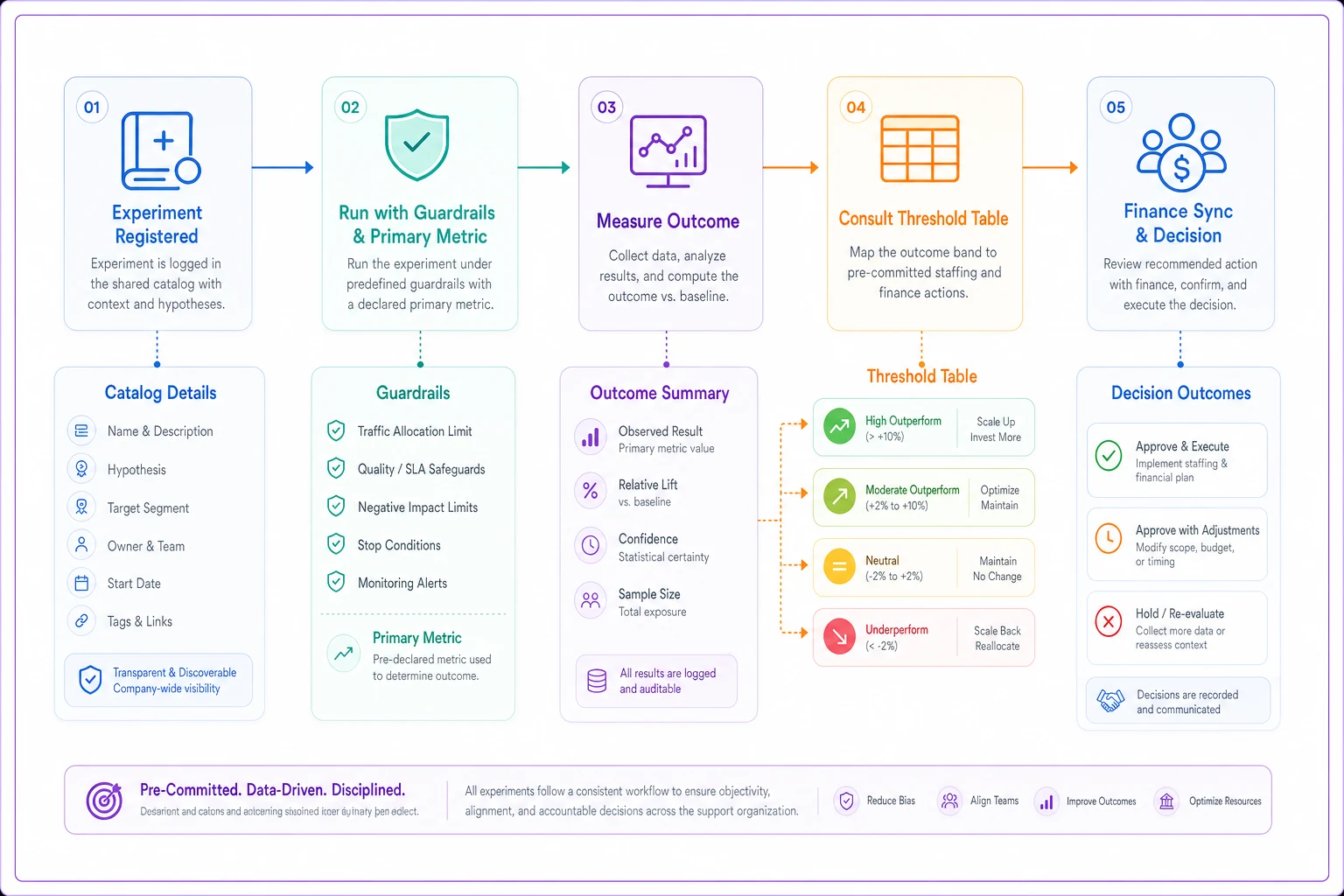
This visual shows the workflow from registering an experiment to mapping outcomes to pre-committed actions and finance decisions.
Thresholds also need a direction for the negative case. If a test to tighten a first-response SLA raises cost without moving CSAT, the pre-committed action should be "revert and document why" — so the next person who proposes the same thing finds the evidence instead of repeating the mistake.
A lightweight governance cadence (not a committee)
The fastest way to kill experimentation governance is to make it heavy. The second you need a 45-minute meeting to approve a macro test, people route around you and you're back to Slack-thread chaos.
-
Weekly, 20 minutes — the pipeline review. Walk the catalog. What's proposed, what's running, what concluded. Approve low-risk tests on the spot. The only questions that matter: is the hypothesis falsifiable, is there prior art, and are the guardrails set?
-
Monthly — the evidence review. Concluded experiments get read against their pre-declared thresholds. Did the delta clear the bar? Was the pre-committed action taken? This is where results become decisions.
-
Quarterly — the finance sync. The accumulated wins and kills get rolled into staffing and budget conversations. This is the meeting where "we ran 14 experiments, here are the three that justify action" actually lands.
Two risk tiers keep the cadence honest.
Low-risk experiments — a macro reword, a snippet change, a KB title — get self-serve approval as long as they follow the schema. Testing customer-facing copy sits squarely here, and the mechanics of doing it safely are worth reading in the piece on A/B testing canned responses with personalization and localization safety checks. High-risk experiments — anything touching SLAs, routing logic that affects customer outcomes, or automated deflection — need an owner, explicit guardrails, and a stop condition before they run. The weekly review is where that line gets enforced.
A real scenario
A mid-sized SaaS support team — around 22 agents, handling somewhere near 9,000 tickets a month across billing, onboarding, and technical queues — had the classic problem. Lots of experiments, no memory. Over about a year they'd run a new deflection flow twice (the second team didn't know the first had tried it), tested three macro variations on the billing queue simultaneously, and "improved" FCR on onboarding in a way that quietly raised reopens.
They put in a catalog with pre-declared hypotheses and a threshold table, plus the de-duplication rule requiring a prior-art link. Nothing fancy — a shared sheet and a 20-minute weekly standup.
Over the next two quarters the visible change wasn't that they ran more experiments. They ran slightly fewer — roughly 15 instead of the 20-odd they'd been averaging — because de-duplication killed the repeats before they started. But of the ones they ran, about two-thirds produced a clean, defensible result tied to a pre-committed action. The onboarding reopen problem got caught by a guardrail and reverted inside a week instead of running for a full quarter. And when budget season came, the support lead walked in with three experiments that translated into roughly a third of an FTE in recovered capacity and a defensible case to delay one planned hire. Finance signed off without the usual "prove it" friction, because the proof was already in the format they needed.
When this makes sense — and when it's overkill
Worth building when:
-
You're running more than a handful of changes per quarter and losing track of outcomes.
-
Finance keeps asking support to justify headcount or automation spend and you can't produce clean evidence.
-
You've caught yourself re-running old tests or arguing about what "success" meant after the fact.
Overkill when:
-
You're a team of three or four handling low volume. A shared doc listing what you changed and whether it helped is enough — formal thresholds would just slow you down.
-
Your experiments are purely cosmetic and carry no staffing or budget implication.
Who should not do this: teams that won't enforce the pre-declaration step. If people are allowed to register the hypothesis after seeing results, the whole structure becomes theater. Better to run no governance than fake governance, because fake governance produces evidence people trust when they shouldn't.
The checklist to stand this up
The checklist to stand this up
-
[ ] One catalog, visible to the whole team, with the full schema
-
[ ] Every experiment registered before it runs, with a falsifiable hypothesis
-
[ ] One pre-declared primary metric and at least one guardrail per test
-
[ ] A prior-art link required on every proposal (de-duplication)
-
[ ] No overlapping populations on the same primary metric
-
[ ] A threshold table mapping deltas to staffing/finance actions
-
[ ] A dollar translation attached to each primary metric
-
[ ] Weekly pipeline review, monthly evidence review, quarterly finance sync
-
[ ] Two risk tiers — self-serve for low-risk, owner + stop condition for high-risk
-
[ ] Concluded winners promoted into the standard and closed out
Concluded winners promoted into the standard and closed out
The real shift
The hard part of support experimentation governance isn't the math or the tooling. It's the discipline of deciding what a result means before you know what it is. Everything else — the catalog, the de-duplication rules, the cadence — exists to protect that one commitment from the very human urge to rationalize after the fact.
Get that right and support stops being the department that "feels like it's improving" and becomes the one that can walk into a finance review with evidence strong enough to move a budget. That's the difference between running experiments and producing proof.
Get that right and support stops being the department that "feels like it's improving" and becomes the one that can walk into a finance review with evidence strong enough to move a budget. That's the difference between running experiments and producing proof.
Ready to elevate your customer support?
Join 2,000+ support teams using Helpyly to reduce response times, automate workflows, and deliver outstanding customer experiences.