

Most tone experiments die in one of two ways. Either the test never launches because nobody can agree on what "better" means, or it launches, moves a metric, and quietly damages something nobody was watching — like refund requests or escalations. Tone is sneaky like that. A warmer apology can lift CSAT and simultaneously teach customers that complaining harder gets them more.
This post is specifically about support message tone tests: experiments where you're changing how something is said, not what the underlying resolution is. Different apology phrasing. A softer or firmer offer. A more casual greeting. These feel low-risk because you're "not changing anything real." That assumption is exactly where teams get burned.
Below is why tone experiments fail differently than normal template tests, and the guardrails that keep them honest.
Why tone tests behave differently than template tests
When you A/B test a canned response for resolution rate or reply time, the failure modes are pretty obvious. A template either solves the problem or it doesn't. Tone is fuzzier. The same words can land as reassuring to one customer and patronizing to another, and the metric that catches the damage is almost never the one you were tracking.
A typical example: a team tests a more generous-sounding apology on billing complaints — something like "You're absolutely right, that's on us, let me fix it immediately." CSAT ticks up two or three points. Everyone celebrates. Three weeks later the refunds team notices concession rates on billing tickets crept up because agents, following the warmer script, started conceding fault faster and offering goodwill credits more readily. The tone changed behavior on both sides of the conversation.
That's the core thing most people miss. Tone doesn't just change how the customer feels. It changes what they ask for next, and it changes what your agents feel licensed to do. You're not testing words. You're testing an incentive.
If you haven't already locked down the mechanics of running clean template experiments, start with Stop shipping untested templates: A/B testing canned responses, personalization safety checks and localization rules. This post assumes you've got that foundation and focuses only on the tone-specific traps.
The three tone dimensions worth isolating
Lumping "tone" into one variable is the first mistake. There are three separate levers, and they need separate tests because they fail for different reasons.
Never let a customer request slip through the cracks.
Helpyly helps you track, resolve, and optimize every support interaction effortlessly.
- Centralized ticket management
- Automated customer notifications
- Performance analytics dashboard
No credit card required
| Dimension | What you're changing | Primary risk to watch |
|---|---|---|
| Message tone | Warmth, formality, greeting/sign-off style | Feels fake or over-familiar; erodes perceived competence |
| Offer phrasing | How a resolution, credit, or workaround is presented | Anchors expectations; trains customers to push for more |
| Apology language | Degree of fault admitted, sympathy expressed | Legal/liability exposure; concession creep; repeat-complaint incentive |
Keep these separate. Apology language carries liability weight that greeting warmth doesn't. If you bundle "friendlier greeting + stronger apology" into one variant and it wins, you have no idea which half did the work — and you might be shipping an admission-of-fault phrasing that legal would never have approved if they'd seen it in isolation.
Apology language especially deserves its own controlled test. Phrases like "we take full responsibility" read as kind but can matter in disputes and chargebacks. Test them separately so you can actually measure the downstream cost, not just the CSAT bump.
Safety checks before a single variant goes live
Tone tests need pre-launch gates that normal experiments skip. Here's the checklist worth running before flipping any tone variant into a live queue:
-
Concession ceiling defined. If the new phrasing could invite more refund or credit requests, set a hard limit on what agents can grant without escalation before launch — not after you see the damage.
-
Liability review on apology wording. Anything that admits fault, promises a fix by a specific date, or uses absolutes ("this will never happen again") needs a quick legal sanity check.
-
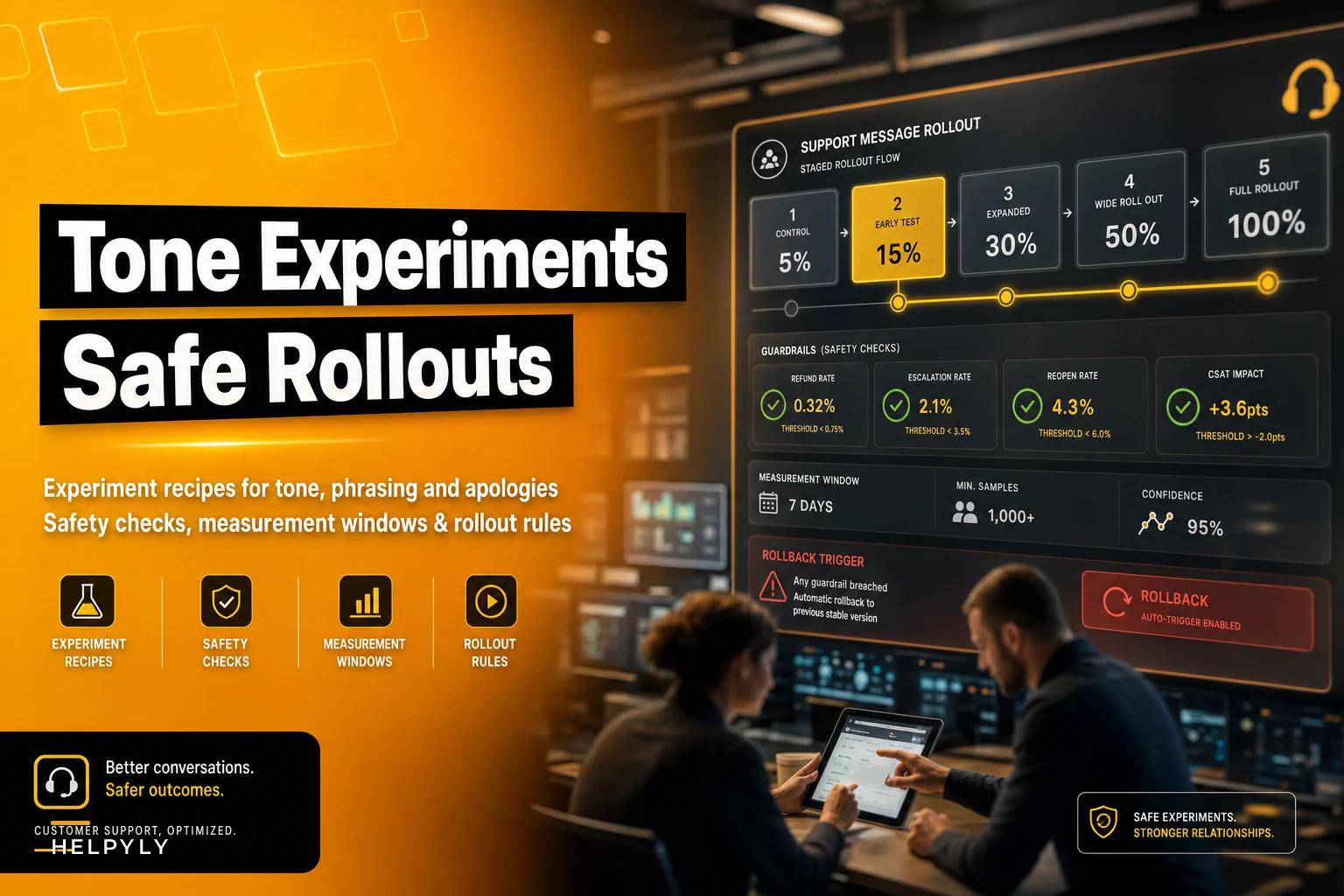
Guardrail metrics named. Pick two or three metrics you expect to stay flat. Common ones: refund rate, escalation rate, reopen rate, average concession value. If any of these move, the test is a loss even if CSAT wins.
-
Segment exclusions set. Exclude high-value accounts, active disputes, and anyone already in an escalation path. Running casual-greeting experiments on a customer threatening to cancel is asking for trouble.
-
Rollback trigger written down. Define the exact threshold that kills the test early — for example, escalation rate up more than 15% on the variant for two consecutive days.
The guardrail metrics are the part teams most reliably forget.
The guardrail metrics are the part teams most reliably forget. A tone test that only tracks what it's trying to improve is basically designed to look successful. You measure the things you hope don't move because those are where tone does its quiet damage.
The measurement window problem
Standard template tests can often call a winner in a few days. Tone tests can't, and the reason is straightforward: the effects that matter most show up after the first interaction.
-
Run the exposure window long enough to hit a meaningful sample — for most mid-size queues that's closer to two or three weeks, not three days.
-
Hold a downstream observation window of at least 14 days after each ticket's first response, so repeat contacts and reopens attributed to the same customer get counted against the variant that caused them.
-
Attribute downstream tickets to the original variant, not the agent who caught the follow-up. This is the step almost everyone skips, and it's the one that reveals concession creep.
Tone changes have a delayed cost curve. Short measurement windows systematically hide the cost while fully crediting the benefit. That asymmetry is why plenty of "successful" tone tests quietly make things worse over time.
A real scenario
A regional SaaS company with a nine-person support team ran a tone test on their "we can't do that" refusal messages — the phrasing for feature requests and out-of-scope asks. The old version was flat and slightly corporate. The new version was warmer, offered a workaround suggestion, and included an invite to a feedback board.
In the first week, CSAT on refusal tickets jumped from the low 70s to around 84. Clear win by the usual scorecard.
But they'd set guardrails. Reopen rate on those same tickets was one of them. Over the 14-day downstream window, reopens on the warmer variant climbed noticeably — customers read the friendly "great idea, we'll pass it along" language as a soft yes and came back asking when the feature was shipping. Roughly one in six of the warmer refusals generated a follow-up ticket the flat version didn't produce.
The net was messy: happier initial interaction, more total tickets, and a chunk of customers left more disappointed on the second contact than they would've been with a clear no upfront. They kept the warmer tone but rewrote the workaround line to remove the implied promise. That version held the CSAT lift without the reopen tail. Without the downstream window, they'd have shipped the leakier version and celebrated it.
Rollout rules that keep a win from turning into a mess
Winning a tone test isn't the finish line. How you roll it out determines whether the result holds.
-
Ramp, don't flip. Move from a 50/50 test to full rollout in stages — something like 25% of the queue, then 60%, then full — watching guardrail metrics at each step. Tone effects can scale oddly; what's fine at half the volume can behave differently across every agent and segment.
-
Freeze the winning wording. Once a variant wins, lock the exact text. Tone results don't transfer when agents paraphrase. A warmer apology that works verbatim can come across as sarcastic in a rushed rewrite.
-
Re-test after any adjacent change. If you later change the offer or the escalation path, the tone result is no longer valid. Tone interacts with what comes next in the conversation — worth reviewing how this couples with your escalation ladders and customer communication templates before assuming a win is permanent.
-
Set an expiry. Tone that lands well now can feel off after a pricing change, an outage, or a seasonal shift. Put a review date on winning variants instead of treating them as settled forever.
A simple rollout workflow helps visualize the staged ramp and guardrail checks.
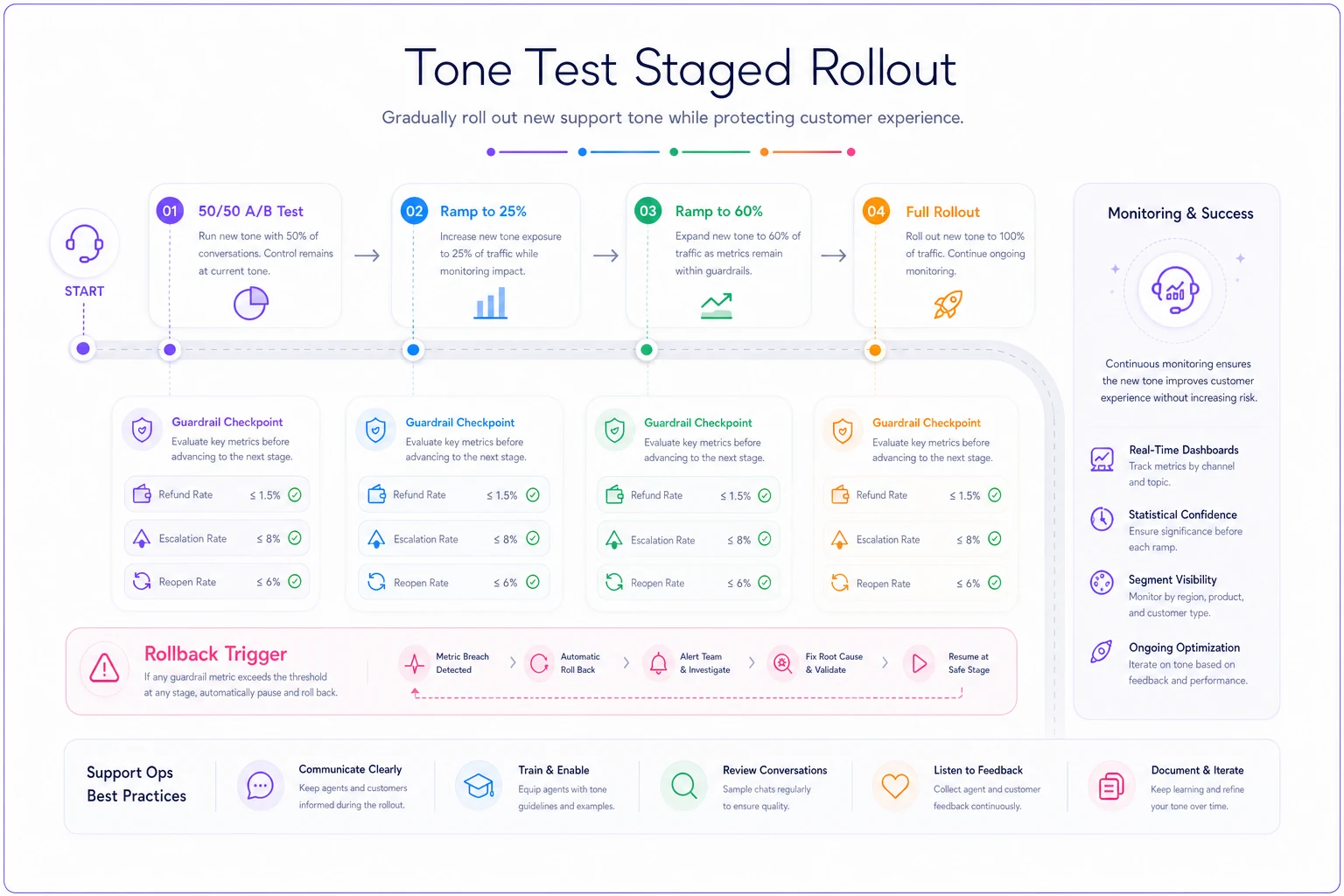
A tone win is a local result, valid for the exact wording, segment, and surrounding workflow it was tested in. The moment any of those change, you're extrapolating — and tone doesn't extrapolate cleanly.
When tone testing actually makes sense
Run these experiments when you've got enough volume on a specific message type to reach a meaningful sample inside a reasonable window — high-frequency apologies, refusal messages, common offer phrasings. Those earn the effort because the wording gets used thousands of times.
Run these experiments when you've got enough volume on a specific message type to reach a meaningful sample inside a reasonable window — high-frequency apologies, refusal messages, common offer phrasings. Those earn the effort because the wording gets used thousands of times.
When it's a bad idea
Skip tone testing on low-volume, high-stakes messages — cancellation saves for enterprise accounts, legal or compliance responses, anything tied to an active dispute. The sample will be too thin to trust, and the downside of getting it wrong on a big account dwarfs any CSAT gain. For those, use judgment and review, not experiments.
Skip tone testing on low-volume, high-stakes messages — cancellation saves for enterprise accounts, legal or compliance responses, anything tied to an active dispute. The sample will be too thin to trust, and the downside of getting it wrong on a big account dwarfs any CSAT gain. For those, use judgment and review, not experiments.
Who should not do this yet
If you can't attribute downstream tickets back to the original interaction, don't run tone tests at all yet. You'll capture the upside and stay blind to the cost — which is worse than not testing, because it gives you false confidence to ship things that quietly raise your ticket volume. Fix attribution first, then come back to this.
If you can't attribute downstream tickets back to the original interaction, don't run tone tests at all yet. You'll capture the upside and stay blind to the cost — which is worse than not testing, because it gives you false confidence to ship things that quietly raise your ticket volume. Fix attribution first, then come back to this.
Tone tests fail quietly because the benefit shows up immediately while the cost is delayed and lands somewhere you weren't watching. Separate the three levers, name the metrics you hope don't move, run a downstream window long enough to catch repeat contacts, and roll out in stages with the exact wording frozen. Done right, tone testing is one of the cheaper, higher-leverage things a support team can run. Skip the guardrails and you're just A/B testing your way into a heavier queue with a better CSAT chart to explain it.
Ready to elevate your customer support?
Join 2,000+ support teams using Helpyly to reduce response times, automate workflows, and deliver outstanding customer experiences.