

Most support orgs don't have a performance problem. They have a connection problem. The metrics live in one dashboard, the manager meetings run on a different logic, incentives reward whatever was easy to measure two years ago, and retention numbers get reviewed by someone in finance who's never sat on a queue. Each piece works fine in isolation. Together they pull in slightly different directions, and the team feels it even when nobody can name it.
The teams that consistently hit their numbers treat support performance management as a single system — one where a KPI movement triggers a specific manager action, where OKRs change shape depending on how mature the team is, and where the incentive scorecard is wired to outcomes leadership actually cares about (retention, NRR) rather than vanity throughput. This article walks through how those parts fit, where they break, and what the connective tissue looks like in practice.
Why disconnected metrics quietly sabotage good teams
The pattern shows up constantly: a support org invests in a solid analytics setup, gets clean dashboards, and still can't explain why CSAT dipped three points in Q2. The data is there. What's missing is the chain that turns a number into a human decision.
A KPI by itself is inert. "First response time went from 40 minutes to 58 minutes" is a fact. It becomes useful only when it maps to a question — why — and then to an owner who's expected to do something about it within a defined window. Most teams stop at the fact. The dashboard shows red, everyone nods in the Monday meeting, and nothing changes because no one's job explicitly says "when FRT crosses this line, you investigate staffing coverage first, then queue routing second."
This usually happens when the metrics layer and the management layer were built by different people at different times. Analytics gets built for reporting up. Management rhythms get built around whatever the current leader personally finds useful. They were never designed to interlock. If you're still sorting out which metrics deserve attention in the first place, the groundwork in this metrics playbook that links support KPIs to decisions is worth reading before building the action maps below — it's the layer underneath everything here.
The KPI → manager-action map
The single highest-leverage artifact in a support performance system isn't the dashboard. It's a one-page table that says: for each metric, what moves, who owns the response, and what the first action actually is. Without it, every anomaly becomes a debate. With it, the debate happened once — when you built the map — and daily operations just execute.
Never let a customer request slip through the cracks.
Helpyly helps you track, resolve, and optimize every support interaction effortlessly.
- Centralized ticket management
- Automated customer notifications
- Performance analytics dashboard
No credit card required
Here's what a working version looks like for a mid-sized team:
| KPI | Trigger (what moves) | Primary owner | First manager action | Escalate if… |
|---|---|---|---|---|
| First response time | >25% above rolling 2-week baseline | Shift lead | Check coverage gaps + queue routing before touching headcount | Still elevated after 2 shifts |
| CSAT | Drops 3+ pts week-over-week | Team manager | Pull 10 lowest-rated transcripts, tag root cause | Root cause is product, not support |
| Reopen rate | >12% on a given queue | QA lead | Sample reopens, check for premature closes | Pattern tied to one macro/template |
| Escalation volume | Spikes on a single category | Team manager | Flag to product liaison, check KB gap | Recurs 2 weeks running |
| Agent-level handle time | 1.5x team median, sustained | Direct manager | Coaching conversation, not a warning | No movement after coaching cycle |
The point isn't to copy this table. It's the structure: trigger, owner, first action, escalation condition. Notice the first actions are deliberately specific and deliberately not "add people." The most common management mistake is reaching for headcount or a stern email when the real first move is diagnostic. A manager who sees FRT climbing and immediately asks for more agents is skipping the step where they find out it was a routing bug sending general tickets into a specialist queue.
One thing worth sitting with: teams that build this map often discover they have KPIs nobody owns. That's not a reporting gap — it's an accountability gap wearing a dashboard costume.
OKRs that change shape as the team matures
A five-person support team and a fifty-person support org should not have the same OKRs. And yet templated OKR libraries hand them identical goals. The result is either a tiny team drowning in objectives built for a measured, instrumented operation, or a large team still setting goals like "respond faster" long after that stopped being the actual bottleneck.
OKRs need to be staged to where the team actually is. A rough maturity framing that holds up across most orgs:
Stage 1 — Ad hoc / firefighting. The team is reactive, metrics are thin, knowledge lives in people's heads. OKRs here should focus on instrumentation and stability, not optimization. Example objective: "Establish a reliable measurement baseline." Key results might be getting consistent CSAT collection on 90%+ of resolved tickets, documenting the top 20 repeat issues, and defining what a "resolved" ticket even means. You can't optimize what you haven't yet defined.
Stage 2 — Measured. Now you have data you trust. OKRs shift toward reducing variance and finding root causes. Objective: "Cut avoidable ticket volume." KRs: reduce reopen rate below a target, ship KB articles for the top recurring issues, bring the gap between your best and worst agent's quality scores within a defined band.
Stage 3 — Optimized / proactive. The team is stable and instrumented, so OKRs move toward business outcomes — retention, expansion, deflection that actually holds. Objective: "Support contributes measurably to retention." KRs tied to NRR on supported accounts, save rates on at-risk customers flagged through escalation patterns, and resolution quality that correlates with renewal.
A quick template you can adapt per stage:
-
Objective — one sentence, aspirational, no numbers.
-
2–4 Key Results — each measurable, each with a baseline and target.
-
Stage check — one line answering "is this team actually ready for goals at this level?"
-
Owner per KR — a name, not a team.
-
Review cadence — weekly check-in, monthly scoring.
The mistake here is ambition mismatch. Leadership sees a competitor's retention-linked OKRs and copies them onto a team that doesn't yet have trustworthy CSAT data. The OKRs look impressive and quietly go unmet for two quarters because the foundation wasn't there.
Wiring incentives to retention and NRR without breaking behavior
Incentives are where support performance systems go sideways fastest, because people optimize exactly what you pay them for — including the parts you didn't think through.
Pay agents purely on ticket volume and you'll get fast closes and a rising reopen rate. Pay purely on CSAT and you'll get agents gaming surveys, avoiding hard tickets, and quietly over-promising. The fix isn't a cleverer single metric — it's a balanced scorecard where no one dimension can be won by sacrificing another.
-
Quality (QA score / resolution accuracy) — ~35%. The anchor. Prevents speed from eating correctness.
-
Customer outcome (CSAT or resolution confirmation) — ~25%. Did the customer actually get helped.
-
Efficiency (handle time or volume, normalized by complexity) — ~20%. Keeps throughput honest.
-
Retention contribution (save rate / NRR on touched accounts) — ~20%. The business tie-in.
That last line is the one most teams skip, and it's also the one that connects a frontline agent's day to the number the CFO watches. You don't need every agent to personally own NRR — but a team-level or pod-level retention component changes how people treat an escalation from a renewal-risk account.
When this makes sense: once you're solidly in Stage 2 or beyond, with QA data you actually trust. Calibrated quality scoring is the foundation of any fair incentive — if your QA is inconsistent, your incentives will be too, and the fastest way to lose a team's trust is to pay them on a number they don't believe in. If that's where things stand, fix scoring reliability first using the approach in scaling QA without chaos through calibration and async reviews.
When it's a bad idea: Stage 1 teams. If your measurement baseline is shaky, incentives amplify the noise. You'll end up rewarding whoever happened to catch easy tickets that week.
Who should NOT do this: anyone considering individual-level NRR incentives on a small team. Retention is too multi-causal and too lumpy at small volumes — one churned enterprise account can wipe out a quarter's bonus for reasons that had nothing to do with support. Keep retention components at team or pod level until your account volume makes the numbers stable enough to be meaningful.
Keep retention components at team or pod level until your account volume is large enough to make individual NRR meaningful.
If that's where things stand, fix scoring reliability first using the approach in scaling QA without chaos through calibration and async reviews.
The manager cadence: the rhythm that holds it all together
All of the above is static until a cadence animates it. The cadence is the heartbeat — the recurring meetings, the coaching rhythm, the escalation reviews — that turns your maps and scorecards into weekly behavior. This is the part most often left to improvisation, and improvisation at scale means every manager runs a different system.
A cadence that works across most teams layers four loops at different frequencies:
Daily (10–15 min standup). Yesterday's anomalies against the KPI map, today's coverage, any active escalations. Not a status recital — just: what's red, who owns it, what's the first action. If nothing's red, it's a two-minute meeting.
Weekly (30–45 min team review). Trend review against OKR key results, QA calibration spot-check, one coaching theme for the week. This is where the manager connects individual patterns to team goals.
Biweekly (1:1 coaching, per agent, 30 min). Individual scorecard, specific transcript review, one development focus. Not performance theater — actual coaching.
Monthly (OKR scoring + incentive review). Score the key results, review the scorecard distribution, check whether incentives are producing the behavior you intended or quietly distorting it.
A quick visual can make it obvious who owns each loop and how information flows between the KPI map, OKRs, incentives, and coaching.
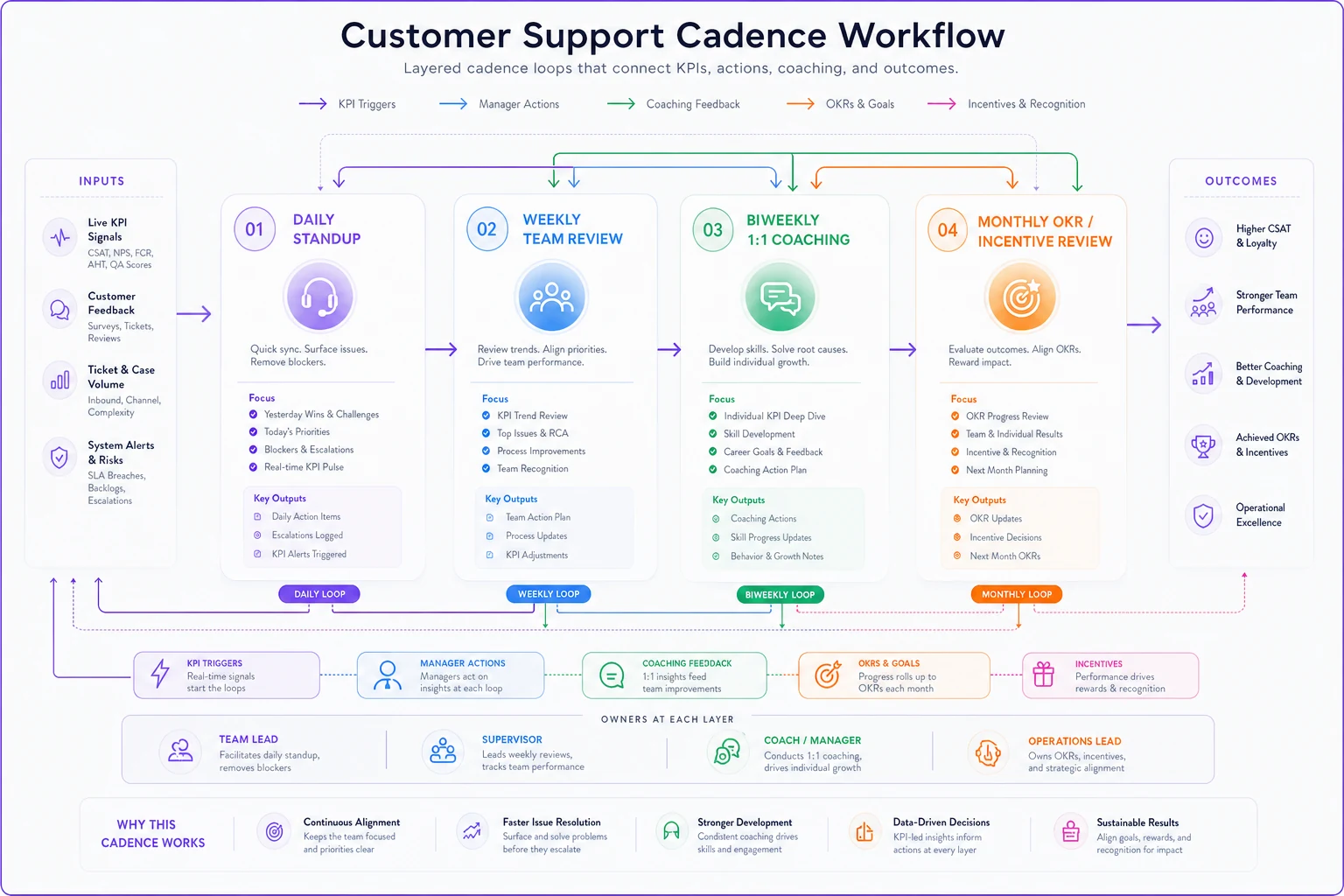
Use this visual to map who owns each loop in your org and where handoffs occur.
A sample weekly team-review agenda
-
Wins (5 min) — name two specific good resolutions, with the agent named. Sets tone.
-
KPI map review (10 min) — walk the reds, confirm owners and first actions, note anything escalating.
-
OKR check (10 min) — where's each KR versus target, what's blocking.
-
One coaching theme (10 min) — a pattern worth the whole team hearing (a macro misuse, a recurring escalation type).
-
Blockers up (5 min) — what the team needs from the manager or other functions.
The discipline that separates good cadences from ceremonial ones: every item ends with an owner and a next action, or it doesn't belong on the agenda. Meetings that produce no owned actions are the single most common waste in support orgs — they feel productive and change nothing.
Coaching scripts: making the 1:1 actually move a number
Managers freeze in 1:1s when the conversation is about underperformance, so they either avoid it or turn it into a vague "you need to do better." Neither moves anything. A light script removes the freeze.
A workable structure for a coaching conversation tied to a specific metric:
-
Open with the pattern, not the person. "Your reopen rate's been running about double the team's over the last three weeks — I want to dig into why together."
-
Look at evidence together. Pull two or three actual transcripts. "Walk me through what happened here." Let them narrate.
-
Find the cause, not the blame. Often it's a knowledge gap or a bad macro, not effort. The point of the review is diagnosis.
-
Agree on one change. One. "Let's try confirming resolution with that checklist before you close, and look again in two weeks."
-
Close with support. "What do you need from me to make that work?"
The mistake managers make is bundling five issues into one conversation. The agent leaves overwhelmed and changes nothing. One focused change per cycle, reviewed at the next 1:1, compounds far faster than trying to fix everything at once.
A real scenario: pulling the system together
A B2B SaaS company with a support team of roughly 18 agents had the common disconnect — good dashboards, improvised management. CSAT sat around 87%, reopen rate near 15%, and nobody could reliably say why renewals on heavily-supported accounts were softer than the book average.
They built the KPI→action map first, which immediately surfaced that reopen rate had no owner. They moved QA into a calibrated weekly rhythm so quality scores became trustworthy, then layered a balanced incentive scorecard with a pod-level retention component. OKRs got re-staged — the team had been chasing optimization goals while sitting on a Stage 2 foundation, so they reset to variance-reduction objectives.
Over about two quarters: reopen rate came down into the 9–10% range, CSAT drifted up a few points into the low 90s, and the number leadership actually cared about — NRR on supported accounts — closed most of its gap to the overall book. No single intervention did it. The reopen work fed quality, quality made incentives fair, fair incentives changed how the team handled at-risk accounts, and the cadence kept all of it from drifting back. That connectedness was the result, not any one change.
Where this breaks at scale
Once a team grows past the point where one manager personally knows every agent's patterns, the informal version of all this collapses. What held three managers together through hallway conversations doesn't survive at eight managers across three time zones. The map, the staged OKRs, the scorecard, the cadence agendas — these stop being nice-to-haves and become the only thing keeping the org coherent.
The second failure point is manager variance. Without shared agendas and coaching scripts, each manager runs a personal system, and agents who move between teams experience real whiplash. Standardizing the cadence while leaving room for individual coaching style is the balance that actually scales.
Finally, retention and OKRs have to stay connected to the career structure, or your best people hit a ceiling and leave — taking the institutional knowledge your whole system depends on. The incentive and performance layer only pays off if there's somewhere for high performers to go; the thinking in support career ladders that actually retain agents is the natural companion to everything covered here.
Bringing it together
A support performance system isn't a dashboard, a bonus plan, or a meeting calendar. It's the way those pieces talk to each other — a KPI that triggers a defined action, an OKR scaled to the team's real maturity, an incentive wired to the outcome leadership tracks, and a cadence that keeps the whole loop running when attention wanders.
Build any one piece in isolation and it works for a while, then quietly drifts out of sync with the others. Build them as one interlocking rhythm, and the team stops reacting to last week's fire and starts moving a number on purpose.
Start with the map. It's the cheapest artifact and the one that exposes the most — because the moment you try to assign an owner and a first action to every metric, you find out exactly where your system isn't actually a system yet.
A support performance system isn't a dashboard, a bonus plan, or a meeting calendar. It's the way those pieces talk to each other — a KPI that triggers a defined action, an OKR scaled to the team's real maturity, an incentive wired to the outcome leadership tracks, and a cadence that keeps the whole loop running when attention wanders.
Build any one piece in isolation and it works for a while, then quietly drifts out of sync with the others. Build them as one interlocking rhythm, and the team stops reacting to last week's fire and starts moving a number on purpose.
Ready to elevate your customer support?
Join 2,000+ support teams using Helpyly to reduce response times, automate workflows, and deliver outstanding customer experiences.