

Most privacy policies in support orgs live in a Confluence page that nobody opens. The actual decisions—"can I send this chat transcript to the US vendor?", "do I delete this recording now or in 90 days?", "does this customer get their data in 30 days or 45?"—happen at the agent level, under SLA pressure, often by someone who has never read GDPR Article 17 and never will.
That gap is the whole problem. The legal rules are jurisdiction-specific and written for lawyers. The work is ticket-specific and done by humans with 14 open conversations. Nobody has translated one into the other. So agents guess, and the business absorbs the risk silently until a regulator or a deletion request exposes it.
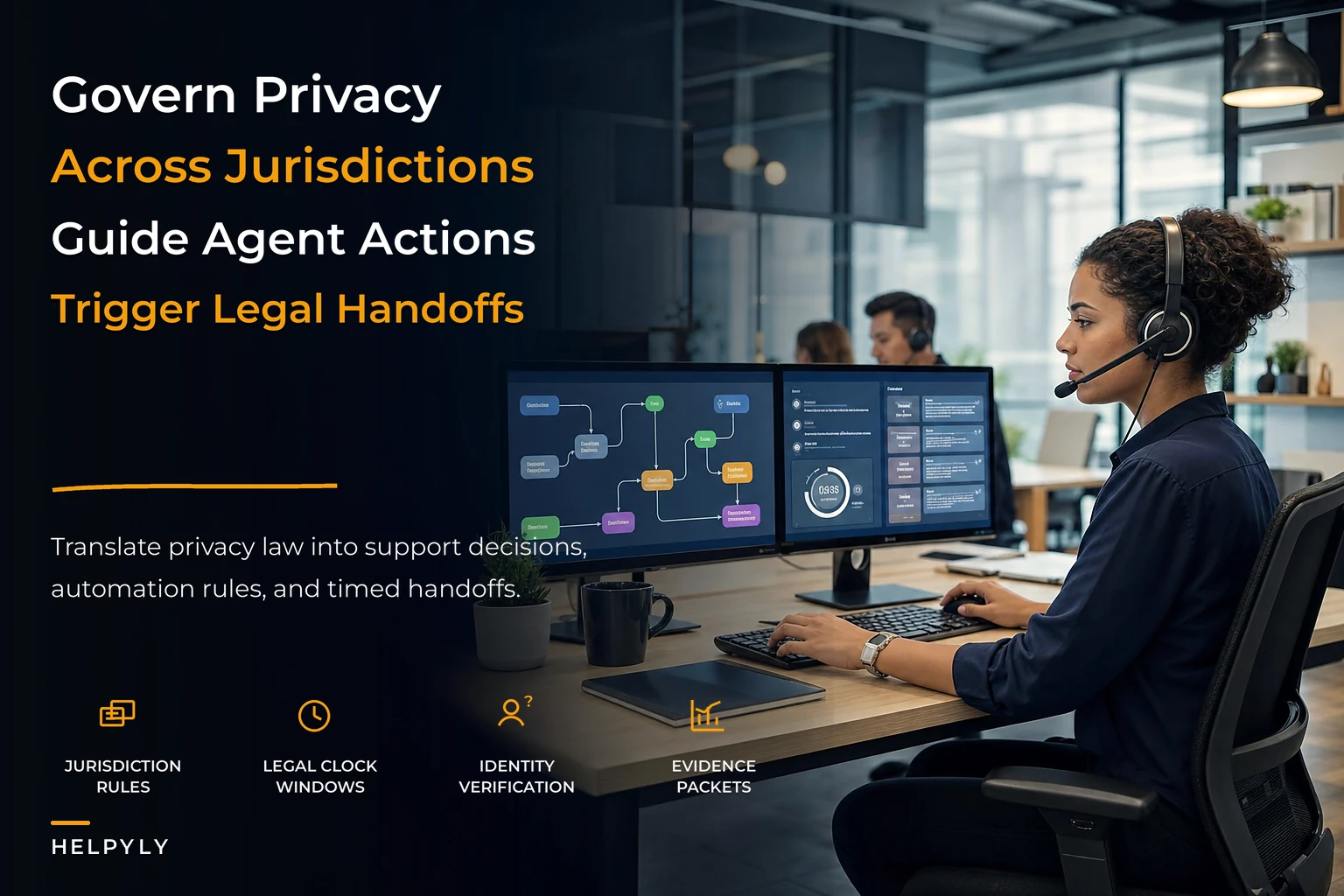
This article is about closing that gap with structure: decision trees agents can follow, enforcement rules that run automatically, evidence templates that survive an audit, retention windows that match the law, and clean handoffs when a request crosses into territory a frontline agent shouldn't touch. The goal isn't to make your team into privacy lawyers. It's to make the law operational—so the right action happens without someone pausing to interpret statute.
Why support data privacy jurisdiction breaks differently than you'd expect
The intuitive failure mode is "we didn't know the law." In practice, that's rarely what goes wrong. Teams usually know GDPR exists, know CCPA exists, maybe know Brazil's LGPD and Canada's PIPEDA are out there. The breakage happens one level down, in the operational translation.
A few patterns show up repeatedly:
The jurisdiction gets decided by the wrong signal. Agents default to the customer's account country or their IP, when the legally relevant factor is often where the data subject is located at the time of the request, or where your legal entity operates, or both. A customer with a US billing address emailing from Berlin can trigger EU obligations. If your routing logic keys off billing country, you've already mishandled it before anyone touches the ticket.
Retention becomes a storage problem instead of a legal one. Support platforms keep everything forever by default because deletion is annoying and storage is cheap. But "we keep chat logs indefinitely" is a direct contradiction of data-minimization principles in multiple regimes. The retention window should be a function of data type and jurisdiction, not a function of whatever your help desk's default setting happened to be.
SLA clocks don't match legal clocks. Your support SLA might promise a first response in 4 hours. A GDPR erasure request gives you roughly a month (extendable). A CCPA request has its own timeline. When these two clocks live in different systems—support SLA in the help desk, legal deadline in someone's head—the legal one gets missed, because the support clock is louder.
What shows up consistently across support orgs is that the privacy risk isn't concentrated in the obvious "delete my data" tickets. It's spread thin across thousands of ordinary interactions—a screenshot with a full card number, a transcript copied into a vendor's QA tool, a recording retained past its window. The volume is the risk.
The core idea: law → agent action → automation
The useful mental model is a three-layer translation. Each legal rule should map cleanly down two levels until it becomes something a system or an agent does without interpreting.
Never let a customer request slip through the cracks.
Helpyly helps you track, resolve, and optimize every support interaction effortlessly.
- Centralized ticket management
- Automated customer notifications
- Performance analytics dashboard
No credit card required
The failure in most orgs is that the middle layer doesn't exist. Legal writes the top layer, engineering sometimes builds parts of the bottom layer, and the agent is left to bridge a gap they're not equipped to bridge. Every law needs to resolve into a tree the agent follows and an automation that enforces it—so the agent's judgment is spent on the customer, not on the statute.
| Layer | What it contains | Who/what owns it | Example |
|---|---|---|---|
| Law | Statutory obligation, jurisdiction-specific | Legal / DPO | "EU residents have a right to erasure within 1 month (GDPR Art. 17)" |
| Agent action | A decision the agent can make from a tree | Frontline agent | "Verify identity → tag as erasure → route to privacy queue → do NOT self-resolve" |
| Automation | Enforcement that runs without a human | The platform | "Auto-start 30-day timer, lock ticket from bulk-export, redact PII in analytics copy" |
The failure in most orgs is that the middle layer doesn't exist. Legal writes the top layer, engineering sometimes builds parts of the bottom layer, and the agent is left to bridge a gap they're not equipped to bridge. Every law needs to resolve into a tree the agent follows and an automation that enforces it—so the agent's judgment is spent on the customer, not on the statute.
Build the decision tree agents actually follow
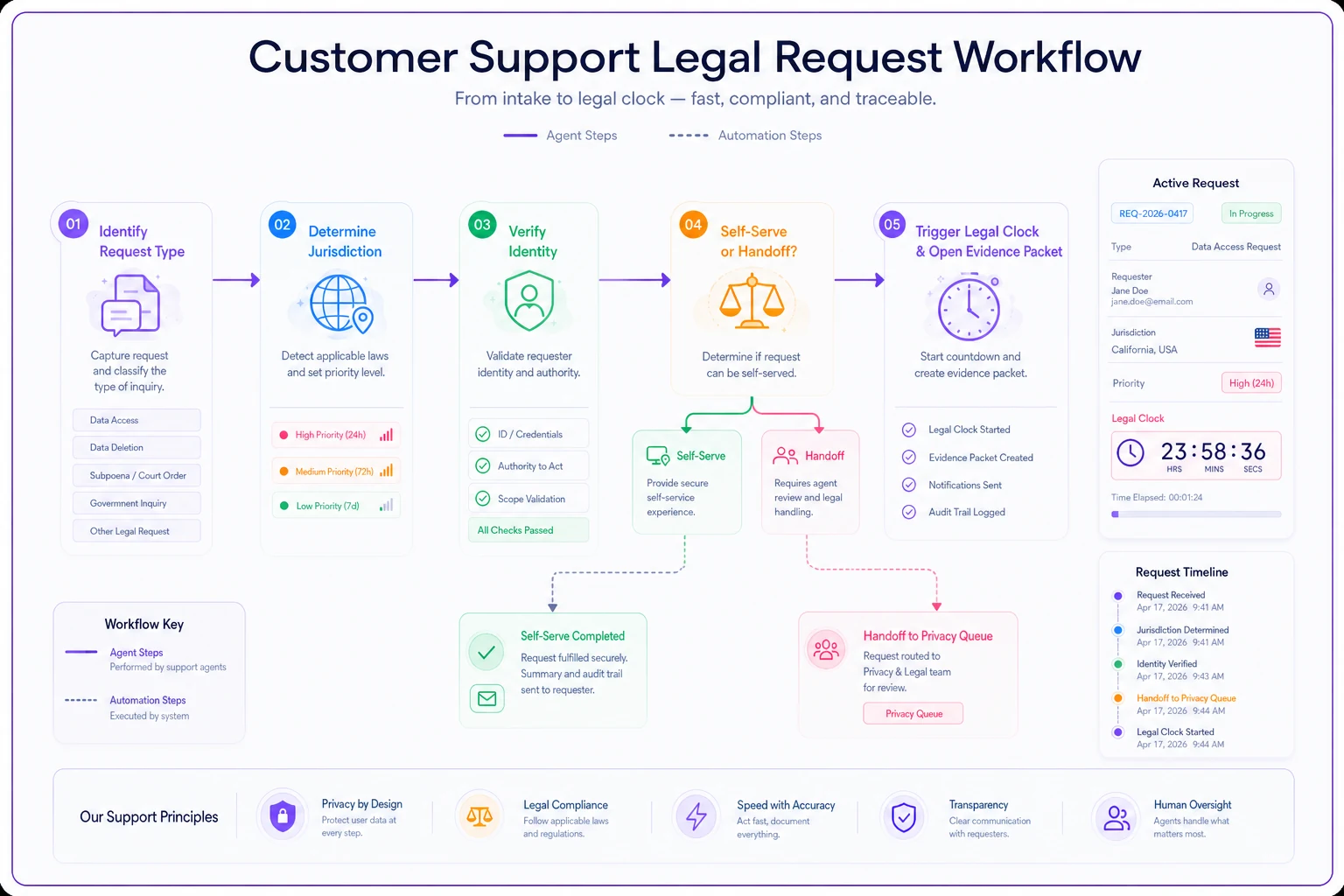
A privacy decision tree for support has to be short enough to run in the agent's head and specific enough that two different agents reach the same answer. Here's the shape of one for inbound data-subject requests.
-
Identify the request type. Access, deletion, correction, portability, opt-out, or "none of these—it's a normal ticket." Most tickets exit here as normal.
-
Determine the governing jurisdiction. Not by guessing. Use a defined signal order: declared residency on file → entity-of-contract → location at time of request. Document which signal won.
-
Verify identity to the required standard. This threshold changes by jurisdiction and request type. A deletion request needs stronger verification than a simple access request. Under-verifying creates a different risk—handing data to an impersonator is itself a breach.
-
Decide
self-serve or handoff.
Opt-out of marketing? Agent can often handle it. Full erasure touching billing, vendor systems, and backups? Handoff to the privacy queue. The tree should name the exact boundary. -
Trigger the clock and the evidence packet. The moment a request is confirmed, the legal timer starts and the evidence template opens. Not when someone gets around to it.
The discipline that matters here is step 2. If your agents can't deterministically answer "which law applies," everything downstream is built on sand. Write the signal-priority order down and make it non-negotiable—this is where most of the inconsistency actually lives in real operations.
Write the signal-priority order into ticket metadata so the chosen jurisdiction is auditable.
Here's a visual of the decision flow agents follow.
The discipline that matters here is step 2. If your agents can't deterministically answer "which law applies," everything downstream is built on sand. Write the signal-priority order down and make it non-negotiable—this is where most of the inconsistency actually lives in real operations.
Automated enforcement: the rules that shouldn't depend on memory
Some things should never be left to an agent remembering to do them. These are the automation candidates—rules that fire on a condition and don't ask permission.
-
PII redaction on ingress. Card numbers, national IDs, and health terms get masked in transcripts before they hit analytics, QA, or any copy that leaves the primary system. This is foundational, and if you haven't locked it down yet, the mechanics of practical PII redaction, retention policies and access controls are worth setting before you layer jurisdiction logic on top.
-
Export locks on flagged tickets. Once a ticket is tagged as an active data-subject request, it should be excluded from bulk exports, vendor QA sampling, and training datasets automatically. Humans forget. Rules don't.
-
Retention timers per data type and region. A recording might have a 30-day window in one regime and 90 in another. The timer should be set at creation, not reviewed manually at quarter-end.
-
Cross-border transfer gates. If a ticket's governing jurisdiction is the EU and a vendor is US-based without an adequate transfer mechanism, the routing should block or warn before the data moves.
Enforcement rules fail silently when they're missing. Nobody notices the recording that should've been deleted 40 days ago. That invisibility is exactly why they belong in automation—the cost of a missed manual step doesn't show up until it's an audit finding.
Evidence-packet templates: what you'll wish you had later
When a regulator asks "show me how you handled this request," a tidy narrative isn't enough. You need a reproducible evidence trail per request. The template is boring on purpose:
Evidence packet fields:
-
Request received timestamp (and channel)
-
Request type and governing jurisdiction, with the signal that determined it
-
Identity verification method and result
-
Actions taken, with timestamps and actor (human or system)
-
Systems touched and confirmation of action in each (deleted/exported/corrected)
-
Vendor sub-processors notified, if applicable
-
Completion timestamp vs. legal deadline
-
Any extension invoked, with justification
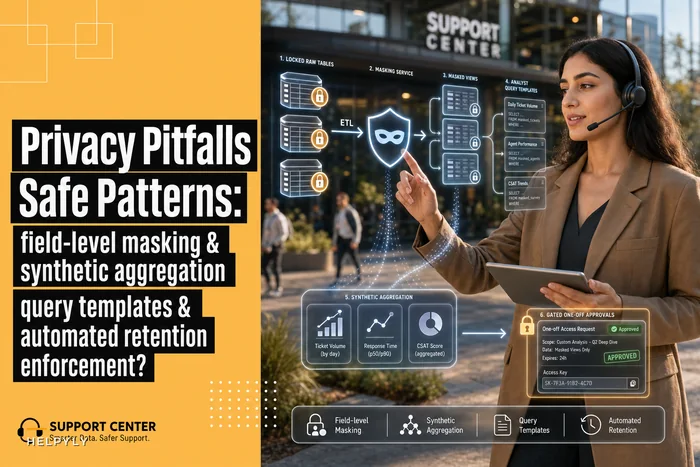
The reason to template this is consistency under audit. A pile of inconsistent ad-hoc notes reads as "we don't have a process." A uniform packet across every request reads as "we have controls." Same underlying work, completely different audit posture. If you're also running analytics on support data, keep the evidence trail separate from the analytical copy—the patterns in analytics-safe handling of support data matter here so your reporting layer doesn't quietly become a second, ungoverned store of personal data.
Retention windows that match the law, not the storage bill
Retention is where good intentions go to die. The honest default in most support stacks is "keep it." Flipping that requires a retention matrix that's specific about data type and jurisdiction—then wiring it to automation so deletion actually happens.
A workable approach:
-
Classify the data types you hold. Transcripts, call recordings, screenshots/attachments, metadata, derived analytics. These have different sensitivity and often different windows.
-
Set a window per type per region. Resist the urge to apply one global window—it'll either be illegally long somewhere or operationally painful everywhere.
-
Separate the "active legal hold" exception. A deletion schedule has to pause when a dispute, investigation, or litigation hold is active. Automating deletion without a hold-exception mechanism is how you destroy evidence you were legally required to keep.
-
Log every deletion. The proof that you deleted is itself an evidence artifact. "We deleted it and here's the timestamped log" is the defensible position.
The pattern to avoid: treating retention as a one-time policy decision instead of a running system. Laws change, vendors change, data types proliferate. A retention window set in 2022 and never revisited is often out of compliance by now without anyone noticing.
SLA handoffs: where frontline stops and privacy starts
The handoff is the seam where things tear. An agent who tries to fully resolve a complex erasure request—touching billing systems, backups, and three vendors—is both over their depth and outside their SLA. But the request still has a legal clock running.
-
Agent confirms the request and triggers the legal timer (the clock is now running regardless of who holds the ticket).
-
Agent completes the parts within their authority (acknowledgment, identity verification, marketing opt-out).
-
Ticket moves to the privacy/legal queue with the evidence packet already started—not a blank handoff.
-
The privacy owner executes the cross-system work and closes the packet.
-
The legal deadline, not the support SLA, governs the closure.
This is fundamentally a routing-and-ownership design, and it benefits from the same rigor you'd apply to any compliance gate. If you've already worked through embedding legal review into support workflows with compliance flags and handoff gates, this is a specialization of that same machinery—applied specifically to the friction of jurisdiction-driven privacy requests.
The subtle failure here: handing off the ticket without handing off the clock. If the legal deadline lives only in the frontline agent's head and the ticket moves to a queue someone checks weekly, the deadline blows past without anyone noticing. The clock has to be an attribute of the request, visible to whoever currently owns it.
A real scenario: mid-size SaaS support team
A B2B software company with a support team of around 20 agents handled customers across the US, EU, and a growing base in Brazil. Privacy requests came in through the general support inbox mixed with everything else—roughly a dozen or so a month, nothing that felt urgent individually.
The problem surfaced during a customer's vendor-security review. Asked to demonstrate their erasure process, they found inconsistent handling: some requests resolved in days, some sat for weeks, a couple had been "completed" by an agent who deleted the ticket but not the data in the billing system or the call-recording vendor. Retention was effectively infinite—recordings from three years back were still sitting in the vendor platform.
They didn't buy a bigger platform. They built the three layers:
-
A short decision tree that routed any data-subject request out of the general queue into a dedicated privacy queue with the clock attached.
-
Enforcement rules
export locks on tagged tickets, redaction on transcripts feeding their QA tool, and retention timers set per region (shorter windows for EU and Brazil recordings).
-
A standard evidence packet per request.
Within about two quarters, completion time for erasure requests dropped from "somewhere between a few days and a few weeks" to consistently under two weeks, well inside legal windows. More importantly, the next security review was uneventful—they handed over uniform evidence packets instead of scrambling. The volume of requests didn't change. The variance did, and variance was the actual risk.
When this level of structure makes sense—and when it doesn't
When it's worth it: You operate across more than one jurisdiction, you handle recordings or sensitive attachments, or your customers run security reviews on you. Any one of those makes the ad-hoc approach a liability. If you're B2B selling to larger customers, the audit will come whether you're ready or not.
When it's overkill: A single-jurisdiction team with low volume and no sensitive data categories doesn't need a full jurisdiction matrix. A simpler retention policy and basic redaction covers most of the exposure. Building a five-layer decision tree for a dozen edge cases a year is effort better spent elsewhere.
Who should NOT start here: If your team hasn't yet locked down the fundamentals—redaction, access controls, a baseline retention policy—start there before layering jurisdiction logic on top. Jurisdiction-specific routing on top of an ungoverned data store just adds process over a leak. Fix the leak first, then route.
The operating principle underneath all of this
The reason jurisdictional privacy feels impossible in support is that it's usually framed as a knowledge problem—"our agents need to understand the law." That framing guarantees failure, because agents under SLA pressure will never reliably interpret statute, and they shouldn't have to.
Reframe it as a translation problem. Every rule that matters becomes a branch in a tree, a timer that starts automatically, a lock that prevents the wrong export, a template that produces consistent evidence, and a handoff that carries the clock with it. The law stops being something agents interpret and becomes something the system enforces. That's what makes multi-jurisdiction support survivable at scale—not more training, but fewer decisions left to memory under pressure.
The reason jurisdictional privacy feels impossible in support is that it's usually framed as a knowledge problem—"our agents need to understand the law." That framing guarantees failure, because agents under SLA pressure will never reliably interpret statute, and they shouldn't have to.
Reframe it as a translation problem. Every rule that matters becomes a branch in a tree, a timer that starts automatically, a lock that prevents the wrong export, a template that produces consistent evidence, and a handoff that carries the clock with it. The law stops being something agents interpret and becomes something the system enforces. That's what makes multi-jurisdiction support survivable at scale—not more training, but fewer decisions left to memory under pressure.
Ready to elevate your customer support?
Join 2,000+ support teams using Helpyly to reduce response times, automate workflows, and deliver outstanding customer experiences.