

Most support transformations don't fail because the idea was bad. They fail because someone flipped the switch on a Tuesday morning, the new routing logic sent VIP tickets into a general queue, and by lunch three account managers were escalating on Slack asking why their enterprise customers were waiting four hours.
The mechanics of the change were probably fine. What was missing was a way to move from "we built the thing" to "the thing is live for everyone" without a scary gap in the middle where nobody knows if it's working.
That gap is where a change-management charter lives. Not a policy document. An actual operating procedure that says: here's how a change earns the right to expand, here's what we watch while it expands, and here's exactly what we do when it goes sideways. This is the part that gets skipped, and it's the part that decides whether your KB redesign is remembered as a smooth upgrade or the week everyone stopped trusting the search bar.
Why the switch-flip approach keeps happening
The all-at-once rollout is tempting for reasons that feel rational in the moment.
Someone spent six weeks building a new automation. The pressure to show it working is enormous. Staging it feels like admitting you're not sure it works — which nobody wants to say out loud after six weeks of effort. So the change ships fully, framed as "we tested it in QA," and QA testing gets treated as the same thing as production validation. It isn't. QA tells you the feature does what the spec said. It tells you almost nothing about how it behaves against real ticket volume, weird customer phrasing, and the twelve edge cases nobody wrote a spec for.
The second reason is that support changes are invisible until they're not. A routing change doesn't throw an error. It just quietly sends the wrong tickets to the wrong people, and you find out three days later when reopen rates creep up and someone digs into why. Unlike a website that goes down loudly, a broken support process degrades silently. That silence is exactly why staged gating matters — you can't rely on the failure announcing itself.
The third reason, honestly, is that most teams don't have a repeatable process for this. Every transformation gets managed as a one-off. The KB redesign has its own ad-hoc rollout plan, the routing change has a different one, the automation rollout has a third. Nobody built the reusable charter, so every project reinvents the change process and reinvents the same mistakes.
The charter in one sentence
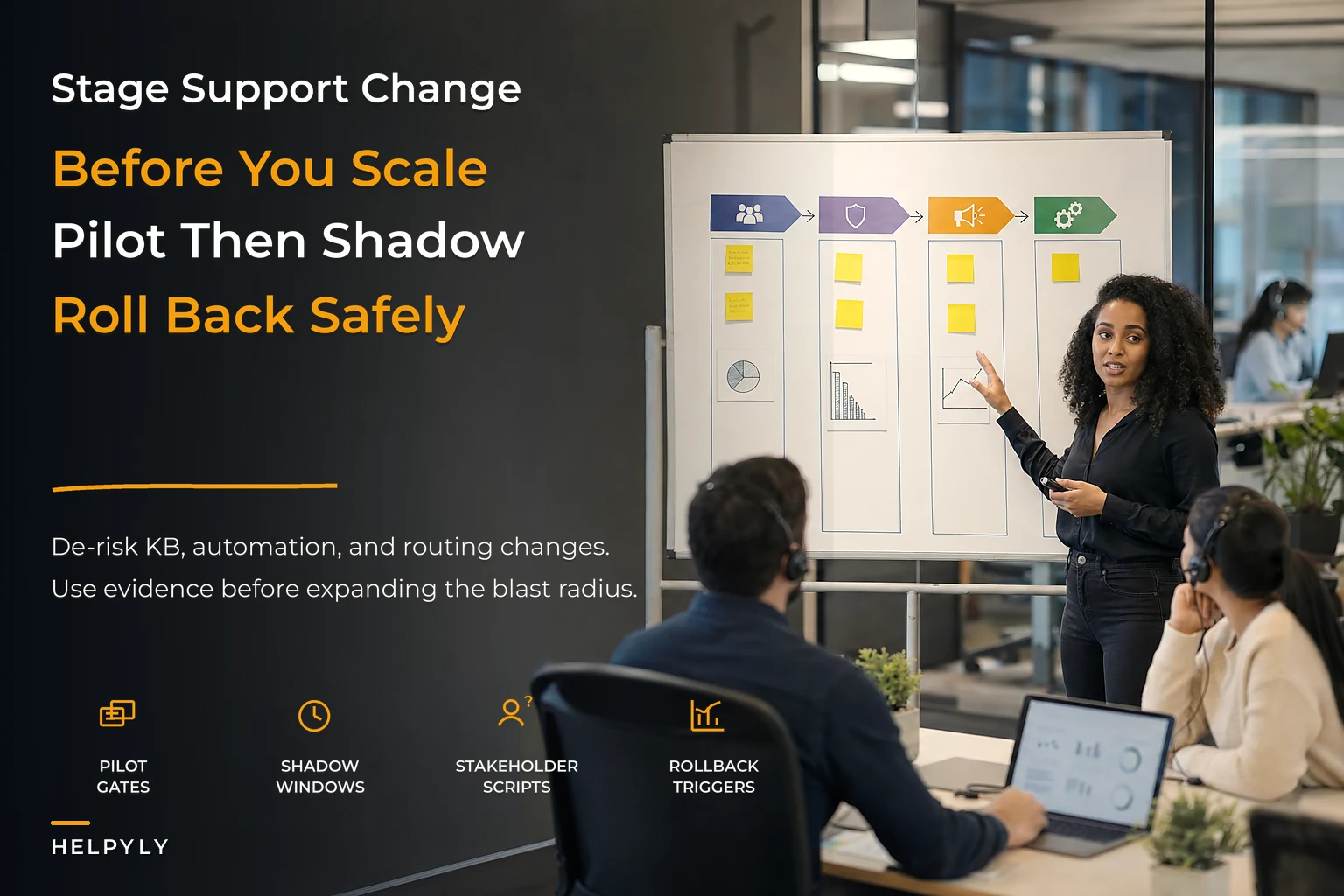
A change goes through four stages — pilot → shadow → rollout → optimize — and it cannot advance to the next stage until it clears the gating criteria for the current one. Each stage has an owner, a defined blast radius, a set of metrics being watched, and a rollback trigger that anyone can pull.
Never let a customer request slip through the cracks.
Helpyly helps you track, resolve, and optimize every support interaction effortlessly.
- Centralized ticket management
- Automated customer notifications
- Performance analytics dashboard
No credit card required
That's the whole thing. The rest is filling in the specifics for the type of change you're making, because a KB redesign fails differently than a routing change, and your gates need to reflect that. If you've read our take on treating support playbooks like code, this is the deployment pipeline for that mindset — the difference between merging to main and actually shipping to production users.
The four stages, and what each one is actually for
People conflate these stages, so it's worth being precise about what each one does.
| Stage | Blast radius | Primary question it answers | Who's exposed |
|---|---|---|---|
| Pilot | Tiny, controlled group | Does this work at all under real conditions? | A handful of volunteer agents or a low-risk queue |
| Shadow | Runs in parallel, no customer impact | Does it agree with the current system on real traffic? | Nobody customer-facing — it runs silently alongside |
| Rollout | Expanding % of real traffic | Does it hold up as volume and variety increase? | Growing slice of real customers |
| Optimize | Full traffic | Where's the remaining friction, and what do we tune? | Everyone |
The stage that gets skipped most often is shadow, and it's the most valuable one for anything algorithmic. Shadow mode means the new routing logic or automation runs against live tickets and records what it would have done — without actually doing it. You compare its decisions against the current system's decisions. Where they disagree, you investigate. This catches the "sends VIP tickets to general queue" problem before a single customer feels it, because the disagreement shows up in the shadow log first.
Pilot and shadow are not interchangeable. Pilot is small and real. Shadow is full-volume and fake. You want both, because pilot catches usability problems (agents hate the new interface) and shadow catches logic problems (the classifier is wrong on 8% of tickets).
Here's a quick visual to keep the flow clear.
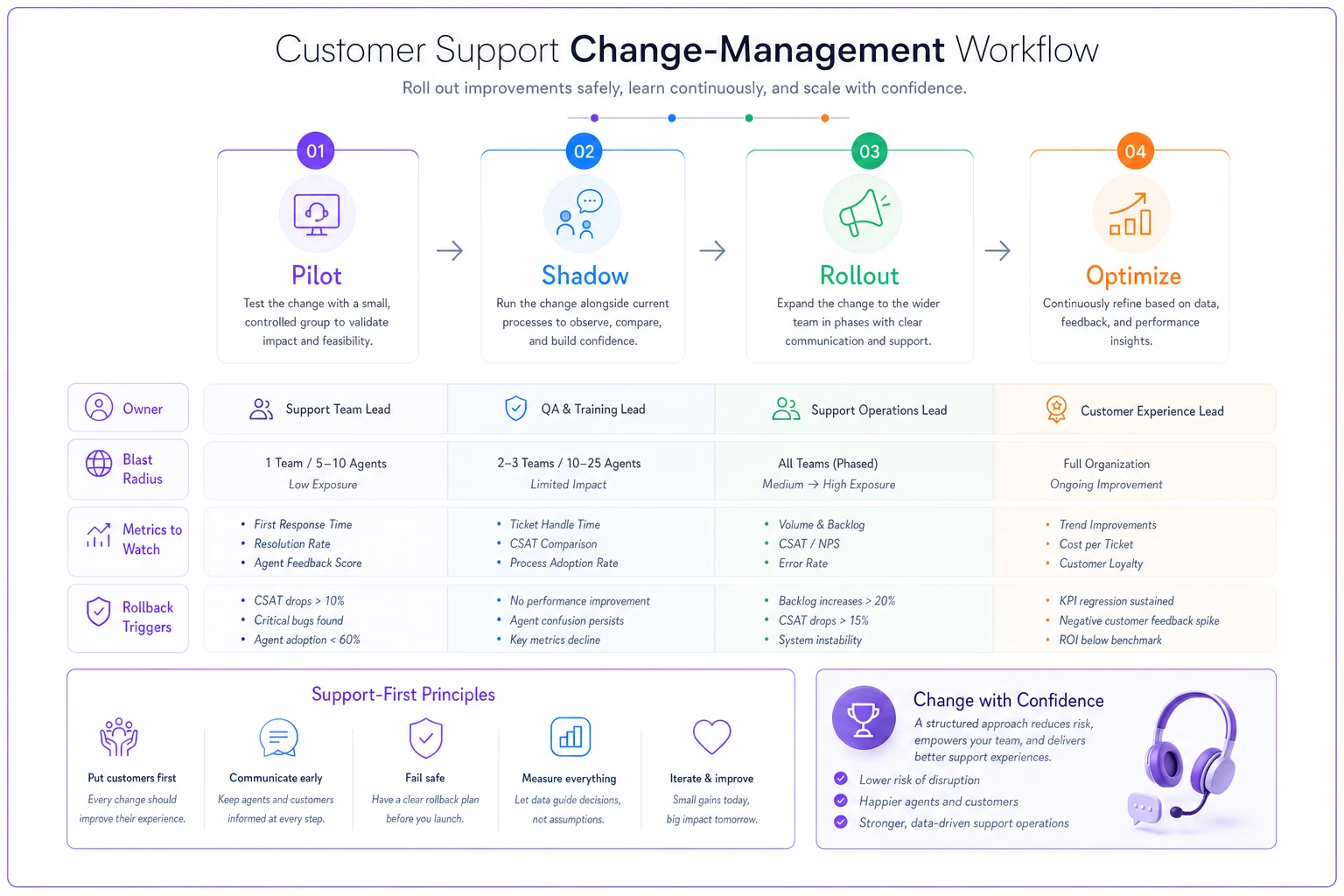
Pilot catches usability issues; shadow catches logic issues; rollout validates scale; optimize tunes the final experience.
Gating criteria: how a change earns the next stage
This is the core of the charter. A change doesn't move forward because two weeks passed. It moves forward because it hit specific, pre-agreed numbers. Deciding those numbers before you start is what keeps the process honest — otherwise you'll rationalize any result as "good enough" once you're emotionally invested in shipping.
Pilot → Shadow gate:
-
Pilot ran for at least one full business cycle (usually a week, so you catch Monday spikes and weekend lulls)
-
No critical incidents attributable to the change
-
Pilot agents rate the change as neutral-or-better on a simple usability check
-
The change did what it was supposed to do on at least 90% of pilot cases
Shadow → Rollout gate:
-
Shadow decisions agreed with the current system, or were verifiably better, on the large majority of traffic
-
Every disagreement category has been reviewed and explained — no unexplained divergence
-
The specific failure modes you were worried about did not appear at meaningful rates
Rollout → Optimize gate:
-
Metrics held stable through each rollout percentage increase (you didn't see degradation appear at higher volume)
-
No rollback was triggered during the ramp
-
The success criteria you defined at the start are being met on full-ish traffic
Write the gating criteria before the pilot starts and lock them down to avoid moving the goalposts mid-flight.
The important discipline: write these down before the pilot starts, and don't move the goalposts mid-flight. The most common failure I've watched is a team quietly loosening the gate when the change doesn't quite hit it, because rolling back feels like failure. Loosening the gate is how you ship a broken change with a paper trail that says it passed.
Tailoring the charter to the change type
A generic charter is almost useless. The whole point is that different transformations break in different ways, so their gates and evidence need to be different.
KB redesigns
A KB redesign fails in discoverability and trust. The article can be technically correct and still worse than what it replaced if people can't find it or don't believe it.
What to gate on:
-
Search success rate — are people finding the article for their query, or bouncing?
-
Self-service resolution — are ticket deflections holding or dropping after the redesign?
-
Ticket creation from KB pages — if "contact us" clicks from articles spike, your redesign made people give up
The sneaky failure here is that a redesign often improves the articles you looked at and quietly breaks the fifty you didn't. You redesign the top 20 articles, they test great, and the long tail — which collectively handles more volume than your top 20 — is now inconsistent with the new structure. Your pilot needs to include long-tail articles, not just the hero pages.
Automation rollouts
Automation fails by doing the wrong thing confidently, or by creating cleanup work that costs more than the automation saved.
What to gate on:
-
False-action rate — how often the automation did something it shouldn't have
-
Escalation-after-automation rate — customers who got the automated response and immediately needed a human anyway
-
Handle time on tickets the automation touched but didn't resolve — this is the hidden cost; if agents spend longer untangling what the automation did, you've moved work, not removed it
Shadow mode is non-negotiable for automation. Let it decide silently, log what it would have done, and have a human review a sample before you ever let it act. The gate to leave shadow should specifically test the scenario where the automation is confidently wrong — those are the ones that damage customer trust, not the cases where it politely hands off.
Routing changes
Routing fails through misroutes and load imbalance. It can also fail in a way that looks fine on averages but hides real pain — average wait time is stable while your enterprise queue quietly triples.
What to gate on:
-
Misroute rate — tickets that landed in the wrong queue and had to be moved
-
Per-segment wait times, not just aggregate — always break out your high-value segments separately
-
First-assignment resolution — are tickets getting solved where they land, or bouncing between queues?
Routing is the change type where shadow mode saves you the most embarrassment. Run the new routing logic against yesterday's actual tickets and diff the assignments. If the new logic would have sent 40 enterprise tickets to general support, you find that in a spreadsheet instead of in an angry email.
Rollback triggers: decide before you're panicking
The rollback trigger is a number that, when crossed, reverts the change automatically or near-automatically — no meeting, no debate, no "let's give it another hour." You set it in advance because in the middle of an incident, everyone's judgment gets worse, and there's always someone arguing to wait it out because rolling back looks bad.
Good rollback triggers are specific and pre-authorized:
-
Misroute rate exceeds double your baseline for more than 30 minutes → revert routing
-
Automation false-action rate crosses a set threshold in any hour → pause automation, route to humans
-
KB self-service resolution drops by more than X points day-over-day → restore previous article structure
-
Any critical incident directly attributable to the change → immediate revert, investigate after
The key word is pre-authorized. The on-call person shouldn't need VP approval to pull the trigger. If the number is crossed, they revert, and the retro happens afterward. Making rollback a low-drama, expected part of the process is what lets people ship boldly — they know the safety net actually works.
One pattern worth stealing: keep the old system warm during rollout. Don't decommission the previous routing rules or the old KB structure until the new one has cleared optimize. A rollback you can execute in five minutes is worth ten times a rollback that requires rebuilding what you tore down.
Evidence packs: what you keep, and why
Every stage should produce an evidence pack — a small, standardized bundle of what happened, so the decision to advance (or not) is based on artifacts, not vibes. This also means when someone asks "why did we ship this?" six months later, there's an actual answer.
-
The gating criteria that were set at the start
-
The actual measured results against each criterion
-
The disagreement log (for shadow) or incident log (for pilot/rollout)
-
A sample of real cases — including the ugly ones, not just the wins
-
The sign-off from whoever owns the go/no-go decision
The discipline of including bad cases in the evidence pack is what separates a real review from a rubber stamp. A pack that shows only successes is a marketing deck. A pack that shows "here are the 6 cases where it got it wrong and here's why we think that's acceptable" is an actual engineering decision.
Stakeholder scripts: the part everyone underestimates
The technical rollout is maybe half the work. The other half is that a support transformation touches agents, team leads, adjacent teams, and sometimes customers — and each group needs to hear something different, at the right time.
The mistake is announcing everything to everyone at once, which either overwhelms people or gets ignored. Script the communication by audience and stage instead.
For pilot agents, before pilot: "You're testing something new for a week. It might be rough. Your job is to break it and tell us how. Here's exactly what's changing and here's the one channel to report problems." The framing matters — they're testers, not victims of a half-baked rollout.
For the wider team, before rollout: "This is coming, here's what's different, here's what to do if it misbehaves, here's who to ping." No surprises. The worst version is agents discovering a changed workflow mid-shift with no warning.
For adjacent teams (sales, account management, product), before anything that could touch their customers: "Routing is changing this week. If your customers experience anything odd, here's the context and here's the escalation path." The account manager who knows a change is happening handles a hiccup gracefully. The one blindsided by it escalates to leadership.
For customers, only when the change is visible to them and only if it's material: usually a KB redesign or a new self-service flow warrants a light heads-up. Most routing and automation changes should be invisible — if customers notice your routing change, something went wrong.
Getting the communication right is a big part of how support earns the credibility to run these transformations at all — which ties into treating support as a strategic function rather than a cost center that changes things quietly and hopes nobody notices.
A real scenario
A mid-sized SaaS company — support team of about fourteen, handling somewhere around 2,800 tickets a month — wanted to roll out a new routing model. Their old routing was a flat queue with manual triage, and their enterprise customers were increasingly frustrated because urgent tickets sat behind routine ones.
Pilot exposed the new routing to just the enterprise queue for a week. It surfaced an immediate problem — the "enterprise" tag wasn't being applied consistently, so about 15% of enterprise tickets weren't getting caught by the new rules. That's a data-hygiene issue that staging never would have shown, because staging used clean test data.
Shadow ran the fixed logic against all live traffic for another week, logging assignments without acting. The diff showed the new routing disagreed with human triage on roughly 1 in 9 tickets — and when they reviewed the disagreements, the new logic was right most of the time, but it consistently mishandled a category of billing-plus-technical tickets that didn't fit one skill cleanly. They added a rule for those before advancing.
Rollout ramped over two weeks — 25%, then 50%, then 100% of traffic — with a pre-set trigger to revert if misroutes crossed double the baseline. It never tripped. Enterprise first-response times dropped from somewhere in the four-to-five hour range down to under 90 minutes, and misroutes ended up lower than the old manual process because humans triaging under pressure had been making their own mistakes.
The whole thing took about five weeks instead of a Monday morning. No incident, no angry escalations, and a clean evidence trail. The extra four weeks bought them a transformation nobody had to apologize for.
When to use the full charter — and when it's overkill
The full four-stage charter is right for changes that are hard to reverse, affect many customers, or involve logic that behaves unpredictably against real data. Routing changes, automation rollouts, and major KB restructures all qualify.
It's overkill for small, obviously-reversible changes. Fixing a typo in a canned response, adjusting one article's title, tweaking a macro used by two people — running those through pilot-shadow-rollout is bureaucratic theater. A good rule: if you can revert it in one click and it touches almost nobody, just ship it and watch. Reserve the charter for changes where being wrong is expensive.
Who should not adopt this yet: if your team doesn't have baseline metrics — if you can't say what your current misroute rate or self-service resolution rate actually is — the charter won't help, because every gate compares against a baseline you don't have. Get instrumentation first. This maps to the earlier stages of the support operational maturity model; you need to be measured before staged deployment is meaningful. A charter on top of guesswork is just slower guesswork.
Making it repeatable
The real payoff isn't running this once. It's that the charter becomes a template. The second transformation reuses the structure — you swap in the change-specific gates and metrics, but the stages, the rollback discipline, the evidence-pack format, and the stakeholder scripts all carry over.
Once a team has run two or three transformations through the same charter, something shifts. Changes stop being scary events that require heroics and start being routine deployments. People propose bolder changes because they trust the process to catch problems early. The tooling to run this — the shadow logging, the metric dashboards that watch each stage, the automated rollback triggers — is worth building once you're running transformations regularly, because doing all of it manually gets expensive fast, and manual monitoring is exactly where staged rollouts quietly fail.
The teams that do this well don't ship fewer changes. They ship more, because each one carries less risk. The charter isn't a brake. It's what lets you drive faster without wrapping the car around a tree on a Tuesday morning.
The teams that do this well don't ship fewer changes. They ship more, because each one carries less risk. The charter isn't a brake. It's what lets you drive faster without wrapping the car around a tree on a Tuesday morning.
Ready to elevate your customer support?
Join 2,000+ support teams using Helpyly to reduce response times, automate workflows, and deliver outstanding customer experiences.