


Most support teams are sitting on a goldmine of expansion intent and don't even know it. Every "can I do X?" ticket, every seat-limit error, every integration question is a customer telling you exactly where they want to grow. The problem isn't a lack of signal. It's that the signal dies in a ticket queue, gets marked "resolved," and never reaches anyone who can act on it commercially.
This is the gap that kills support-driven expansion in practice. Not strategy. Not intent. Wiring. Support sees the buying signal three weeks before sales does, but there's no reliable path from "agent noticed something" to "someone ran a play." The signal decays, the moment passes, and the renewal conversation happens later at a worse time with less context.
What follows is the actual system that connects these two worlds — the instrumentation, the mapping logic, the handoff mechanics, and the measurement that lets finance actually attribute expansion revenue back to support. This isn't a "train your agents to upsell" pep talk. That approach fails at scale because it depends on individual agents remembering to do something extra during a busy shift. What works is a system that surfaces the right signal to the right person at the right moment, regardless of who's on shift.
Why support signals rot before they become revenue
The core failure is structural. Support tooling is optimized to close tickets fast. Every incentive in the queue — CSAT, handle time, backlog — pushes agents to resolve and move on. Nothing in that workflow rewards noticing that the customer who just asked about API rate limits is about to outgrow their plan.
So the signal exists, but it's trapped in unstructured text. A ticket that reads "we're trying to sync data to Salesforce but hitting the limit" contains a clear expansion trigger. But it's sitting in a free-text field, tagged as "integration question," resolved in four minutes, and invisible to anyone thinking about account growth.
-
Week 0 Customer hits a limit or asks about a higher-tier capability. Clear intent.
-
Week 1–2 Ticket resolved. Agent gave a workaround or a "yes you'd need to upgrade for that" answer. Signal logged nowhere.
-
Week 3–6 Customer either finds a competitor's workaround, builds their own patch, or quietly gives up on the use case.
-
Renewal Sales walks in cold, no idea the customer was actively trying to expand two months ago.
The moment of highest intent — when the customer is actively trying to do more with your product — is exactly when support is talking to them and sales isn't. By the time sales shows up, that intent has cooled or been solved elsewhere.
There's a second, subtler failure: when support does try to pass signals over, they pass everything. Sales gets a firehose of "this customer seems interested" notes with no prioritization, no evidence, and no context. After a few weeks of chasing low-quality leads, reps stop trusting the source entirely. The channel dies not from silence but from noise.
The instrumentation layer: turning conversations into structured signals
Before you can map signals to plays, you have to capture them in a form that's actually actionable. Prescriptive instrumentation means deciding in advance what a signal looks like and how it gets recorded — not "let's tag interesting tickets and see."
Never let a customer request slip through the cracks.
Helpyly helps you track, resolve, and optimize every support interaction effortlessly.
- Centralized ticket management
- Automated customer notifications
- Performance analytics dashboard
No credit card required
-
The trigger — the specific observable event (a rate-limit error, a "can I add users" question, a feature request that maps to a higher tier).
-
The evidence — the actual ticket text, the account's current plan, usage data at the time.
-
The confidence — how strong the buying intent is, based on the trigger type and context.
The mistake most teams make is trying to detect "intent" as a vague sentiment. That never works reliably. What works is defining a concrete taxonomy of triggers tied to specific product boundaries. A signal is only worth capturing if it maps to a real commercial motion.
Here's the kind of trigger taxonomy that actually holds up in production:
| Signal type | What the customer says/does | Confidence | Mapped play |
|---|---|---|---|
| Hard limit hit | "Getting a seat/usage/API limit error" | High | Direct upgrade conversation |
| Capability gap | "Does your product do X?" (X is a higher tier) | Medium-high | Feature-tier upsell |
| Adjacent use case | Asking about a workflow a different product/module solves | Medium | Cross-sell / expansion module |
| Volume growth | Usage climbing steadily toward plan ceiling | Medium | Proactive plan review |
| New stakeholder | New team/department showing up in tickets | Medium | Seat expansion |
| Workaround fatigue | Repeatedly asking how to hack around a limitation | High | Upgrade + solution consult |
The confidence column is what protects the sales relationship. High-confidence signals get fast, direct handoffs. Medium signals get batched and reviewed. Low or ambiguous ones stay in support and get nurtured through knowledge content instead of getting thrown at a rep.
This is where automation earns its place quietly. Manually tagging every ticket against this taxonomy is unrealistic at any real volume — agents won't do it consistently, and you'll get maybe 30% coverage on a good day. A layer that reads ticket content and surfaces candidate signals against your defined taxonomy — leaving the confidence judgment and the actual handoff decision to a human — turns that 30% capture rate into something closer to comprehensive, without adding work to the agent's plate. The point isn't to automate the selling. It's to make sure no signal silently rots in the queue.
The signal→action mapping: from trigger to prioritized play
Capturing signals is worthless if every signal gets the same response. The whole value of a prescriptive playbook is that a specific trigger maps to a specific, pre-decided action with an owner and a timeline.
A signal→action map is essentially a routing table. For each signal type, you define:
-
Who owns it (support closes it, CSM picks it up, AE gets a direct handoff)
-
The trigger threshold (how strong the signal has to be before it moves)
-
The play (the specific motion — upgrade offer, plan review call, module demo)
-
The SLA (how fast it has to move before the intent cools)
The sequencing matters more than people expect. A hard-limit signal that sits for a week is a failed handoff — the customer already felt the pain and either solved it or got frustrated. That one needs a same-day or next-day touch. An adjacent-use-case signal can wait for a batched weekly review because the intent is softer and slower-moving.
The workflow that holds together in practice:
Signal detected → confidence scored → routed to the right lane → play executed → outcome logged back to the signal.
Here's a short visual of that flow to make routing expectations explicit.
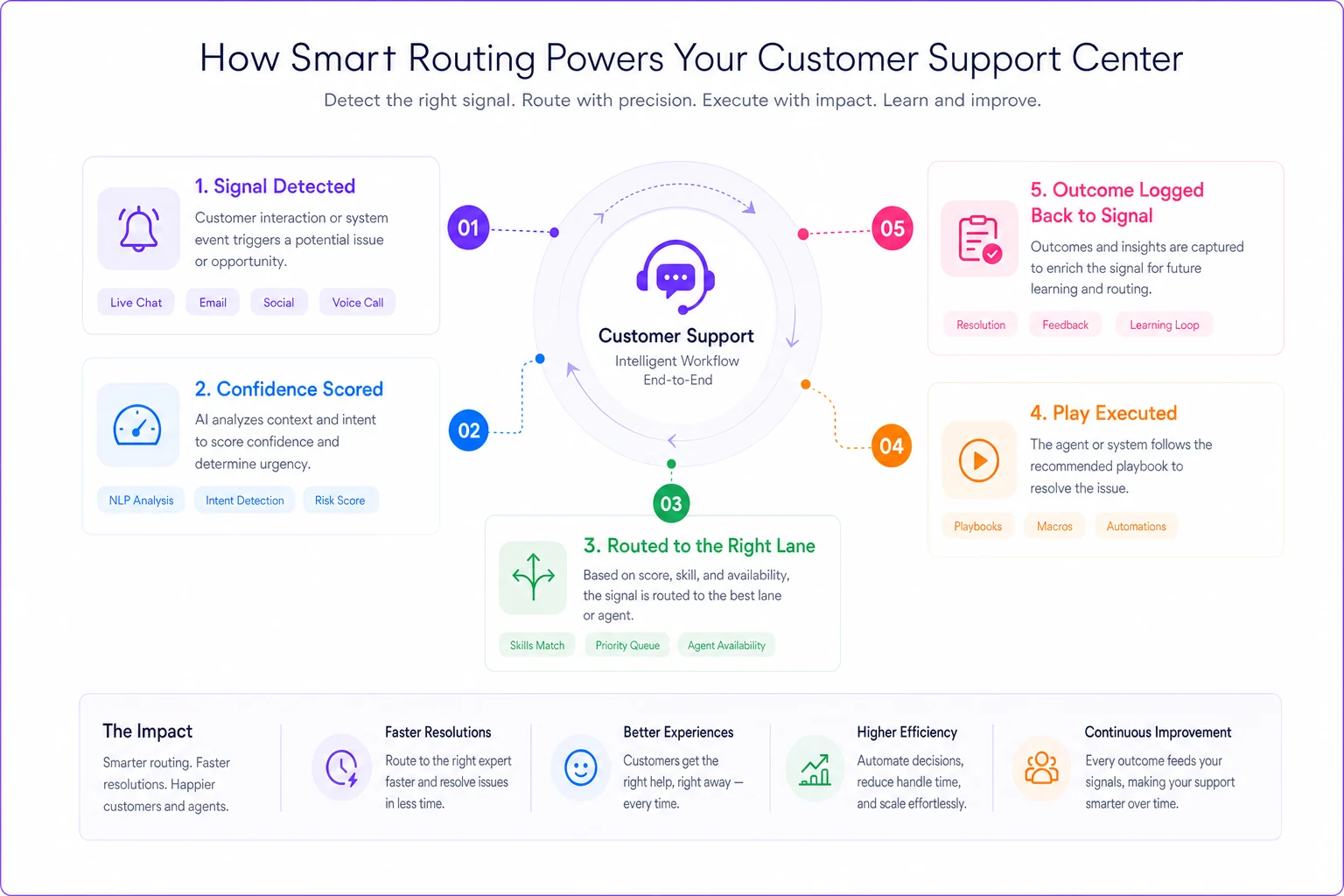
That last step is the one everyone skips and the one that makes the whole thing measurable. If the play outcome — accepted, declined, no response — doesn't get written back to the originating signal, you can never learn which triggers actually convert. You're running blind, and finance has nothing to attribute.
One pattern worth stealing: don't send high-confidence signals through a CRM lead queue where they mix with cold inbound. Route them into a dedicated, small, high-trust lane that a specific rep or CSM checks daily. The whole reason these signals convert better than cold leads is that they're timely and contextual. Dumping them into a generic queue destroys exactly that advantage.
This kind of routing logic sits naturally alongside the work of turning support into a strategic input rather than a cost center — worth reading more about in how to position support as a strategic function, because the signal→action system only gets funded and staffed when leadership already sees support as revenue-adjacent.
Experiment packs: proving which signals actually convert
Most support-to-revenue programs go soft here. They launch, generate some wins, everyone's excited, and then nobody can say whether the program is actually working or whether those deals would have closed anyway.
You need experiment packs — small, pre-designed tests that isolate whether a specific signal→play mapping is causing incremental revenue.
-
Hypothesis — "Customers who hit a seat limit and get a proactive upgrade touch within 48 hours will expand at a higher rate than those who don't."
-
The signal definition — exactly which trigger counts, no ambiguity.
-
Treatment vs. holdout split — usually 70/30 or 80/20 depending on volume.
-
Success metric — expansion rate, expansion ARR, or time-to-expansion.
-
Window — long enough to capture the decision cycle, usually 30–90 days.
-
Minimum sample — don't call a winner on eight data points.
A realistic first result might look like: treated seat-limit signals expand at around 22% within 60 days, holdout expands at roughly 9%. That gap is your incremental lift, and it's the number finance actually cares about. Not "we ran 40 plays," but "the play caused roughly a 13-point lift in expansion for this signal type."
The mistake is running one giant experiment across all signal types at once. Different triggers convert completely differently. A hard-limit signal might show a huge lift; an adjacent-use-case signal might show almost none. Blend them and you get a mushy average that hides both the winners and the losers. Test signal types separately so you know where to invest and where to stop wasting a rep's time.
Finance-ready NRR attribution: making the revenue stick
If you can't attribute expansion revenue back to support signals in a way finance accepts, the program stays a nice story and never gets real budget. This is what turns "support helps with revenue sometimes" into a line item.
NRR attribution for support-driven expansion needs to answer one question cleanly: how much of our expansion ARR originated from a support signal?
The attribution template that survives a finance review looks like this:
| Field | What it captures |
|---|---|
| Originating signal ID | Links the expansion back to a specific captured signal |
| Signal type | Which trigger category |
| Detection date | When the signal fired |
| Play executed | What motion was run |
| Expansion close date | When the deal landed |
| Expansion ARR | The dollar value |
| Attribution model | First-touch, influenced, or holdout-validated |
| Time-to-expansion | Days from signal to close |
The attribution model column is where the honesty lives. First-touch attribution ("support saw it first, so support gets credit") is easy but overclaims. The holdout-validated number from your experiments is the defensible one — it's the incremental lift you proved, not just the deals that happened to follow a signal.
Be disciplined about reporting both the gross number and the incremental number. Gross ("$180k of expansion ARR touched a support signal this quarter") is good for internal momentum. Incremental ("holdout testing suggests roughly $70k–$90k of that was caused by the proactive motion") is what you take to finance. Confusing the two is how these programs lose credibility the moment someone digs in.
If you're building the cost side of this equation too, it pairs directly with the work of showing support ROI in finance terms — because expansion revenue attribution only becomes a real ROI story when you can put it next to what the program costs to run.
Evidence packets: what actually moves the handoff
A signal handed to sales with no evidence is just a hunch, and reps learn to ignore hunches. An evidence packet is the difference between a rep saying "not worth my time" and "let me call them today."
-
The verbatim signal — the actual ticket quote, not a summary
-
Account context — current plan, tenure, recent usage trend
-
The specific gap — what they're trying to do and what's blocking them
-
Suggested play — the pre-mapped motion for this signal type
-
Timing note — how fresh the signal is (this decays fast)
Lead with the verbatim ticket quote in the first line of the packet so the rep can open the conversation with high context.
The verbatim quote matters more than anything else in the packet. When a rep can open with "I saw your team hit the API limit trying to sync to Salesforce last Tuesday — let's fix that," the customer feels seen, not sold to. When the rep opens with "our system flagged you as an expansion opportunity," you've lost.
The evidence-packet discipline also protects support from the "you sent me garbage leads" complaint. If every handoff carries real evidence, the quality bar is enforced by the format itself. Weak signals literally can't fill out a packet convincingly, so they don't get sent.
A sample support-to-sales handoff runbook
Here's the mechanical flow that ties it together, written as an actual runbook a team can follow:
-
Detection. Agent resolves a ticket normally. In parallel, the signal layer flags the ticket as a candidate expansion signal and assigns a provisional confidence.
-
Triage. A designated reviewer (support lead or ops role) confirms or rejects the signal daily. Confirmed high-confidence signals get an evidence packet auto-assembled from ticket + account data.
-
Route. High-confidence packets go to the dedicated expansion lane with a 48-hour SLA. Medium signals batch into a weekly review with the CSM team.
-
Execute. The rep or CSM runs the mapped play. No improvising the motion — the play is pre-defined per signal type.
-
Log outcome. Result (accepted / declined / no response / expansion ARR) is written back to the originating signal ID. Non-negotiable.
-
Feed the loop. Weekly, review conversion by signal type. Kill plays that don't convert. Double down on the ones that do.
The whole thing depends on step 5. Without outcome logging, you have activity without learning. Six months in, you'll have run hundreds of plays and still won't know which signals are worth capturing — which means you're staffing a program you can't defend.
This handoff discipline mirrors the operational contract thinking behind closing the loop between support and product — the same principle applies here, just pointed at revenue instead of bug fixes. A signal is only useful if there's a contractual, measurable path from detection to outcome.
When this makes sense — and when it doesn't
This system is not free. It costs instrumentation effort, a review role, coordination between support and sales, and ongoing measurement. It's worth it under specific conditions and a waste under others.
When it makes sense:
-
You have a tiered or usage-based pricing model where customers naturally hit boundaries.
-
Support volume is high enough that manual signal-spotting misses most of it.
-
Sales and support are close enough organizationally to coordinate a handoff.
-
Expansion is a meaningful part of your growth (high NRR ambition).
When it's a bad idea:
-
Flat, single-tier pricing with no natural expansion path. There's nothing to upsell into, so the signals don't map to anything.
-
Very low ticket volume where a CSM already reads every conversation manually. You're building infrastructure for a problem you don't have.
-
A support org still fighting fires on basic SLAs. Fix the foundation first — a team drowning in backlog can't run a disciplined expansion program on top of it.
Any team where sales and support actively distrust each other should also hold off. The handoff mechanics assume good faith on both sides. If the relationship is already adversarial, the signals will get ignored or mishandled, and you'll have built an expensive pipeline to nowhere. Fix the relationship before the wiring.
A realistic scenario
A mid-sized B2B SaaS company — project management tooling, roughly 900 paying accounts, tiered by seats and feature depth — was renewing customers fine but expanding almost nobody proactively. Expansion happened only when a customer initiated it.
Their support team was handling somewhere around 1,400 tickets a month. Digging through a sample, a decent chunk — maybe 8–10% — contained a clear expansion trigger: seat-limit questions, "does the higher plan do X," requests for a capability only in the enterprise tier. Almost none of these went anywhere. They got answered and closed.
They started small: one signal type (hard seat limits), a defined evidence packet, a single CSM owning the expansion lane with a 48-hour SLA, and a 30% holdout. Over the first quarter, treated seat-limit signals converted to expansion at roughly 20%, versus about 8% for the holdout. On the volume they were seeing, that translated to somewhere in the range of $60k–$80k of incremental expansion ARR that quarter, from one signal type — traceable back to specific tickets, defensible to finance.
The more important outcome wasn't the dollars. It was that sales started trusting support handoffs, because every one came with real evidence and actually converted. That trust is what let them expand the program to the next two signal types.
The takeaway that actually matters
The revenue was always there. Customers were telling support exactly where they wanted to grow — the system just wasn't built to hear it and act on it. Building support-driven expansion isn't about turning agents into salespeople. It's about instrumentation that captures intent, a mapping that routes it to the right owner, evidence that makes the handoff trustworthy, and measurement honest enough that finance will fund it.
Start with one signal type. Prove the lift with a holdout. Log every outcome. Expand only when the numbers hold. The teams that get this right don't do it with a big rollout — they do it by wiring up one clean loop and letting the evidence build the case for the next.
Start with one signal type. Prove the lift with a holdout. Log every outcome. Expand only when the numbers hold. The teams that get this right don't do it with a big rollout — they do it by wiring up one clean loop and letting the evidence build the case for the next.
Ready to elevate your customer support?
Join 2,000+ support teams using Helpyly to reduce response times, automate workflows, and deliver outstanding customer experiences.